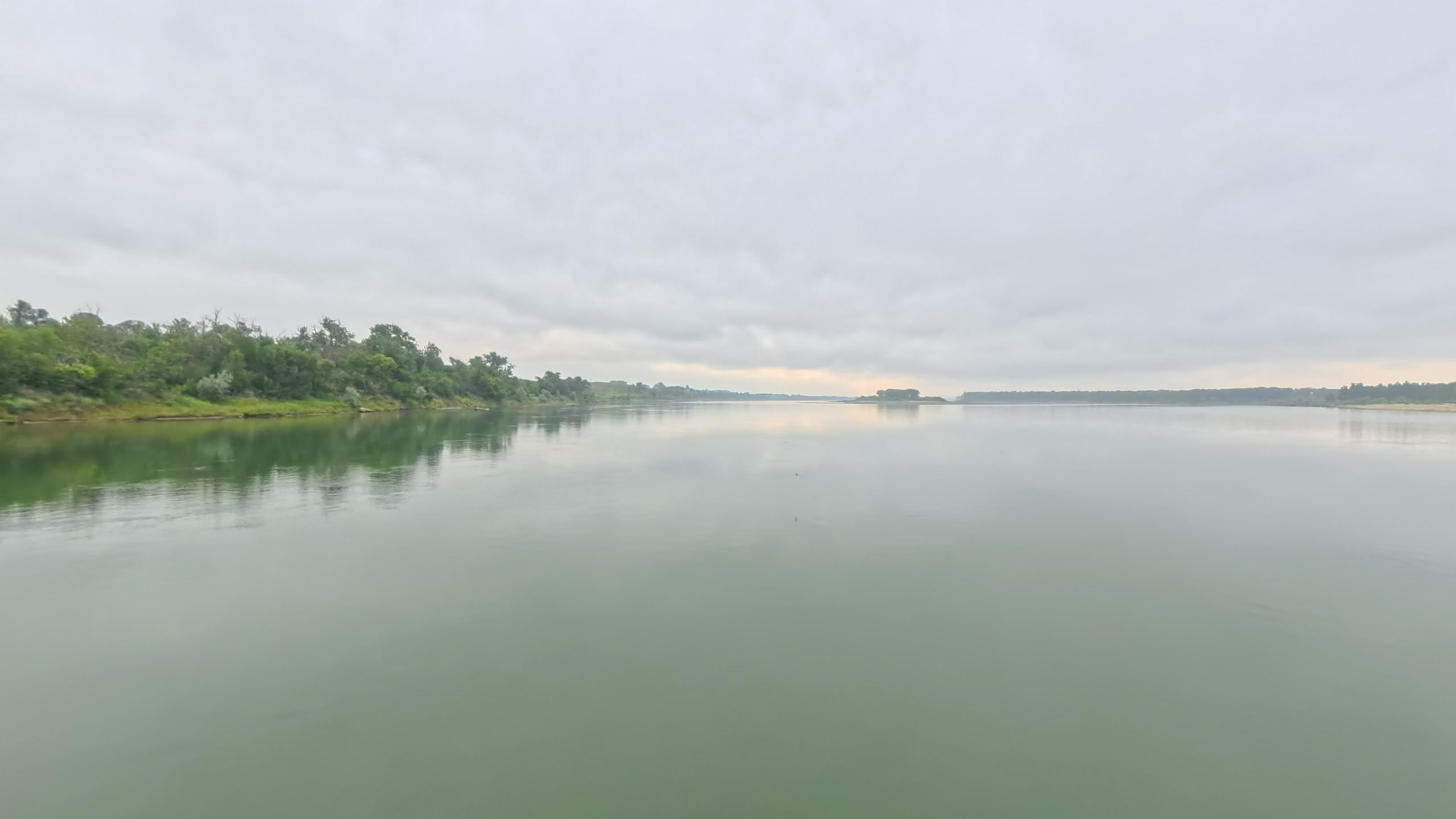

The journal entries for February 9, 1805 offer a striking contrast in narrative focus. Meriwether Lewis, writing as commanding officer, devotes his entry almost entirely to a disciplinary incident inside the walls of Fort Mandan. Sergeant John Ordway, by contrast, looks outward across the frozen Missouri and records the labor of Mandan women hauling timber to their village. Read together, the two passages illustrate how rank and responsibility shaped what each narrator considered worth preserving.
Lewis and the Problem of the Scaled Wall
Lewis opens conventionally enough with weather and a social call from a North West Company clerk, but the entry quickly pivots to an offense against garrison discipline. A private named Howard, having been granted leave to visit the Mandan village, returned after the fort’s gate had been shut for the night. Rather than rouse the guard, he climbed the palisade — and, more troublingly to Lewis, was observed and imitated by a Mandan man:
this evening a man by the name of Howard whom I had given permission to go the Mandane vilage returned after the gate was shut and rether than call to the guard to have it opened scaled the works an indian who was looking on shortly after followed his example.
The captain’s response is layered. To the Mandan visitor he offers explanation and a diplomatic gift: “I convinced the Indian of the impropryety of his conduct… I gave him a small piece of tobacco and sent him away.” Toward Howard, however, Lewis is unsparing, noting that he committed the soldier to the guard “with a determineation to have him tryed by a Courtmartial for this offence.” The closing sentence sharpens the judgment further:
this man is an old soldier which still hightens this offnce-
For Lewis, the scaled wall is not merely a breach of regulation. It is a demonstration to the Mandan that the fort’s defenses are permeable, and worse, a demonstration delivered by a veteran who should have known better. The aggravating factor of Howard’s experience reveals how Lewis weighed military culpability: knowledge of duty intensifies, rather than excuses, the lapse.
Ordway’s Outward Gaze
Ordway’s entry for the same day occupies a wholly different register. Where Lewis attends to the interior politics of command, Ordway records ethnographic and environmental detail:
the Squaws from the l8t village are cutting their lodge timber on the opposite Side of the River from the Fort, So as to hale it up to the village on the Ice.
The observation is practical and economical. Ordway notes who is doing the work (women from the first Mandan village), what the work is (cutting lodge timber), and why the timing matters — the river ice provides a smooth haul road from the cutting site to the village. This is the kind of detail that Lewis, preoccupied with Howard’s court-martial, omits entirely. Across the multi-volume record of the expedition, Ordway repeatedly proves attentive to indigenous labor practices and to the logistical use Native communities make of seasonal conditions, observations the captains often pass over when other matters press.
Two Registers of Fort Life
The divergence between these entries is characteristic of the larger archive. Lewis, when he writes at all during the Fort Mandan winter (his journal-keeping in this period is famously irregular), tends toward matters of command, diplomacy, and natural history fitted to scientific report. Ordway, the orderly sergeant, maintains a more even daily chronicle, recording weather, work parties, hunters’ returns, and — as on this date — the visible activity of Mandan neighbors across the river.
Neither narrator copies the other on February 9. Their entries do not overlap in subject matter at all, which itself is informative: a reader relying solely on Lewis would know nothing of the Mandan timber operation, while a reader relying solely on Ordway would have no inkling that an old soldier sat under arrest awaiting court-martial within the fort. The day at Fort Mandan, reconstructed, requires both voices. Lewis supplies the disciplinary interior; Ordway supplies the ice-bound exterior where Mandan women turned the frozen Missouri into a sled road for their winter building.
The juxtaposition also quietly underscores a contrast in cultural framing. Lewis’s Mandan visitor is an actor in a discipline narrative, instructed and dismissed with tobacco. Ordway’s Mandan women are economic agents in their own right, organizing labor on their own terms. The expedition’s record, taken in the round, is richer for holding both perspectives on a single February Saturday.


