

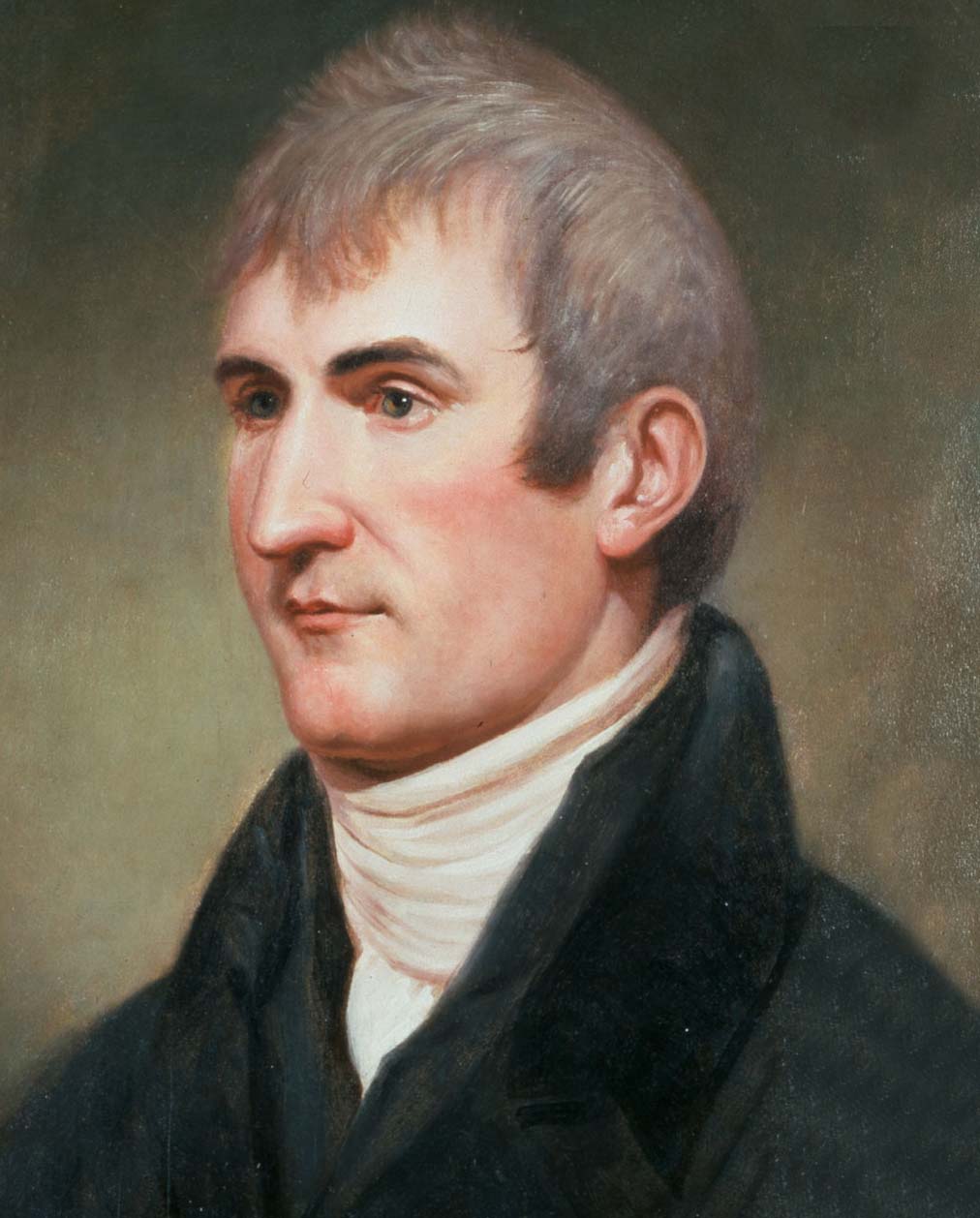

The journal entries for February 7, 1806, offer an unusually clear demonstration of how the Lewis and Clark expedition’s record-keeping operated on parallel tracks. The same events — a hunting party split between Fort Clatsop and a wet camp in the woods, a canoe ferrying elk meat back to the post — generate four entries that range from a single rain-soaked sentence to multi-paragraph natural-history essays. Reading the four side by side reveals not only differences of literary register but also the working method by which Clark transcribed Lewis, and the kinds of observation each man considered worth preserving.
The View from the Wet Camp
Patrick Gass and John Ordway were both in the field party that day, and their entries reflect the conditions of men carrying meat through coastal rain. Ordway, who returned to the fort with the canoe, manages only a fragment:
I and one man went to the Fort with the canoe and some meat1 hard rain. &C.
Gass, who remained encamped with the balance of the meat, is scarcely more expansive but injects a note of personal misery absent from the captains’ record:
bringing in the meat; we got some to the fort; but myself and part of the men had again to encamp out. It rained hard and we had a disagreeable night.
Neither sergeant mentions the marrowbone supper enjoyed back at the fort, the honeysuckle, the huckleberry, or the smallpox. The contrast is striking: while Lewis and Clark were composing botanical descriptions by firelight, Gass was recording a "disagreeable night" in the rain a few miles away. The expedition’s documentary record, in other words, is shaped not only by temperament and literacy but by who happened to be dry that evening.
Lewis and Clark in Parallel
The Lewis and Clark entries for February 7 are nearly identical in content and order, a clear instance of Clark copying from Lewis’s draft — a habit well-documented across the Fort Clatsop winter. Both open with the return of Ordway and Wiser, both then turn to the meal. Lewis writes:
This evening we had what I call an excellent supper it consisted of a marrowbone a piece and a brisket of boiled Elk that had the appearance of a little fat on it. this for Fort Clatsop is living in high stile.
Clark follows almost word for word, but tellingly amplifies the phrase: "this for Fort Clatsop is liveing in high Stile, and in fact fiesting-." The small addition is characteristic of Clark, whose copies of Lewis’s prose frequently insert an emphatic flourish or a personal aside even as the substance is preserved.
The botanical sections that follow — on the honeysuckle, the elder with its "pale sky blue" berry, the seven- or nine-bark, and especially the extended description of a coastal huckleberry — are clearly Lewis’s composition. Clark reproduces the technical vocabulary ("cilindric," "defuse stem," "two ranked") with his customary orthographic improvisation ("accoutely," "apax," "too ranked"). Where Lewis writes that the leaf is "veined, nearly entire, serrate but so slightly so that it is scarcely perceptible," Clark drops the qualification about serration entirely — one of the few places his copy loses information rather than merely respelling it.
The Clatsop Dead
Both captains close with the same somber observation about smallpox among the Clatsops:
The small pox has distroyed a great number of the natives in this quarter. it prevailed about 4 years since among the Clatsops and distroy several hundred of them, four of their chiefs fell victyms to it’s ravages.
Clark hedges Lewis’s "about 4 years since" to "about 4 or 5 yrs Sinc," a small but typical loosening. More significant is the closing sentence. Lewis attributes the deserted villages he infers from the epidemic to those "which we find deserted on the river and Sea coast in this quarter" — a collective observation. Clark personalizes it: "the number of remains of villages which I Saw on my rout to the Kil a mox in Several places." Here Clark departs from his exemplar to anchor the inference in his own recent journey to the Tillamook, a trip Lewis did not make. It is a reminder that even when Clark copies Lewis verbatim for paragraphs at a stretch, his entries occasionally surface firsthand experience that Lewis’s cannot.
Taken together, the four February 7 entries map the social geography of the expedition’s documentary practice: enlisted men recording weather and hardship in fragments, captains composing parallel scientific and ethnographic essays in the relative comfort of the fort, and Clark, even as he transcribes, occasionally writing himself back into the record.


