


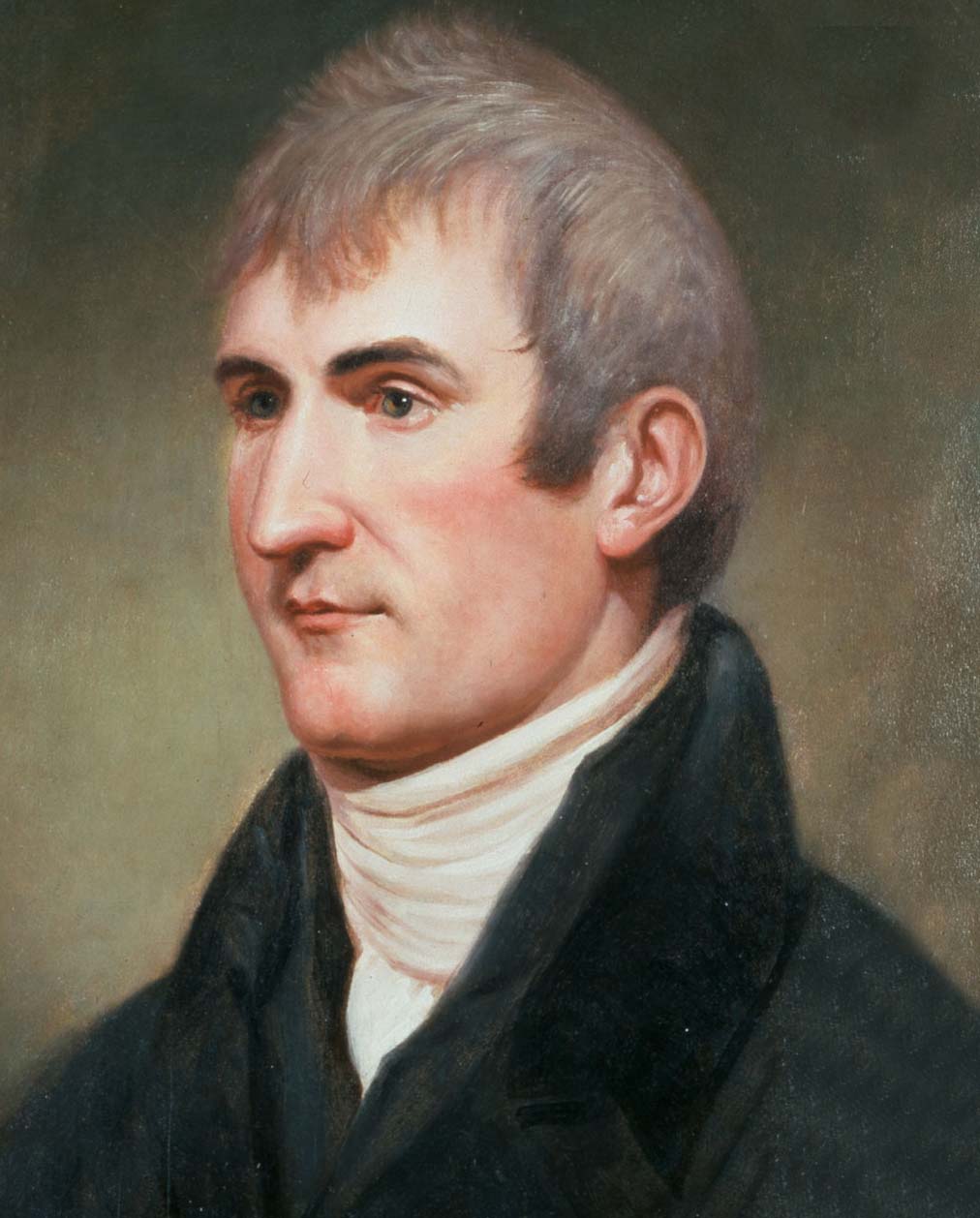
The journal entries of February 3, 1806, capture a routine but revealing day at Fort Clatsop: hunter George Drouillard and Jean Baptiste Lepage return with seven elk killed in the point below the fort; Sergeant Pryor’s recovery party is turned back by tide and wind; Sergeant Gass arrives with the flesh of four more elk from up the Netul; and the saltmakers’ detail returns with about a bushel of salt. Four narrators record the day, and the textual relationships among them illustrate how command-level documentation, enlisted observation, and shared chores converged in the expedition’s record-keeping.
Twin Captains, Single Source
The entries by Meriwether Lewis and William Clark are nearly verbatim. Clark writes that Drouillard had killed seven elk “in the point below us, Several miles distant, but Can be approached within 3/4 of a mile with Canoes by means of a Small Creak which discharges itself into the Bay,” and Lewis renders the same passage with only minor orthographic variation (“creek” for “Creak,” “bay” for “Bay”). Both record the apprehension that:
we are apprehensive that the Clatsops knowing where the meat is, will rob us of a part if not the whole of it.
The phrasing is identical save for capitalization. Both close with the same calculation — “we Calculate on three bushels lasting us from hiere to our deposit of that article on the Missouri” (Clark) — indicating that one captain copied from the other or that both worked from a shared field draft. The convergence of detail (the 10 P.M. return time, the appointment to rejoin Reuben Field, George Shannon, and François Labiche on Friday, the kettles boiling “day and night”) underscores how the captains coordinated their official record while at winter quarters.
Gass and Ordway: The View from the Ranks
Patrick Gass’s entry — composed by a sergeant who had himself just returned from a hunt — is conspicuously brief. He notes the weather, the seven elk, and offers a wry summary of the fort’s diet:
We are fortunate in getting as much meat as we can eat; but we have no other kind of provisions.
Where the captains catalog logistics, Gass distills the day to a single sentence about food monotony. Notably, Gass omits his own arrival with four additional elk — an event Lewis and Clark both record at “half after 4 P.M.” — perhaps because his published journal was edited from briefer field notes, or because he saw no reason to chronicle his own movements.
John Ordway provides the day’s most distinctive detail. Like the captains, he reports the seven elk (and adds “one large beaver” that Lewis and Clark omit). Like them, he records the canoe party turned back by wind. But Ordway alone preserves an ethnographic and culinary observation:
five men came in from the Salt works with about 2 bushels of good Salt, and Some whail meat which the natives call Ecoley. we mix it with our poor Elk meat & find it eats verry well.
The Chinookan term — rendered “Ecoley” by Ordway — does not appear in the Lewis or Clark entries for this date, nor does the whale meat itself. Ordway also gives the salt quantity as “about 2 bushels,” while both captains record “about one busshel only.” The discrepancy may reflect Ordway writing from a different vantage or estimating loosely; the captains’ agreement on one bushel, given their shared text, cannot be treated as independent corroboration.
Patterns in the Record
Three patterns emerge from the day’s entries. First, Lewis and Clark function as a single documentary voice at Fort Clatsop, with one almost certainly transcribing the other; the captains’ anxieties about Clatsop pilfering and the tedium of salt-making are co-authored concerns. Second, Gass compresses where the captains expand, producing a soldier’s-eye summary that captures mood (“we are fortunate… but we have no other kind of provisions”) more than chronology. Third, Ordway preserves details — the beaver, the whale meat, the Chinookan vocabulary, a different salt tally — that the official record loses. For researchers tracing Indigenous foodways or measuring the captains’ provisioning estimates against enlisted accounts, Ordway’s entry on this date is the fullest text.


