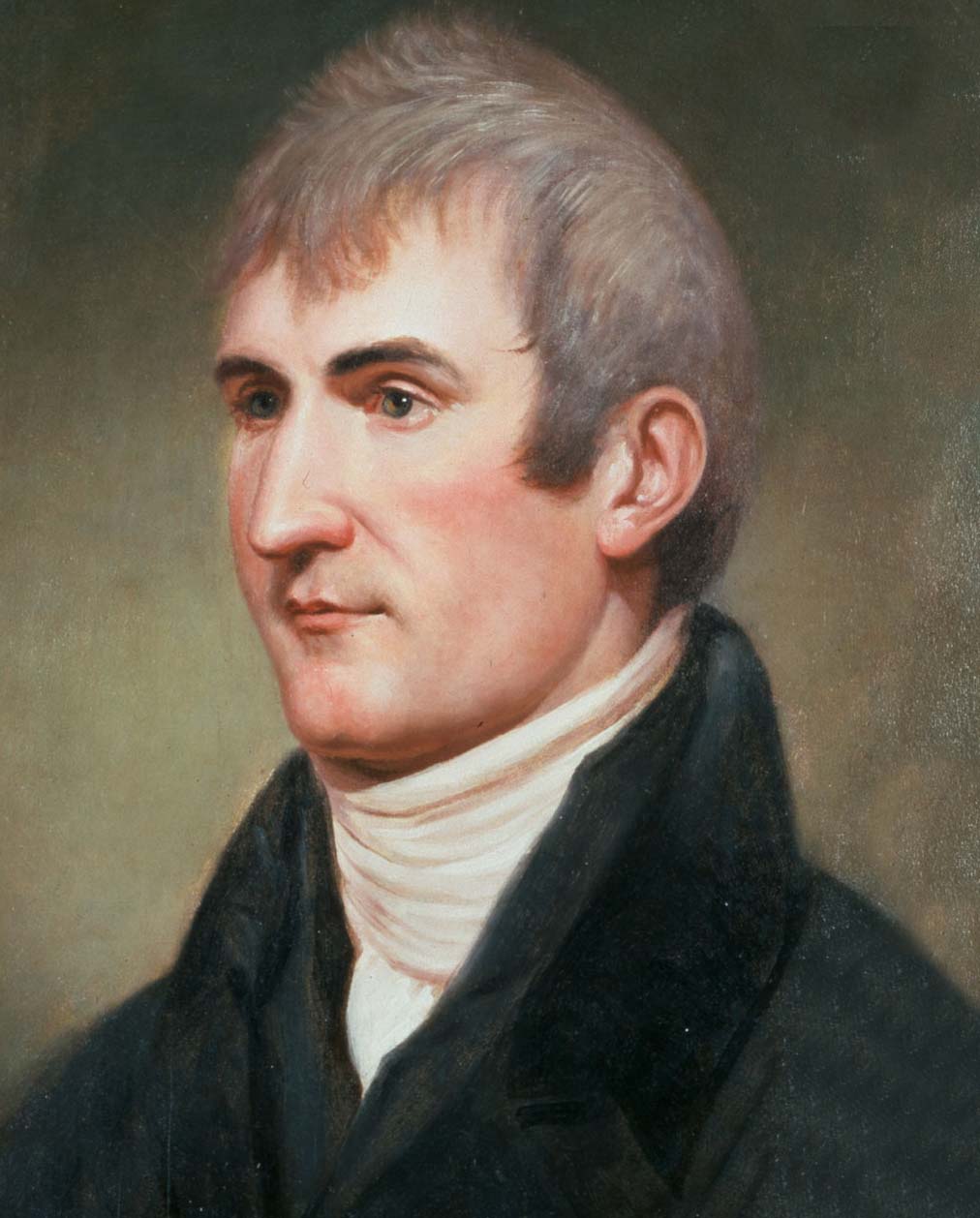


April 25, 1805 produced one of those revealing days in the expedition record when the corps physically divides and the journals divide with it. Persistent headwinds on the Missouri, combined with the captains’ belief that the mouth of the Yellowstone lay close at hand, prompted Meriwether Lewis to set off by land with four men to fix the river’s position by celestial observation. The remaining party — with William Clark, John Ordway, and Patrick Gass aboard the canoes and pirogues — pushed on by water. Four narrators thus describe a single decision from two vantage points, and the differences in detail, register, and emphasis are instructive.
The Decision to Walk: Command Logic vs. Crew Report
Lewis frames the overland departure as a deliberate command calculation. He explains the reasoning in a long, syntactically layered sentence:
The wind had been so unfavorable to our progress for several days past, and seeing but little prospect of a favourable chang; knowing that the river was crooked, from the report of the hunters who were out yesterday, and beleiving that we were at no very great distance from the Yellow stone River; I determined, in order as mush as possible to avoid detention, to proceed by land with a few men to the entrance of that river and make the necessary observations to determine it’s position.
Clark’s parallel entry restates the same logic almost clause for clause, but in the third person and with the co-captain’s characteristic compression:
finding that the winds retarded our progression for maney days past, and no apparance of an alteration, and the river being Crooked that we could never have 3 miles fair wind, Capt. Lewis concluded to go by land as far as the Rochejhone or yellow Stone river.
The verbal echoes — “winds,” “crooked,” “no great distance” — strongly suggest the captains conferred and that Clark drafted his entry with Lewis’s reasoning in mind, or that both men worked from a shared verbal account at the end of the day. Ordway, by contrast, reports the departure as a fait accompli, noting simply that “Capt Lewis myself and 3 more of the party crossed over to the S. Shore to go up by land… (for observations).” Gass is terser still: “Captain Lewis and four men set off by land from this place to go to the river Jaune, or Yellow Stone river.” The sergeants record the order; the captains explain it.
What Each Narrator Notices
Once Lewis is ashore, his journal opens into among the lyrical passages of the upper-Missouri stretch — a panoramic description of the Missouri and Yellowstone valleys glimpsed from a hilltop, with herds so habituated to peace that “the buffaloe Elk and Antelope are so gentle that we pass near them while feeding, without apearing to excite any alarm among them.” His entry pivots from command rationale to natural-historical reverie, recording the killing of three cows and a calf, the taking of tongues and marrow-bones, and the precaution of hanging meat “out of the reach of the wolves.”
Ordway, walking with Lewis’s overland party, supplies a parallel but plainer account of the same march. Where Lewis offers landscape, Ordway offers inventory: a goose shot on her nest with “6 eggs,” “2 cow buffaloe and a calf” killed in “a handsom Smoth bottom,” and a camp fixed “about 2 miles above its mouth” among “large & Small cottonwood & arsh.” Ordway’s entry is the cross-check on Lewis: it confirms the route, the kills, and the camp’s position relative to the Yellowstone’s mouth, but strips away the rhetoric.
Clark, aboard the boats, notes a detail Lewis only mentions in passing — that the canoes had “taken in Some water” before they were forced to lay by — and adds the precise hour of relief: “at 5 oClock the wind luled and we proceeded on and incamped.” Gass, characteristically, supplies the day’s mileage (“about 13 miles”) and a speculative aside found in no other narrator:
I remarked, as a singular circumstance, that there is no dew in this Country, and very little rain, Can it be owing to the want of timber?
The question is Gass’s alone. Neither captain pauses over the aridity of the high plains, and Ordway does not raise it. The sergeant-carpenter’s habit of small environmental theorizing — visible elsewhere in his published 1807 journal — surfaces here as a genuine independent observation.
The Lost Dog
A minor but telling convergence: both captains record the return of Lewis’s Newfoundland, Seaman. Lewis writes that the dog “had been absent during the last night, and I was fearfull we had lost him altogether, however, much to my satisfaction he joined us at 8 Oclock this morning.” Clark notes the same event in nearly identical phrasing — “the Dog which was lost yesterday, joined us this morning” — while Ordway and Gass omit the episode entirely. The detail, trivial in itself, is a useful marker of how the captains’ journals share private incidents that the sergeants either did not know or did not consider worth recording.


