Lewis and Clark at the Three forks
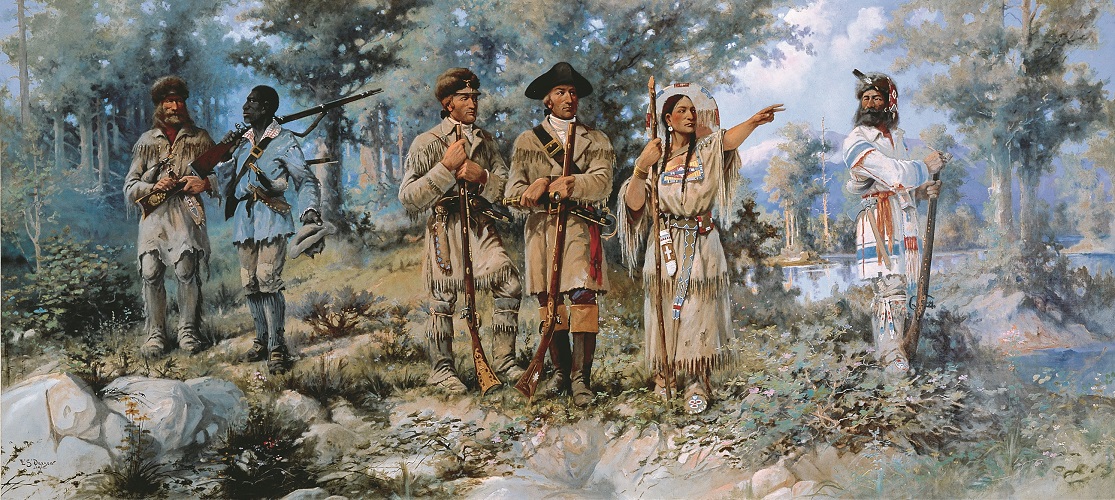
Paxson’s large canvas depicts the Corps of Discovery at the confluence of the Jefferson, Madison, and Gallatin Rivers in present-day southwestern Montana. Meriwether Lewis and William Clark stand in the foreground with members of the party, including Sacagawea, who holds her infant son Jean Baptiste. The composition spreads horizontally across more than twelve feet of canvas, with the explorers occupying a grassy flat, their canoes and equipment near the riverbank, and the broad valley opening toward distant blue ranges. Paxson handles the scene with the documentary specificity he favored: identifiable uniforms, accurate firearms, and the open, sunlit topography of the upper Missouri country. The palette runs to warm browns and ochres in the foreground, with cooler greens and blues receding toward the mountains.
The expedition reached the Three Forks on July 25, 1805, a navigational turning point in the journey west. Lewis named the three streams for President Thomas Jefferson, Secretary of State James Madison, and Secretary of the Treasury Albert Gallatin. The party camped here for several days, resting and recording observations while Sacagawea recognized the country as the territory of her Shoshone people, from whom she had been taken years earlier — information that would shortly help the Corps secure the horses needed to cross the Bitterroots. Paxson painted the canvas in 1912, three years after completing his best-known work, the mural Custer’s Last Stand, and during a period when he was producing a sustained body of paintings devoted to the Lewis and Clark Expedition for Montana civic and commercial patrons.
Edgar Samuel Paxson (1852–1919) moved from New York to Montana in 1877 and spent decades interviewing surviving participants of frontier events, collecting Indigenous and military artifacts, and building a reputation as the state’s foremost narrative painter. His Lewis and Clark series, executed in the years surrounding the expedition’s centennial, remains the most ambitious pictorial treatment of the journey by a Montana-based artist. The painting is held by the Montana Historical Society in Helena and is associated with the Three Forks community, where the confluence is preserved as Missouri Headwaters State Park. The work is frequently reproduced in scholarship and interpretive material concerning the expedition’s passage through Montana.