Rainy Day
one of the canoes fell a considerable distance behind, we were obliged to ly too for her coming up which detained us several hours; it rained very hard on us from 7 this morning untill about three when it broke away and evening as clear with a few flying clouds.
—Meriwether Lewis
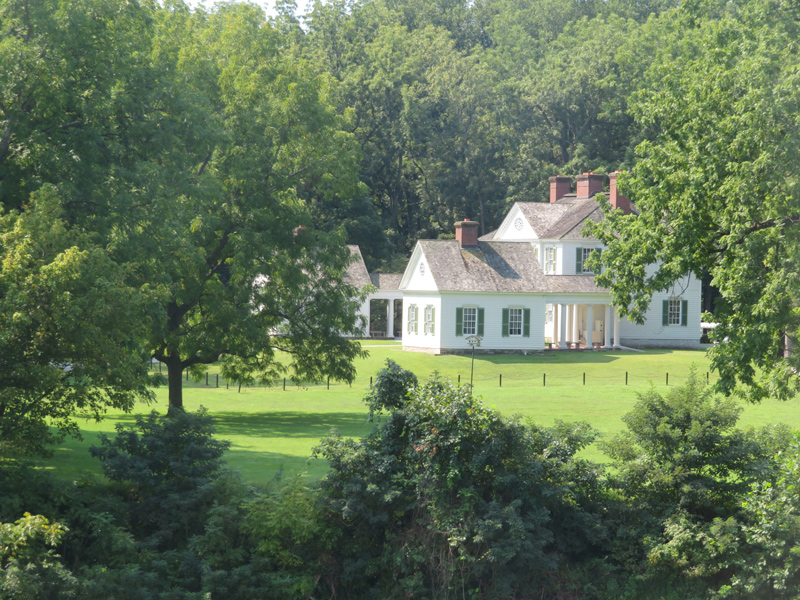
In 1805, Harman Blennerhassett offered the use of this island to train and outfit Aaron Burr’s expedition. Many suspected Burr was attempting to create an independent country and in 1807, he would be brought to trial for treason. Lewis did not mention this island or the estate when he passed by it on this day. Given his difficulties with riffles, perhaps he did not have time for such a stop. On the expedition’s return home 3 September 1806, the captains were told of the duel between Aaron Burr and Alexander Hamilton and perhaps news of “Burr’s Conspiracy.”
Little and Big Hocking Rivers
passed the mouths of the little and big Hockhockin and the settlement of Bellpray—a yanke settlement passed several bad riffles over which we were obliged to lift the boat . . . .
—Meriwether Lewis
On this day, Lewis passed the Little Kanawha and Hocking rivers. Kanawha may be a reference to Conoy an Algonquian tribe related to the Lenape Delawares.1 Hockhockin [Hockhocking] may be a form of the Delaware term for ‘bottle-gourd place.’2.
Blennerhassett Island
Lewis made no mention of Blennerhassett Island. Just nine days behind Lewis, fellow traveler Thomas Rodney recorded this comment:
[September 24, 1803]
The next island we came to was Blaney Hazzards [Harman Blennerhassett], 2 miles below the Little Canaway. The Island as to buildings is very elegantly improved. The dwelling house struck our view as soon as we turned the point of Belleprie.
This Island like all the rest in this river is very rich. The grass in particular is fine on it.
—Thomas Rodney3
Also on this day . . .
Notes
- Hodge, Frederick Webb. Handbook of American Indians North of Mexico (Washington: Smithsonian Institution Bureau of American Ethnology, Government Printing Office, 1912), 1:339.
- William Bright, Native American Placenames of the United States (Norman: University of Oklahoma Press, 2004), 169.
- Dwight L. Smith and Ray Swick, ed., A Journey Through the West: Thomas Rodney’s 1803 Journal from Delaware to the Mississippi Territory (Athens: Ohio University Press, 1997), 71–72.


