After delaying for morning fog, Lewis pushes his crew until nearly dark. They pass an area with trees marked by both Indians and settlers. At camp near present Ravenswood, West Virginia, the crew is exhausted from unloading the barge and pushing it through shallow water.
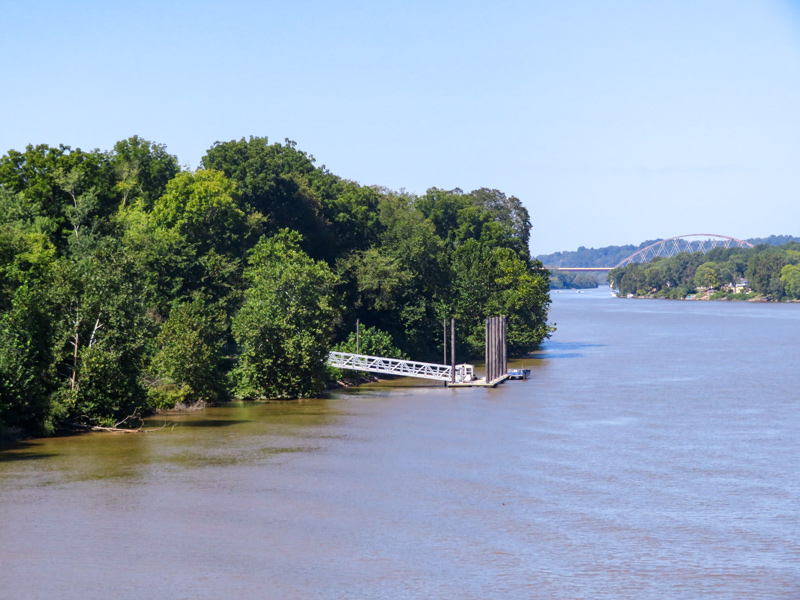
Buffington Island
passed severale very bad riffles and among the rest Emberson’s Island, while they were geting the boat through this long riffle I went on shore and shot some squirrels; my men were very much fatigued with this days labour . . . .
—Meriwether Lewis
Islands and Rapids
During his time on the Ohio in 1770, George Washington described the relationship between islands, gravel bars, and rapids:
every here and there are Islands, some larger, & some smaller, which operating in the nature of Locks, or steps, occasion pretty still water above but for the most part strong & rapid water along side of them —however there is none of these so swift but that a Vessel may be Rowed or set up with Poles —
George Washington1
Nine days behind Lewis, Thomas Rodney nearly ruined his boat passing Buffington Island (Lewis’s Emberson’s Island). He reached the island at six in the evening and missed the main channel. By the time the proper channel was scouted and their boat worked back to it, the sun had set. Continuing in the dark, they struck a rock and sank to the bottom. The next day, two horses dragged the boat to shore and temporary repairs were made. Permanent repairs were made at Maysville, 3 October 1803.2
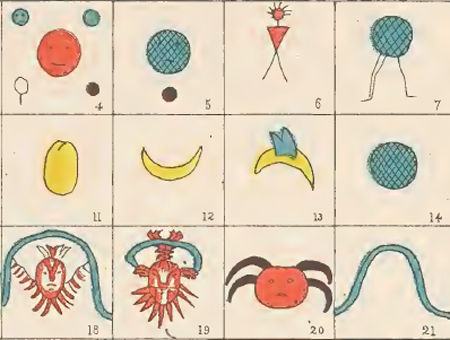
In 1847 under the direction of the Bureau of Indian Affairs, Henry R. Schoolcraft, published a multi-volume work describing the North American Tribes. In the first volume, he inventories various devices used in picture writing, primarily from the tribes residing in the Ohio and Lake Superior regions. Regarding drawings on trees, he writes:
In this figure, Schoolcraft provides the following key:
Graffiti
Before his near disaster at Buffington Island, Rodney took an onshore excursion to view graffiti left by former travelers:
The land on this bend is the richest I have seen on the Ohio. The hickories, walnuts, elms, beaches, etc. were commonly 5 to 6 ft. diameter. On many of the beaches were the initials of various names marked and dates from 1776 to 1802. On one tree was an Indian king drawn with his crown, smoking a pipe . . . . I left my own name and the year 1803 on a large beach tree, and returned to the river.
Thomas Rodney (September 25, 1803)4
On his trip down the Ohio in 1766, John Jennings described the Indian method of marking trees:
March 18 [1766]. At eight passed some Warriors’ Cabbins; these are known by a Tree having the Bark strip’d of all round, about four feet from the Ground, with particular marks Cut on it, denoting what nation they are, & their good or bad success in War, which is known by the Indians who happen to pass that way.
—John Jennings5
Notes
- November 17, 1770. Archer B. Hubert, “Washington’s ‘Tour to the Ohio’ and Articles of The Mississippi Company.” Ohio Archaeological and Historical Society Publications, (October 1908), 480.
- Dwight L. Smith and Ray Swick, ed., A Journey Through the West: Thomas Rodney’s 1803 Journal from Delaware to the Mississippi Territory (Athens: Ohio University Press, 1997), 75.
- Henry R. Schoolcraft, Historical and Statistical Information Respecting the History, Condition and Prospects of the Indian Tribes of the United States, Vol. 1. (Philadelphia: Lippincott, Grambo & Company, 1851), 308, 408.
- Ibid., 74.
- John Jennings, 18 March 1766 in Public Library of Fort Wayne and Allen County, On the Trail of the Pioneers by John T. Faris (1955), 2.


