Watlala Village of the Cascades People
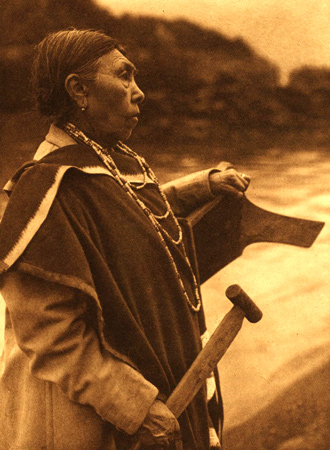
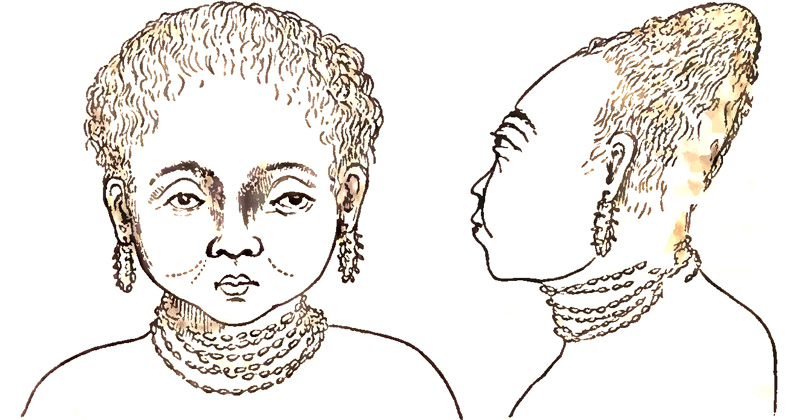
One of Paul Kane‘s subjects was Tamakoun (his To-ma-quin), a Cascade chief. Ethnographers David and Kathrine French, identify the chief’s son in an earlier sketch by Joseph Drayton, a member of the 1841 Wilkes Expedition.3 Of the child, Wilkes wrote:
Watlala was the name of a key Upper Chinookan village at the Cascades of the Columbia. The name has been extended by many to mean the tribe more often called the Cascades. The captains called them the Shahala, meaning ‘those upriver.’5 The natural constriction of the river provided the people with a fishery and a good measure of control over those who traveled up and down the river. As a result, the Cascade Clahclellah village which the expedition visited on 31 October 1805 and 9 April 1806 was a major trade center before and during white contact.
In 1847, artist Paul Kane had time to observe and sketch several Cascade people and the submerged forest above the Cascades. He described the Cascade fishery and their method of collecting tolls from travelers:
We were engaged both days in carrying the parcels of goods across the portage, and dragging the empty boats up by lines. This is a large fishing station, and immense numbers of fish are caught by the Hudson’s Bay Company and the Cascade Indians, who congregate about here in great numbers at the fishing season, which happened at the time of our passing. They gave us a good deal of trouble and uneasiness, as it was only by the utmost vigilance that we could keep them from stealing.6
In the fall of 1805 and spring of 1806, the expedition had similar experiences with the Watlala. At that time, the tribe sold their fish not to an English trading company, but to other tribes. Forty years later saw the arrival of Oregon Trail settlers who hired the Cascades to steer their rafts through the rapids. Just a decade after that, a wooden railroad traversed the portage and steamboats on either end ferried passengers and goods along the river.
The 1855 Treaty
In 1855, Cascade leaders signed the 1855 Willamette Valley Treaty which listed the people as the “Wah-lal-la band of Tumwaters.” The treaty was ratified by Congress, and a majority of Cascades were moved to the Grand Ronde Reservation along with many other native nations from western Oregon. Others moved to the Yakama and Warm Springs reservations.
One of the treaty signers, Tumulth, was still at Watlala when Yakamas and Klickitats attacked Fort Rains in an attempt to block white trade through the Cascades of the Columbia. The Cascades maintained their innocence and did not flee when Lt. Philip Sheridan and his dragoons arrived. Sheridan held court and, according to oral tradition, if the defendant had recently fired his gun, he was declared guilty. Sheridan had Tumulth and eight other Cascades hanged. This was the beginning of the Plateau Indian War, Col. Steptoe’s defeat, and Gen. George Wright’s campaign of brutal retribution in Eastern Washington and parts of the Idaho panhandle.7
The Cascades Today
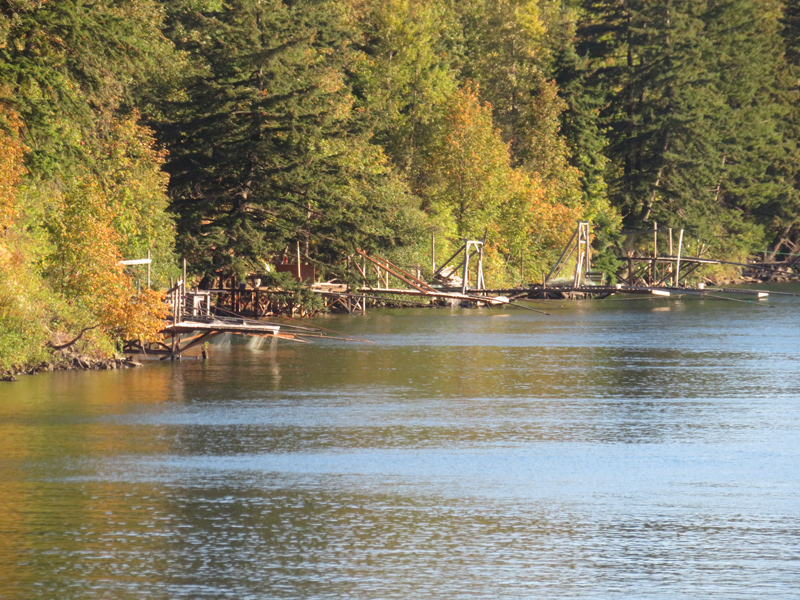
Today, the Cascades maintain a fishery at the falls even though river is a reservoir behind Bonneville Dam. In the 1950s, the Bureau of Indian affairs declared the Grand Ronde Tribe assimilated and it was one of many Western Oregon Tribes terminated via the Western Oregon Indian Termination Act (PL 588). Many could not afford to purchase their allotments and had to move from the reservation. The federal government restored the tribe in 1983 leading to a resurgence of culture and community. Although Kiksht, the language of the Upper Chinook no longer has any speakers, the common Chinuk Wawa pigeon spoken among the diverse tribes living at the Grand Ronde Reservation has been preserved and is now taught.8
Notes
- Edward S Curtis, The North American Indian (1907-1930), vol. 8 (Cambridge, Mass.: The University Press, 1911), facing page 138.
- David H. French and Katherine S. French, Handbook of North American Indians: Plateau Vol. 12, ed. Deward E. Walker, Jr. (Washington, D.C.: Smithsonian Institution, 1998), 371–72; Kenneth R. Lister, …
- French and French, 375.
- Paul Kane, Wanderings of an Artist among the Indians of North America . . . (London: Longman, Brown, Green, Longmans, and Roberts, 1859), 259.
- Williams, 315–16; Donald L. Cutler, “Hang them all”: George Wright and the Plateau Indian War (Norman: University of Oklahoma Press, 2016), 93–94.
- French and French, 360; Robert H. Ruby, John A. Brown, and Cary C. Collins, A Guide to the Indian Tribes of the Pacific Northwest (Norman: University of Oklahoma Press, 2010), 379–80; David G. …


