Lewis: June 1, 1806
Sunday June 1st 1806. Yesterday evening Charbono an LaPage returned,
having made a broken voyage. they ascended the river on this side nearly
opposite to a village eight miles above us, here their led horse which had
on him their merchandize, feell into the river from the side of a steep
clift and swam over; they saw an indian on the opposite side whom they
prevailed on to drive their horse back again to them; in swiming the river
the horse lost a dressed Elkskin of LaPages and several small articles,
& their paint was destroyed by the water. here they remained and dryed
their articles the evening of the 30th Ult. the indians at the village
learning their errand and not having a canoe, made an attempt esterday
morning to pass the river to them on a raft with a parsel of roots and
bread in order to trade with them; the indian raft struck a rock, upset
and lost thir cargo; the river having fallen heir to both merchandize and
roots, our traders returned with empty bags. This morning Drewyer
accompanyed by Hohastillpilp set out in surch of two tomahawks of ours
which we have understood were in the possession of certain indians
residing at a distance in the plains on the South side of the Kooskoske;
the one is a tomahawk which Capt. C. left at our camp on Musquetoe Creek
and the other was stolen from us while we lay at the forks of this and the
Chopunnish rivers last fall. Colter and Willard set out this morning on a
hunting excurtion towards the quamash grounds beyond Collins’s Creek. we
begin to feel some anxiety with rispect to Sergt. Ordway and party who
were sent to Lewis’s river for salmon; we have received no inteligence of
them since they set out. we desired Drewyer to make some enquiry after the
Twisted hair; the old man has not been as good as his word with rispect to
encamping near us, and we fear we shall be at a loss to procure guides to
conduct us by the different routs we wish to pursue from Traveller’s rest
to the waters of the Missouri.I met with a singular plant today in
blume of which I preserved a specemine; it grows on the steep sides of the
fertile hills near this place, the radix is fibrous, not much branched,
annual, woody, white and nearly smooth. the stem is simple branching
ascending, 21/2 feet high celindric, villose and of a pale red colour. the
branches are but few and those near it’s upper extremity. the extremities
of the branches are flexable and are bent down near their extremities with
the weight of the flowers. the leaf is sissile, scattered thinly, nearly
linear tho somewhat widest in the middle, two inches in length, absolutely
entire, villose, obtusely pointed and of an ordinary green. above each
leaf a small short branch protrudes, supporting a tissue of four or five
smaller leaves of the same appearance with those discribed. a leaf is
placed underneath eah branch, and each flower. the calyx is a one flowered
spathe. the corolla superior consists of four pale perple petals which are
tripartite, the central lobe largest and all terminate obtusely; they are
inserted with a long and narrow claw on the top of the germ, are long,
smooth, & deciduous. there are two distinct sets of stamens the 1st or
principal consist of four, the filaments of which are capillary, erect,
inserted on the top of the germ alternately with the petals, equal short,
membranous; the anthers are also four each being elivated with it’s
fillament, they are linear and reather flat, erect sessile, cohering at
the base, membranous, longitudinally furrowed, twise as long as the
fillament naked, and of a pale perple colour. the second set of stamens
are very minute are also four and placed within and opposite to the
petals, these are scarcely persceptable while the 1st are large and
conspicuous; the filaments are capillary equal, very short, white and
smooth. the anthers are four, oblong, beaked, erect, cohering at the base,
membranous, shorter than the fillaments, white naked and appear not to
form pollen. there is one pistillum; the germ of which is also one,
cilindric, villous, inferior, sessile, as long as the 1st stamens, and
marked with 8 longitudinal furrows. the single style and stigma form a
perfict monapetallous corolla only with this difference, that the style
which elivates the stigma or limb is not a tube but solid tho it’s outer
appearance is that of the tube of a monopetallous corolla swelling as it
ascends and gliding in such manner into the limb that it cannot be said
where the style ends, or the stigma begins; jointly they are as long as
the corolla, white, the limb is four cleft, sauser shaped, and the margins
of the lobes entire and rounded. this has the appearance of a
monopetallous flower growing from the center of a four petalled corollar,
which is rendered more conspicuous in consequence of the 1st being white
and the latter of a pale perple. I regret very much that the seed of this
plant are not yet ripe and it is proble will not be so during my residence
in this neighbourhood.
Entities mentioned in this entry
Auto-extracted from the entry text. Hover any entity for context.
Terrain360 · the place today
Camp Chopunnish (Long Camp), waiting for snow to melt in 360°
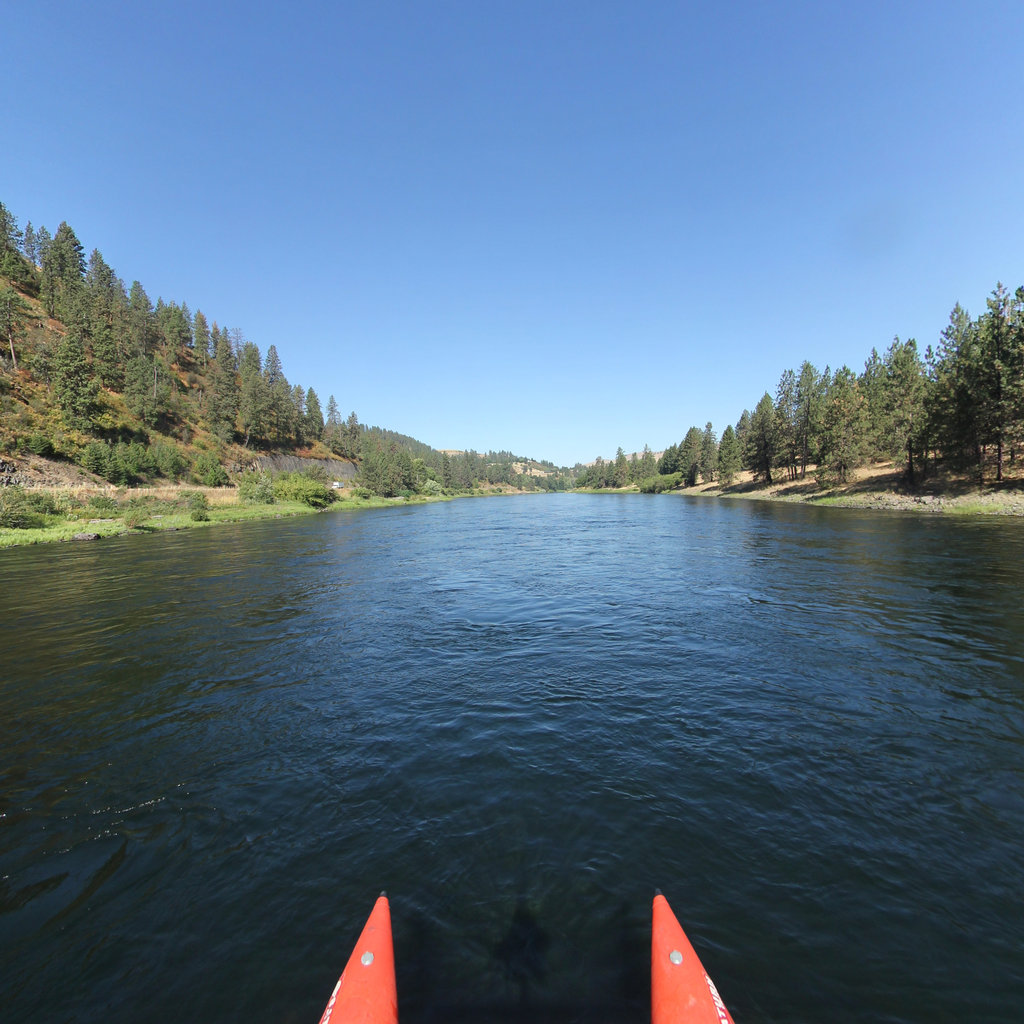
10 frames across 1.6 mi of the route around this location
Analyses
Artwork
Help improve this record
See something that needs correcting, or know a source we are missing? The archive gets better through its readers.


