


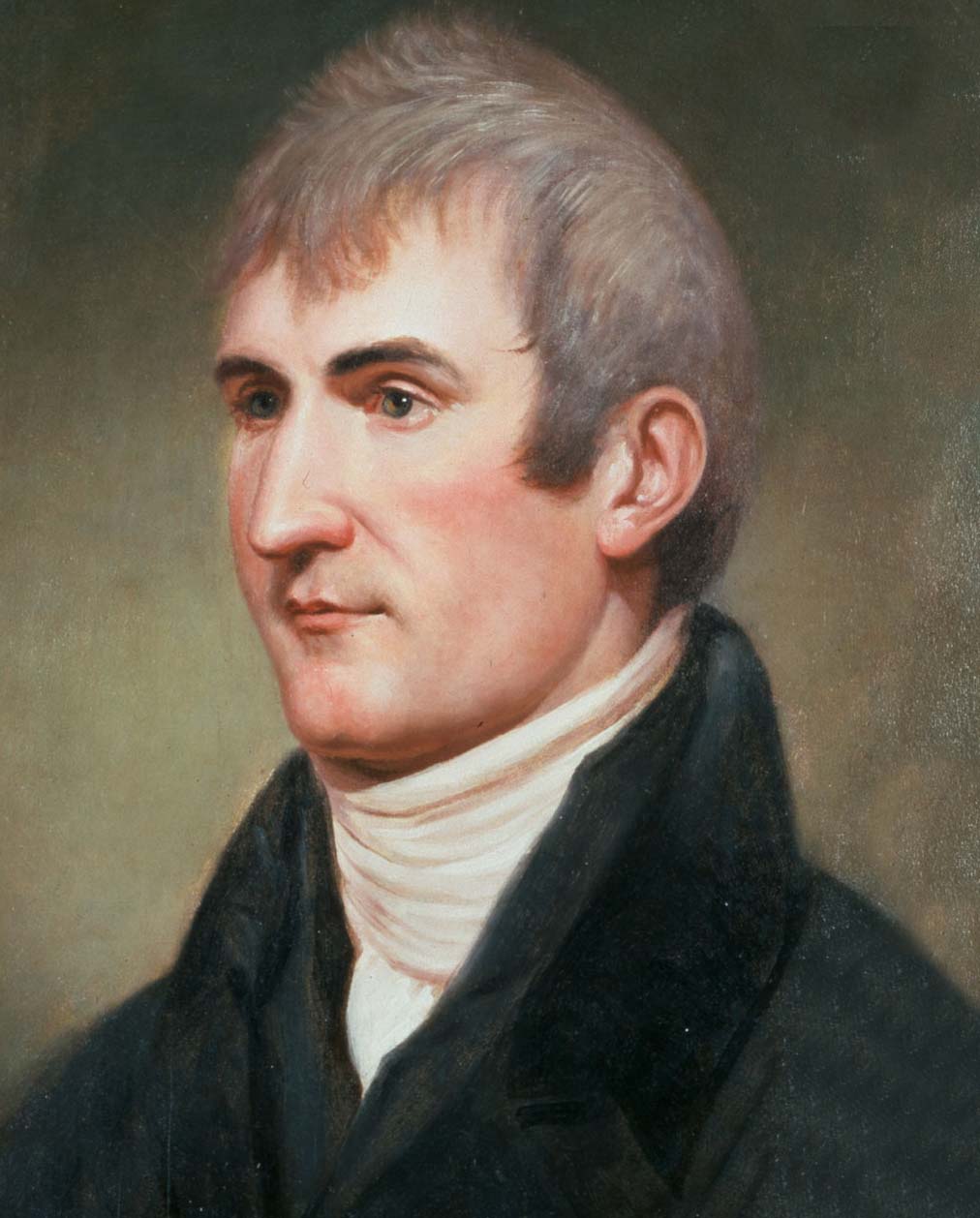
The journals of February 20, 1806 offer an unusually clear demonstration of how the Lewis and Clark expedition produced parallel — and unequal — textual records. Four narrators write from Fort Clatsop and its environs, and the same afternoon’s events refract through markedly different registers: ethnographic curiosity, logistical labor, medical triage, and ideological reflection.
Two Captains, One Manuscript
The entries by William Clark and Meriwether Lewis are, as on many Fort Clatsop days, near-twins. Both open with the identical sentence permitting Collins to hunt; both report Gibson’s recovery, Bratton’s cough, and McNeal’s worsening condition; both then pivot to the visit of the Chinook chief whose name Clark renders as Tfih-cum and Lewis as Tdh-cum. The textual relationship is one of close copying with minor orthographic divergence — Clark’s “Sucksessfull” and “Statue” against Lewis’s “successfull” and “statue,” Clark’s “gratifyed” rendered by Lewis as “gratifyed” as well, but with subtle reorderings of clauses.
Where the two captains differ most is in completeness. Lewis carries the natural-history paragraph further, adding observations on the “large brown woolf” of the Pacific woods that Clark omits. Clark, meanwhile, includes Willard among the sick list (“Willard has a high fever”), a detail Lewis drops. The pattern is consistent with what scholars have long observed: the captains drafted in tandem, one borrowing from the other, each occasionally pruning or extending according to his own judgment.
The Doctrine of Distrust
The most striking feature of the day’s record is the long ideological excursus that both captains attach to Tahcum’s visit. After noting that they gave the chief a small medal and food and smoke, Lewis writes:
we never suffer parties of such number to remain within the fort all night; for notwithstanding their apparent friendly disposition, their great averice and hope of plunder might induce them to be treacherous… the well known treachery of the natives by no means entitle them to such confidence, and we must check it’s growth in our own minds, as well as those of our men.
Clark’s version is virtually identical, with the telling phrase “our preservation depends on our never loseing Sight of this trate in their character.” The passage is among the most explicitly suspicious set-pieces in the captains’ Pacific-coast journals. It is also revealing as an act of self-discipline: Lewis admits that the men, after “a series of uninterupted friendly intercouse,” have grown trusting, and the captains must actively “check it’s growth” by repeating warnings. The hostility, in other words, is presented as policy rather than experience — a doctrine maintained against the grain of the men’s actual relations with the Chinooks.
Notably, this entire framework is absent from the enlisted men’s journals.
What the Sergeants Saw
Patrick Gass, writing from inside the fort, registers the same visitors with no anxiety whatever. His attention falls instead on Chinook craft:
of the Chinook Indians came to the fort with hats to trade. They are made of the cedar bark and silk grass, look hand-some and keep out the rain.
Gass concurs with the captains on one operational point — “in the evening we turned out the natives as usual” — but for him the closing of the gates is routine, not a meditation on treachery. His ethnographic eye catches a material detail (cedar bark, silk grass, water-resistance) that neither Lewis nor Clark records this day, even though the captains elsewhere describe Chinook hats at length.
John Ordway is not at the fort at all. His entry places him on the windswept beach en route to the salt works:
we Set out eairly and proced on along the coast faceing the wind the Sand cut our faces waided a creek rapid current about noon we arived to the Salt works and bought a little Ecoley [blubber] and oil &C from the natives, the waves roles verry high and white froth flying &C.
Ordway’s prose — paratactic, sensory, weather-driven — is the day’s only record of conditions outside Fort Clatsop, and his casual purchase of blubber “from the natives” reads as ordinary commerce, untouched by the captains’ rhetoric of vigilance.
Cross-Narrator Patterns
Three patterns emerge. First, the Lewis–Clark textual dependency is again confirmed, with Lewis the more expansive natural historian and Clark the slightly fuller medical reporter. Second, the captains’ suspicion of the Chinooks is an officer-class discourse: it appears nowhere in Gass or Ordway, even though Gass witnessed the same visit. Third, the enlisted men preserve information — Chinook hat construction, the texture of a sand-blasted coastal march, blubber prices at the salt works — that the captains, absorbed in policy and taxonomy, do not record at all. The day at Fort Clatsop is therefore not one event but four, and the database that holds all four entries side by side allows the asymmetries between command and rank to be read with unusual clarity.


