
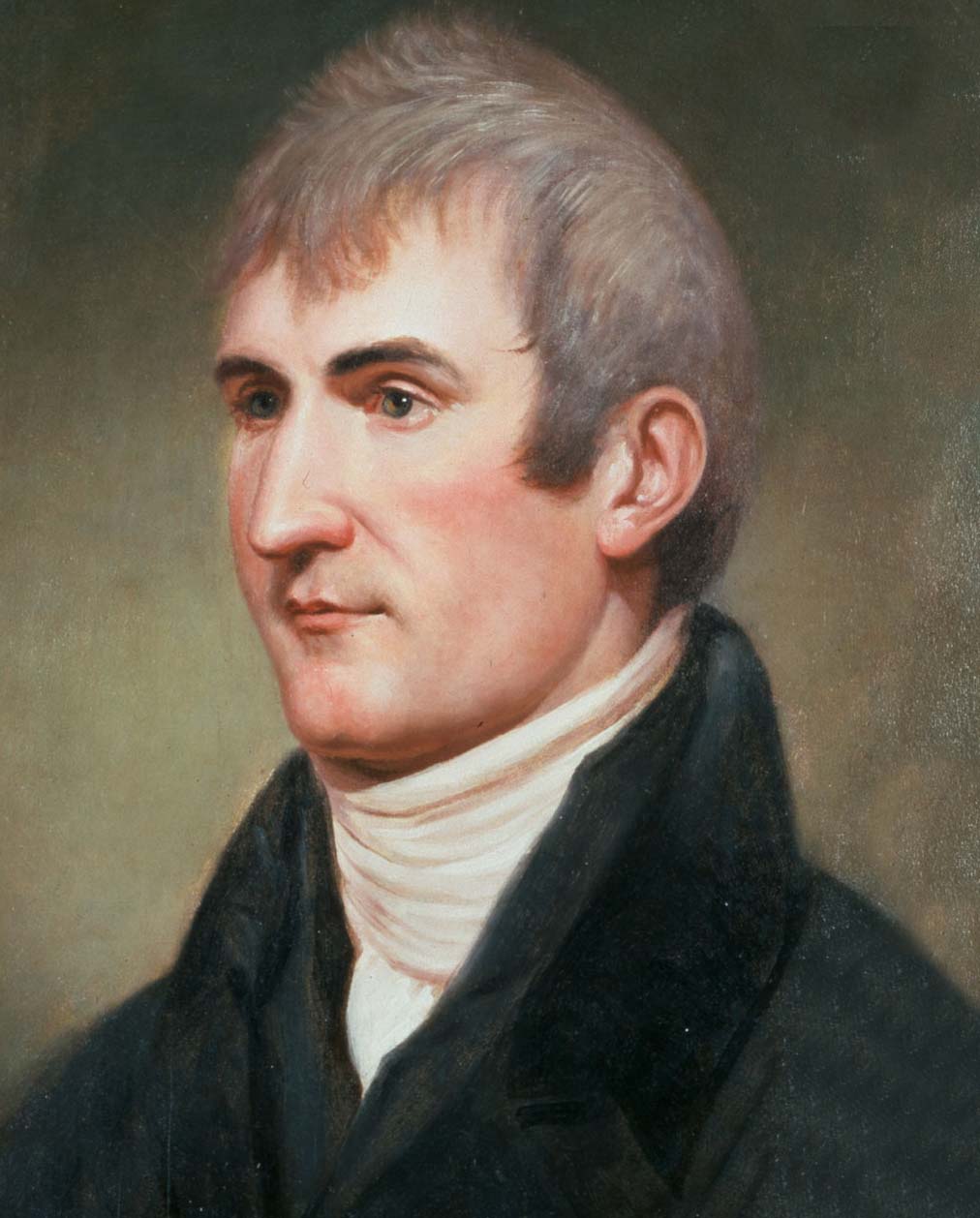

The journals for January 7, 1806 split the Corps of Discovery into two narrative theaters. William Clark leads a party of fourteen southward along the Pacific shore toward a beached whale near present-day Cannon Beach; Meriwether Lewis remains at Fort Clatsop, where George Drouillard’s trapline yields a fat beaver and prompts among the detailed technical digressions in the entire expedition record. Patrick Gass and John Ordway, both at the fort, offer compressed third-party accounts that frame the day from the garrison’s perspective.
Clark on the Mountain, Lewis at the Desk
Clark’s entry is kinetic, topographic, and slightly breathless. After crossing a creek on a felled pine the saltmakers had dropped, his party reaches the mouth of an 85-yard river he names for the Clatsop nation, then ascends what he calls
a Steep mountain, as Steep at it is possible places for 1500 feet we hauled our Selves up by the assistence of the bushes if one had Given way we must have fallen a great distant the Steepest worst & highest mountain I ever assended
The superlative is striking from a man who had crossed the Bitterroots four months earlier. Clark’s prose accumulates hazards — sliding bluffs, soft stone, falling timber, an Indian burial canoe glimpsed three quarters of a mile above the houses — and registers an encounter with fourteen Tillamook returning loaded with blubber, the day’s only direct evidence that the whale’s bounty was already in circulation.
Lewis, by contrast, writes from a stationary desk and a full stomach. His entry opens with a single sentence acknowledging Drouillard’s catch — “the beaver was large and fat we have therefore fared sumptuously today” — and then pivots into a five-hundred-word treatise on the preparation of castor-based beaver bait, complete with substitutions for unavailable ingredients:
this is gently pressed out of the bladderlike bag which contains it, into a phiol of 4 ounces with a wide mouth; if you have them you will put from four to six stone in a phiol of that capacity, to this you will add half a nutmeg, a douzen or 15 grains of cloves and thirty grains of cinimon finely pulverized
The register is pharmacopoeial. Lewis catalogues the male beaver’s six “stones,” distinguishes bark stones from oil stones, and notes reproductive anatomy with a naturalist’s clinical detachment. Where Clark counts vertical feet, Lewis counts grains of cinnamon.
The Garrison Witnesses
Gass and Ordway, both at Fort Clatsop, illustrate how the same day looks from the rear. Ordway’s entry is the shortest of the four — a single sentence reporting Drouillard’s traps and one meteorological observation:
contn clear all day which is a very uncommon thing at this place.
That weather note is the day’s most underappreciated detail; neither Lewis nor Clark mentions it, though Clark’s mountain ascent would have been considerably worse in rain. Ordway, who throughout the winter has functioned as the expedition’s most reliable weather diarist, supplies the climatic frame the captains omit.
Gass, writing in the retrospective and somewhat consolidated style that characterizes his published narrative, telescopes January 7, 8, and 9 into a single paragraph. His version of the whale expedition is secondhand but adds information the captains’ January 7 entries do not yet contain — the skeleton’s measurements and the Tillamook’s processing methods:
They found the skeleton of a whale which measured 105 feet in length and the head 12. The natives had taken all the meat off its bones, by scalding and other means, for the purpose of trade.
Gass also preserves an incident absent from Clark’s January 7 entry: a Tillamook man’s reported attempt on a Corps member’s blanket, foiled by “a squaw of the Chinook nation, who lives among them, and who raised an alarm.” Whether this episode belongs to January 7 or one of the subsequent days Gass collapses into the paragraph is unclear from his text alone, but his record of it is the only one among the four narrators.
Patterns and Divergences
The day exemplifies a recurring division of labor in the Fort Clatsop journals. Lewis treats stationary days as opportunities for systematic natural history; Clark, when moving, produces dense itinerary prose with sharp ethnographic asides. Ordway compresses; Gass synthesizes after the fact and occasionally preserves social incidents the captains pass over. Notably, Lewis does not mention Clark’s departure or the whale at all in this entry — his attention is wholly absorbed by the beaver — while Clark, climbing a coastal headland, says nothing of the fort’s evening fare. Two errands, two registers, and four hands keeping the record from drifting into a single voice.


