
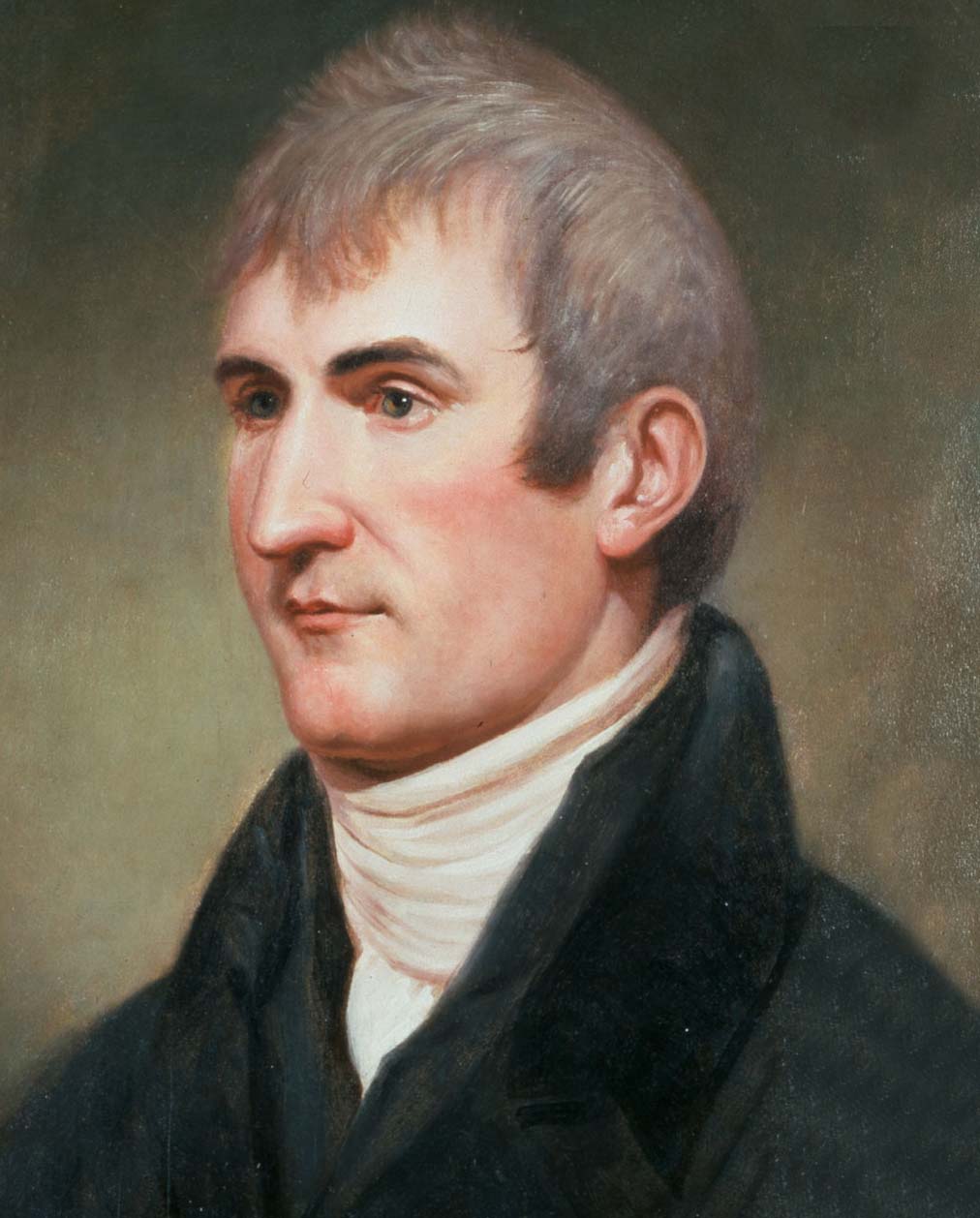


By mid-July 1806 the Corps of Discovery had split into reconnaissance parties, and the journals of 15 July reflect that division with unusual clarity. Patrick Gass and Meriwether Lewis write from the Great Falls of the Missouri, preoccupied with stolen horses, a frightening grizzly encounter, and the logistics of Lewis’s planned excursion up Maria’s River. William Clark and John Ordway, meanwhile, write from the far side of the divide, descending toward and along the Yellowstone (the "Rochejhone"). Reading the four entries together exposes how sharply circumstance shaped each narrator’s register and subject matter on a single day.
The Great Falls Camp: Anxiety, Bears, and Revised Plans
Lewis’s entry is the day’s most introspective. Drouillard’s return without the missing horses forces him to scale back his Maria’s River party, and he records the recalculation in characteristically methodical prose:
I have yet 10 horses remaining, two of the best and two of the worst of which I leave to assist the party in taking the canoes and baggage over the portage and take the remaining 6 with me… I shall leave three of my intended party, (viz ) Gass, Frazier and Werner, and take the two Feildses and Drewyer.
Lewis also discloses an unguarded fear about Drouillard’s safety, admitting he had "already settled it in my mind that a whitebear had killed him." The grizzly looms in his imagination as a near-certain killer of any solitary man on horseback: "the chances in favour of his being killed would be as 9 to 10."
Gass, working from the same camp, confirms the day’s main events — the dispatch of McNeal to check the cached pirogue, Drouillard’s failed search, and Lewis’s revised plan — but he reserves his most vivid writing for an episode Lewis omits entirely: the bear attack on the man (almost certainly McNeal) returning from the portage road.
A white bear met him at Willow creek, that so frightened his horse, that he threw him off among the feet of the animal; but he fortunately (being too near to shoot) had sufficient presence of mind to hit the bear on the head with his gun; and the stroke so stunned it, that it gave him time to get up a tree close by before it could seize him.
Where Lewis treats the grizzly as an abstract probability, Gass reports the concrete encounter — broken gun, three-hour standoff, recovered horse two miles distant. The juxtaposition is instructive: Lewis the captain weighs risks; Gass the sergeant records what actually happened to the men. Gass closes with a generalization that reads almost as a warning to future readers: "These bears are very numerous in this part of the country and very dangerous, as they will attack a man every opportunity."
The Yellowstone Descent: Clark’s Geographer’s Eye
Clark’s entry, by contrast, is a surveyor’s document. He measures the route from the Three Forks of the Gallatin’s easterly fork to the Yellowstone at eighteen miles, notes that the road is "excellent high dry firm," and records the mouth of Shields River with characteristic precision: "35 yards wide deep and affords a great quantity of water it heads in those Snowey Mountains to the N W with Howards Creek." He stratifies the Yellowstone bottoms into a first bottom subject to overflow and a second bottom of "coars gravel pebils & Sand," observing where high floods reach. He notes game in abundance — "Several gangs of Elk from 100 to 200 in a gangue" — and reports the deteriorating condition of the horses’ feet on the stony ground.
Ordway, traveling with Clark’s party, gives the day’s hunting tally with his usual brevity. His list — Collins’s deer and elk, Cruzatte’s antelope, Colter’s "panther a deer and a rattle Snake" — supplies a granular record of what Clark summarizes only as "one Elk only killed to day," a discrepancy suggesting Clark counted only what reached the main party while Ordway tracked individual hunters’ totals. Ordway also closes with the day’s universal complaint: "the Musquetoes verry troublesom in deed."
Patterns Across the Four Hands
The 15 July entries reveal the expedition’s documentary division of labor. Lewis writes strategically, working through the implications of the lost horses for his Maria’s River plan and revealing rare emotional content about Drouillard. Gass, sharing Lewis’s camp and now reassigned away from the Maria’s expedition, captures the embodied danger Lewis only abstracts. Clark performs his standard role as cartographer-geographer, locating tributaries and grading roads. Ordway functions as the expedition’s quiet bookkeeper of meat. None of the four narrators duplicates another; each compensates for what the others omit, and only by reading them together does the full shape of 15 July 1806 — a day of two camps, two terrains, and two anxieties — emerge.


