Blackfeet Burning Crow Buffalo Range
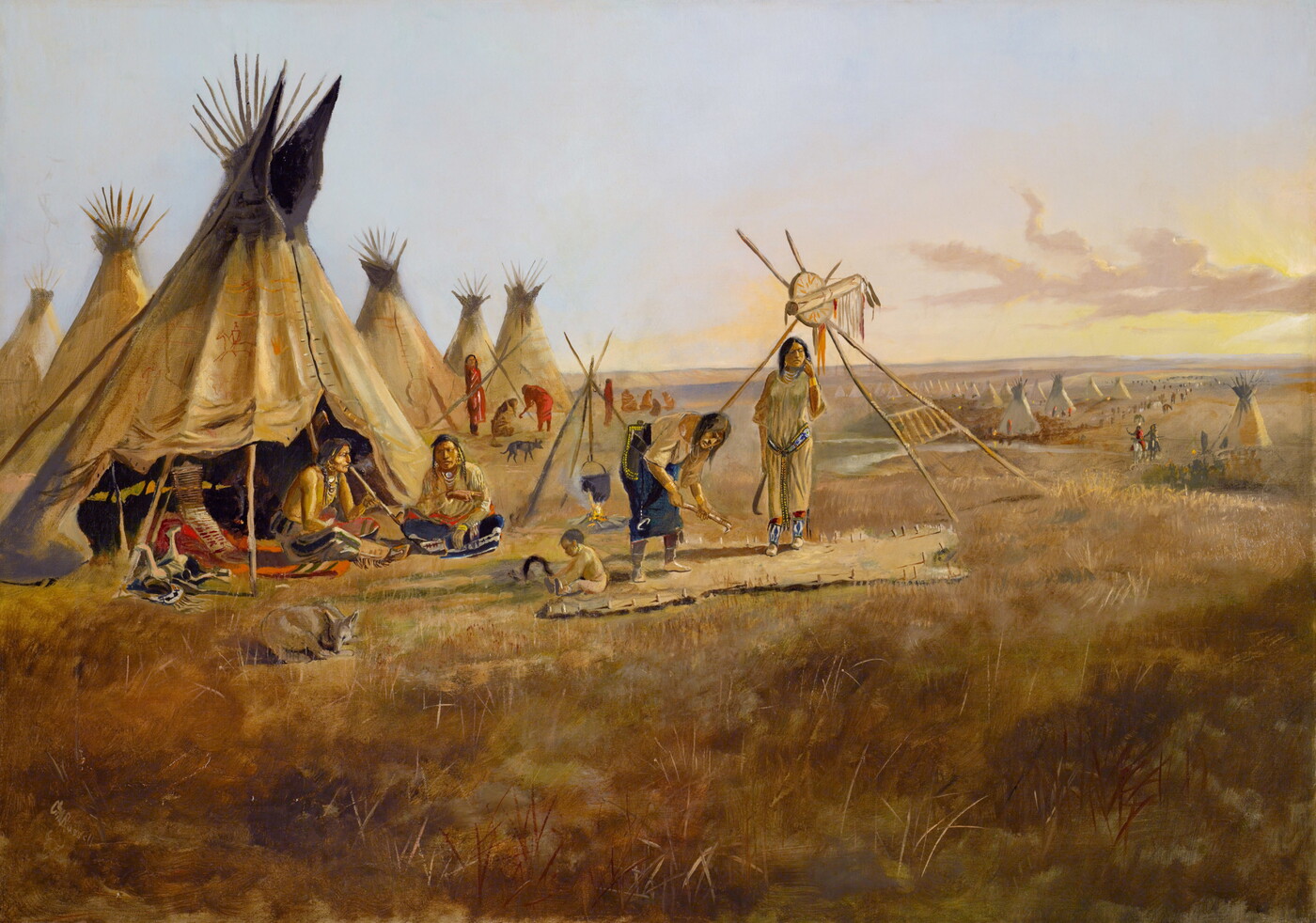
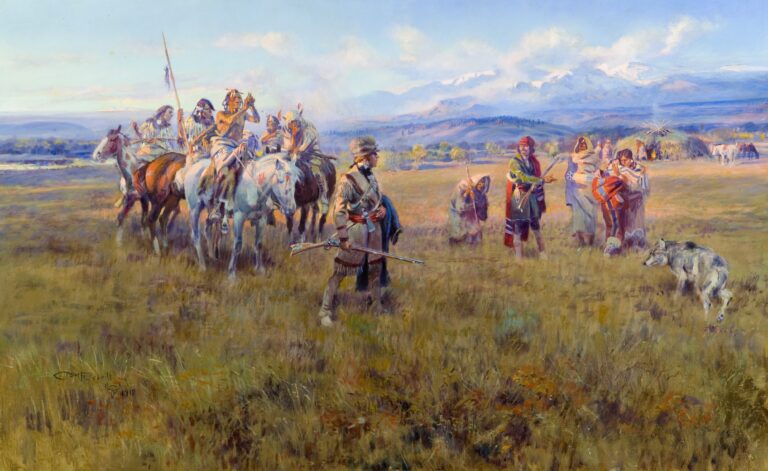
Charles M. Russell’s “Blackfeet Burning Crow Buffalo Range” depicts a scene of intertribal warfare on the northern plains. The composition shows mounted Blackfeet warriors setting fire to grassland, a tactic used to deprive a rival tribe of forage and to drive bison away from enemy hunting territory. Smoke and flame fill the middle distance while the riders move across the foreground, rendered with Russell’s customary attention to horse anatomy, the cut of leggings and shirts, and the carriage of the rider on horseback. As a halftone print measuring roughly 3 1/2 by 5 3/8 inches, the image was reproduced from one of Russell’s painted or drawn originals for mass circulation, a common practice for his work in the early twentieth century.
The 1907 date places this image at the height of Russell’s productive middle career, after he had left the cowboy life behind and settled in Great Falls, Montana, to paint full time. By this point he was widely published in magazines, gift books, and promotional literature, and small halftone reproductions of his Western subjects circulated broadly. The subject reflects Russell’s lifelong interest in the Plains tribes before reservation confinement, a period he treated repeatedly through scenes of hunting, horse raids, and intertribal conflict. The Blackfeet–Crow rivalry he depicts here was a defining feature of the northern plains in the early nineteenth century, the same landscape and peoples the Lewis and Clark Expedition encountered in 1805 and 1806 as the Corps of Discovery moved through what is now Montana.
Russell (1864–1926) is the artist most closely identified with Montana’s visual identity, and his images shaped public understanding of the northern plains for generations. This print is held in the Amon Carter Museum of American Art in Fort Worth, Texas, a major repository of Russell’s work alongside that of Frederic Remington. It entered the collection through the Fred and Jo Mazzulla Collection, an important Colorado-based assemblage of Western American photographs, prints, and ephemera. Russell’s depictions of intertribal warfare and pre-reservation Plains life have been frequently reproduced in Lewis and Clark commemorative publications, where they serve to illustrate the Indigenous world the expedition documented but did not fully understand.