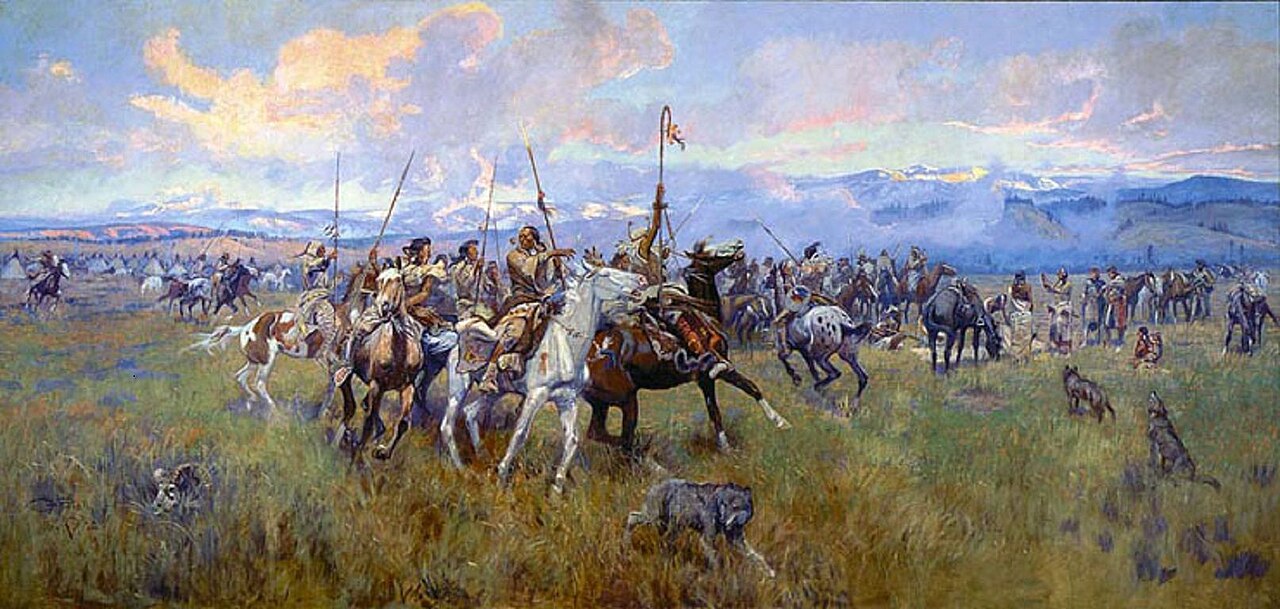
Lewis and Clark Meeting the Flatheads at Ross’ Hole
Russell’s mural shows the encounter between the Lewis and Clark expedition and the Salish (then commonly called Flathead) people on September 4–5, 1805, in the Bitterroot Valley of present-day Montana, at a spot the captains called Ross’s Hole. The composition pushes the white explorers to the right edge of the canvas, where Lewis, Clark, and their interpreters sit mounted on horses, gesturing in conversation. The Salish dominate the foreground and middle distance: mounted warriors in painted buckskins, women and children, and a large herd of horses arrayed across the open meadow. Snow-streaked peaks of the Bitterroot Range rise in the background under a heavy autumn sky. Russell painted in oil on a single canvas spanning twenty-five feet, building the scene around the diagonal sweep of the Salish riders rather than the explorers, an unusual choice for the genre.
The mural was commissioned by the State of Montana in 1911 for the House of Representatives chamber in the new Capitol in Helena. Russell received $5,000, the largest commission of his career to that point, and completed the painting in 1912. The work coincided with the centennial decade of the expedition and with the broader American mural movement that placed regional historical narratives in public buildings. Russell, who had lived among the Blackfeet and had known Salish people personally, used the commission to foreground Native presence in a founding episode of state history, departing from the more familiar nineteenth-century convention of centering Lewis and Clark themselves.
Russell (1864–1926) was by 1912 the most prominent painter of the northern Plains, having moved from cowboy work to full-time art in the 1890s. The Ross’s Hole mural is generally considered his most ambitious composition and the centerpiece of his public work; it remains installed behind the Speaker’s rostrum in the Montana House chamber, where it was conserved in the 1980s. The painting has been reproduced widely in expedition scholarship and in Russell monographs, and it has shaped the visual memory of the Bitterroot crossing more than any other image, including its frequent use in bicentennial materials between 2003 and 2006.
Scene Location
Ross' Hole, Bitterroot Valley, Montana