Captain Lewis Meeting the Shoshones
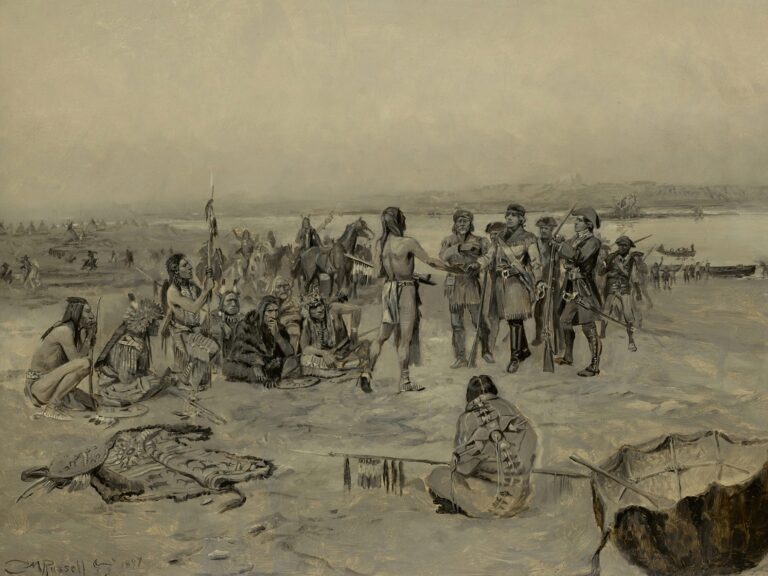
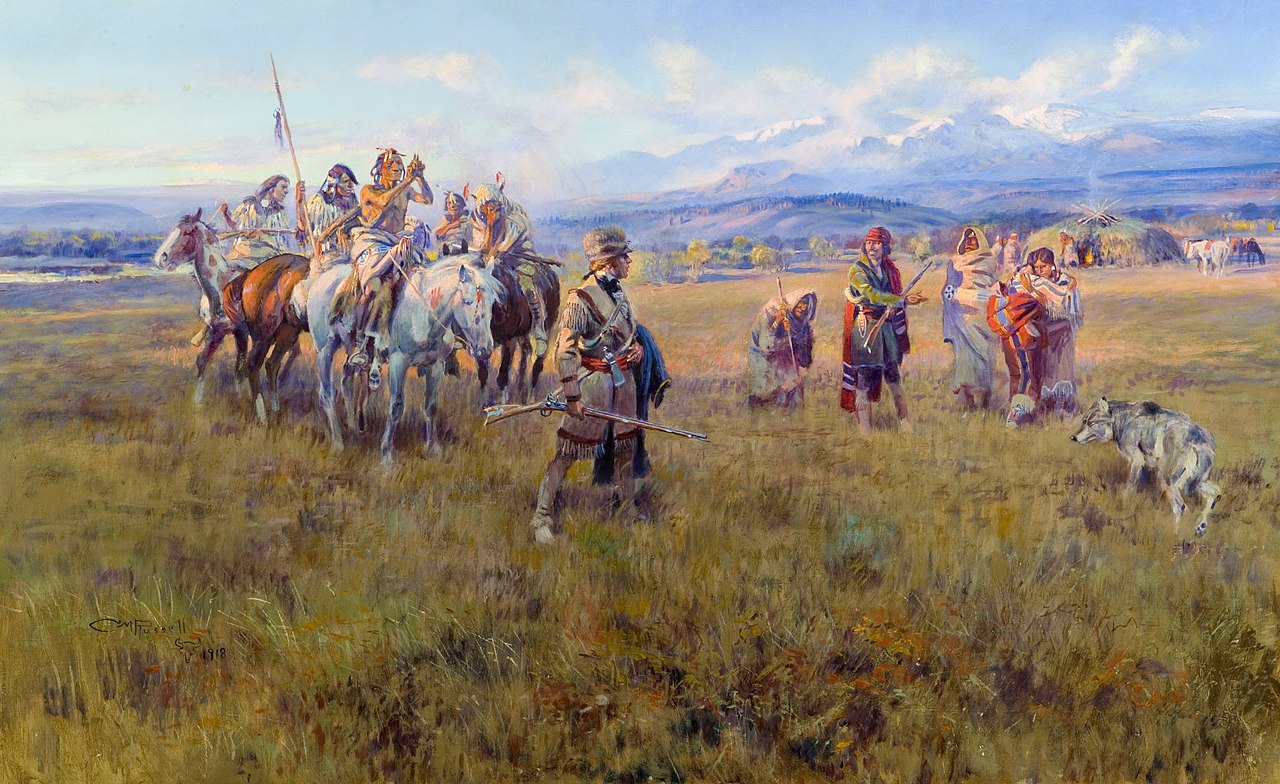
Russell’s oil depicts the August 1805 encounter between Meriwether Lewis and a band of Lemhi Shoshone in the mountain country near the Continental Divide, at the headwaters of the Missouri in present-day Idaho-Montana borderlands. Lewis stands at left in his blue captain’s coat, hand extended, with two members of his advance party behind him. The Shoshone, mounted and on foot, occupy the right and center of the composition, their leader Cameahwait approaching to meet the captain. Russell sets the figures against an open, high-altitude landscape of pale grass and distant blue ridges, the kind of sparse mountain valley the expedition crossed in search of horses to carry them over the Bitterroots. The handling is loose, the palette dominated by tans, dusty greens, and the bright accent of the captain’s coat.
The meeting Russell paints was one of the most consequential of the expedition. Lewis had pressed ahead of Clark’s main party to find the Shoshone, knowing that without their horses the Corps of Discovery could not portage its baggage west across the mountains before winter. The encounter also produced one of the journey’s most improbable reunions: when Sacagawea was brought forward to interpret a few days later, she recognized Cameahwait as her brother. Russell painted the subject in 1903, during the period leading up to the 1904–1906 centennial of the expedition, when popular interest in Lewis and Clark imagery surged and artists including Edgar S. Paxson and Olaf Seltzer were producing major canvases on the same themes.
Russell (1864–1926) had lived in Montana since 1880 and built his reputation on cowboy and Plains Indian subjects drawn from direct observation; by 1903 he was working steadily out of his Great Falls studio and beginning the period of his strongest mature oils. His Lewis and Clark pictures, produced intermittently over two decades, are among the most frequently reproduced visualizations of the expedition, in part because Russell knew the Montana terrain the Corps had traversed. The painting is in a private collection. Its image has circulated in expedition histories, centennial publications, and exhibitions devoted to Russell’s historical subjects.