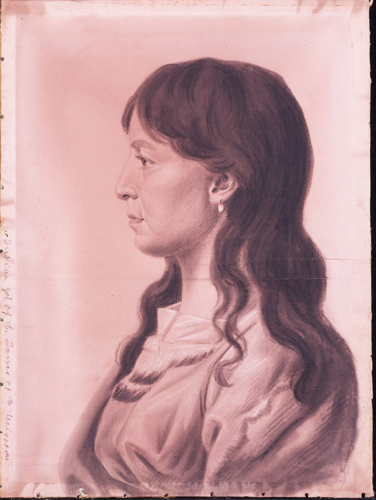
Yellow Corn, Wife of Sheheke
Charles Balthazar Julien Fevret de Saint-Mémin’s 1807 profile portrait of Yellow Corn depicts the Mandan wife of Chief Sheheke (Big White) in strict left profile, rendered life-size in black and white chalk on tinted paper. Saint-Mémin used his characteristic physiognotrace technique, a mechanical drawing device that traced a sitter’s silhouette to scale, which the artist then finished by hand with chalk and crayon to add facial features, hair, and clothing detail. Yellow Corn is shown with her dark hair parted at the center and falling loose, wearing a hide garment with visible decoration at the shoulder. The clean profile, neutral ground, and absence of narrative setting are typical of Saint-Mémin’s portrait practice.
The drawing was made during Sheheke and Yellow Corn’s visit to the eastern United States in 1806–1807. Lewis and Clark had persuaded Sheheke to travel from the Mandan villages on the upper Missouri to meet President Jefferson, and the chief brought his wife and son along with the interpreter René Jusseaume and his family. After meeting Jefferson in Washington in late December 1806, the party traveled through Philadelphia, Baltimore, and other eastern cities. Saint-Mémin, then working in Washington and surrounding cities, drew Sheheke, Yellow Corn, and several other Native delegates connected to the expedition’s diplomatic aftermath. Their return west proved difficult: a first attempt to escort Sheheke home in 1807 was turned back by Arikara hostility, and he did not reach the Mandan villages until 1809.
Saint-Mémin (1770–1852) was a French émigré who fled the Revolution and supported himself in America by producing physiognotrace profiles of statesmen, military officers, and visiting Native leaders before returning to France in 1814, where he later directed the Musée de Dijon. His Native American portraits from 1804–1807 are among the earliest reliable likenesses of Plains and Missouri River people drawn from life, predating the work of Charles Bird King, George Catlin, and Karl Bodmer by decades. The portrait of Yellow Corn is held by the New-York Historical Society as part of its Saint-Mémin holdings and has been reproduced regularly in scholarship on the Lewis and Clark Expedition and on early Euro-American depictions of Mandan culture.