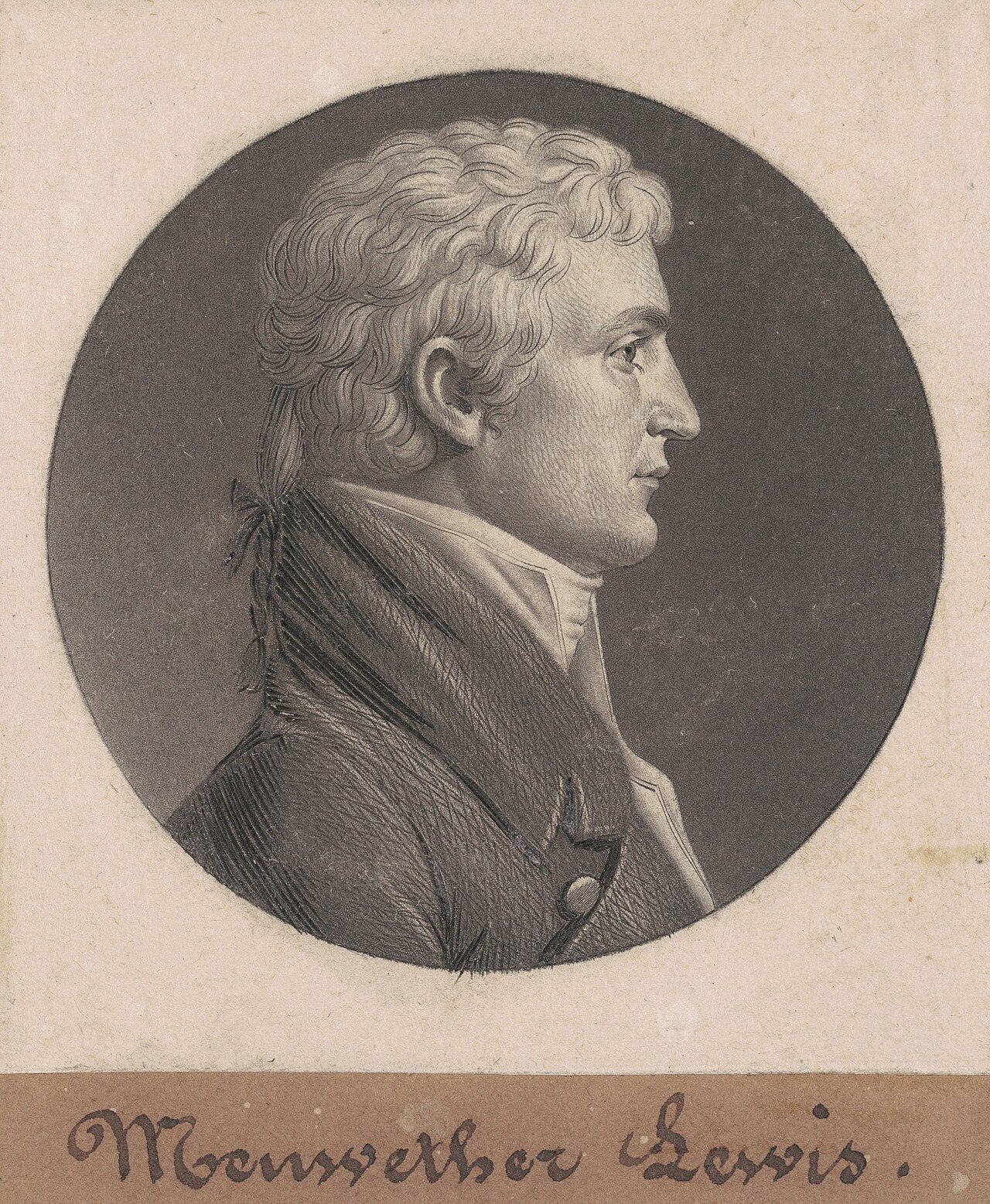
Meriwether Lewis (Profile Portrait)
This small engraving by Charles Balthazar Julien Févret de Saint-Mémin presents Meriwether Lewis in strict left profile, a format the artist used for nearly all his American sitters. Lewis appears bust-length against a plain ground, his hair tied back in the late-Federal style, wearing a dark coat with a high collar and white stock. The likeness is spare and linear, with the precise contour Saint-Mémin achieved through his standard working method: a life-size profile drawn in black and white crayon with the aid of a physiognotrace, then reduced to a small copperplate roundel and printed in multiples. The result has the cool factuality of a documentary record rather than the warmth of a painted portrait.
Saint-Mémin made portraits of Lewis around the time of the expedition, most likely in Washington or Philadelphia between 1803 and 1807. Lewis sat for the artist before departing west in 1803 and again after his return in 1807, when he was lionized as a national figure and used Saint-Mémin’s services partly to document Native American delegates he had brought east. The profile engravings circulated as inexpensive keepsakes, the period’s equivalent of a calling-card photograph, and their flat factual style suited a culture that prized Neoclassical restraint and physiognomic accuracy.
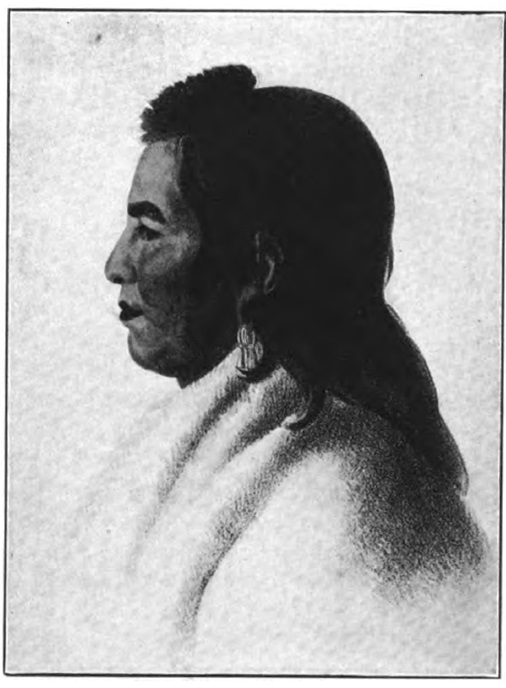
Saint-Mémin, a French émigré who had fled the Revolution, worked in the United States from 1793 to about 1814 and produced roughly 800 of these profile portraits, constituting one of the most complete visual registers of the early American republic. His sitters included Thomas Jefferson, members of Congress, military officers, and the Osage and Mandan delegates Lewis escorted to Washington. The Lewis profile is one of the few contemporary likenesses of the explorer taken from life and has been reproduced repeatedly in biographies, expedition histories, and exhibitions, including the bicentennial-era displays mounted between 2003 and 2006. Impressions are held by several American institutions; the example credited here belongs to the National Gallery of Art in Washington. Together with Charles Willson Peale’s portraits, the Saint-Mémin profile has shaped the standard visual image of Lewis in the historical-memory tradition.