Sheheke (Big White), Mandan Chief
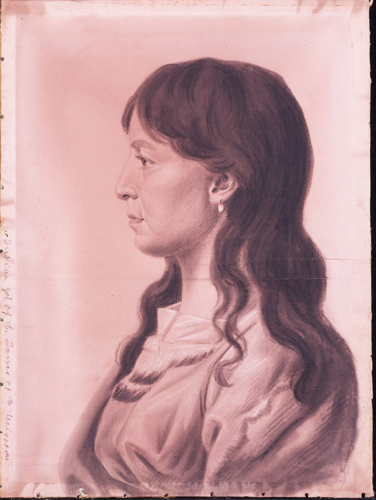
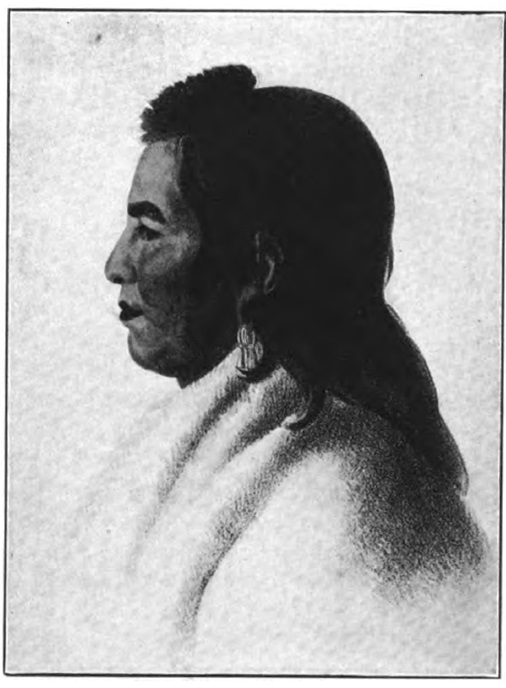
This life-size profile portrait shows Sheheke, the Mandan chief known to Americans as Big White, rendered in chalk and crayon against a plain ground. Saint-Mémin used his customary physionotrace method, mechanically tracing the sitter’s profile to produce a precise outline before working up the head in soft chalks. Sheheke is shown facing left, his features carefully modeled, with indications of his hair and a robe or wrap around the shoulders. The format is severe and classicizing, the head dominating the sheet with little ornament, in keeping with Saint-Mémin’s portraits of Washington-era statesmen and military officers.
The portrait dates to 1807, when Sheheke traveled east in the company of Lewis and Clark following the expedition’s return to St. Louis in September 1806. The chief had accepted the captains’ invitation, made at the Mandan villages on the upper Missouri in the summer of 1806, to meet President Jefferson in Washington. Sheheke, his wife Yellow Corn, and their son, accompanied by the interpreter René Jusseaume and his family, met Jefferson late in 1806 and then continued to Philadelphia, where Saint-Mémin was working. Returning Sheheke safely to the Mandans proved difficult: an 1807 military escort under Nathaniel Pryor was turned back by the Arikara, and the chief did not reach home until 1809, by which time his prolonged absence had eroded his standing among his people.
Saint-Mémin, a French émigré aristocrat who fled the Revolution, established a portrait practice in the United States between 1793 and 1814, producing roughly 800 profile likenesses of the early republic’s political and social class. His sitters from the Lewis and Clark circle include Meriwether Lewis himself and several Osage delegates, making this group among the earliest reliable portraits of Native and expedition figures drawn from life. The Sheheke portrait is held by the New-York Historical Society, which acquired a substantial body of Saint-Mémin’s work. It remains the principal visual record of the Mandan chief and is reproduced in nearly every scholarly and popular account of the expedition’s diplomatic aftermath.