Meriwether Lewis
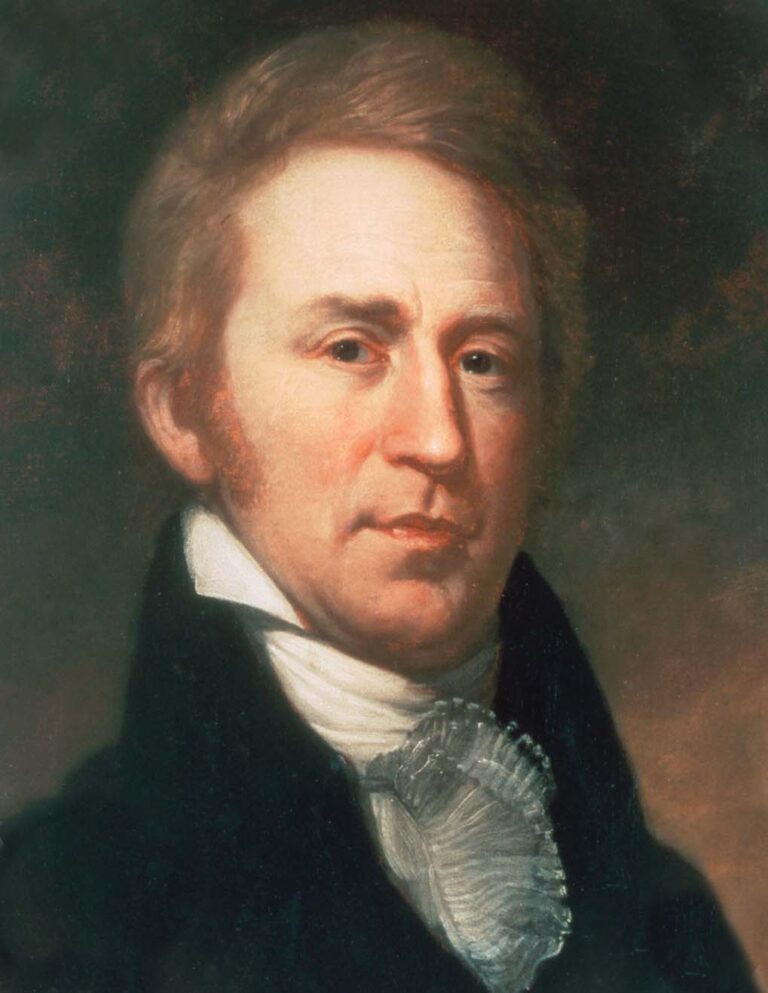
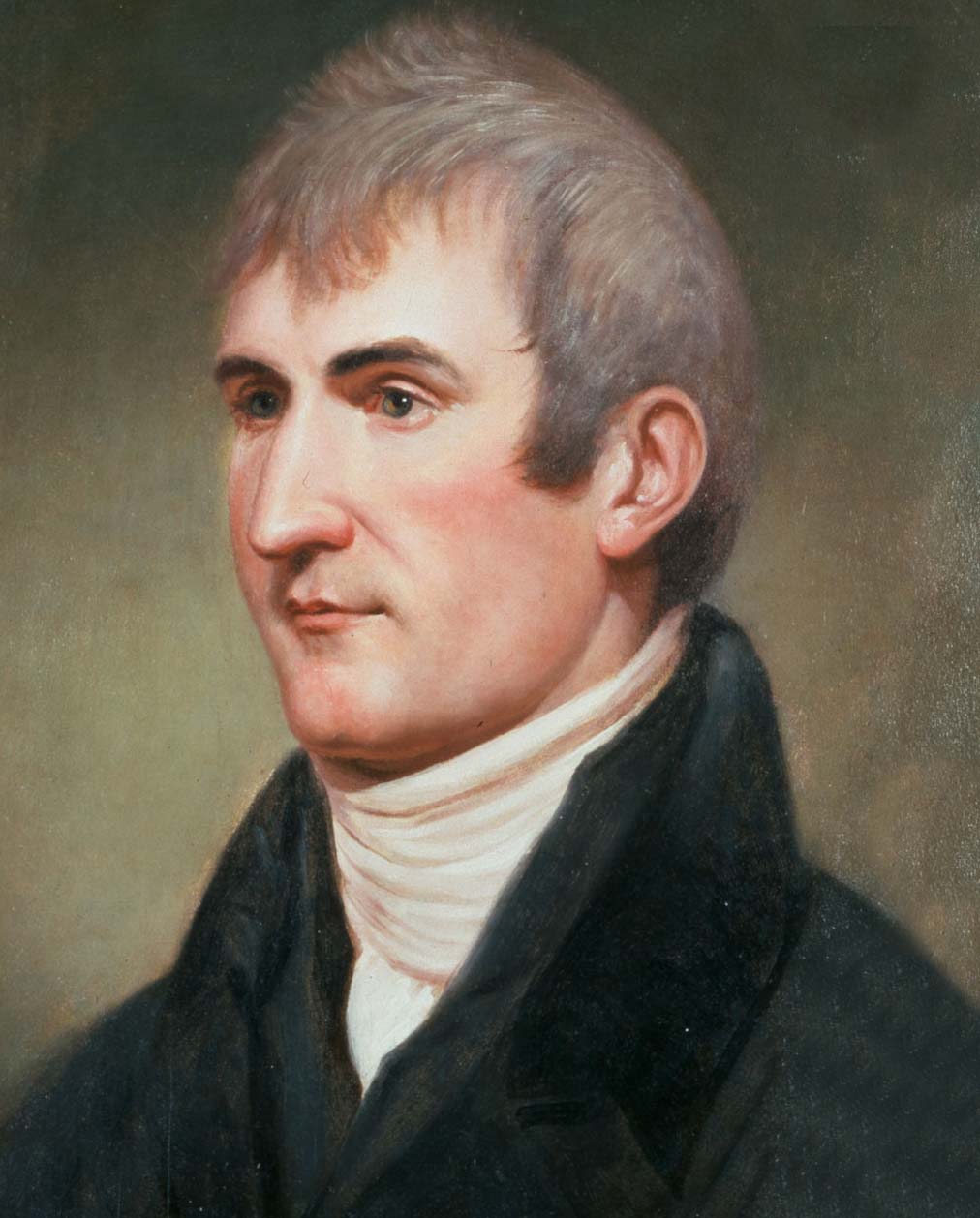
Charles Willson Peale’s portrait shows Meriwether Lewis from the chest up, turned slightly to the viewer’s right against a plain dark background. Lewis wears civilian dress: a dark coat over a high-collared white shirt and cravat, with his hair brushed forward in the Federal-era style. The treatment is straightforward bust-length portraiture in the neoclassical mode Peale favored for his sitters, with even lighting on the face, restrained color, and minimal accessory detail. There is no military regalia, no expedition iconography, and no landscape; the focus is entirely on the likeness of the face.
Peale painted Lewis in 1807, the year after the Corps of Discovery returned from the Pacific. Lewis had reached St. Louis in September 1806, traveled east to a public reception, and by 1807 was preparing his expedition journals for publication while serving as governor of the Louisiana Territory. The portrait was made for Peale’s Philadelphia Museum, where the artist was assembling a gallery of portraits of distinguished Americans. William Clark sat for a companion portrait the following year. Peale, who had also accepted expedition specimens and Native American artifacts for display in his museum, treated the two captains as figures of national scientific as well as political importance.
Charles Willson Peale (1741–1827) had by this point spent more than three decades painting the leadership class of the early Republic, including multiple sittings with Washington, Jefferson, and Franklin. The Lewis portrait belongs to his late museum series, in which the conventions of state portraiture were adapted to a more documentary purpose. The painting is held by Independence National Historical Park in Philadelphia, which inherited a substantial portion of the Peale Museum collection after the museum’s dissolution in the mid-nineteenth century and the dispersal of its holdings. Together with Peale’s portrait of Clark, the image has served as the standard visual reference for Lewis in textbooks, exhibitions, and commemorative materials throughout the bicentennial period and remains the most frequently reproduced likeness of the explorer.