Lewis and Clark Reach Shoshone Camp Led by Sacajawea the “Bird Woman”
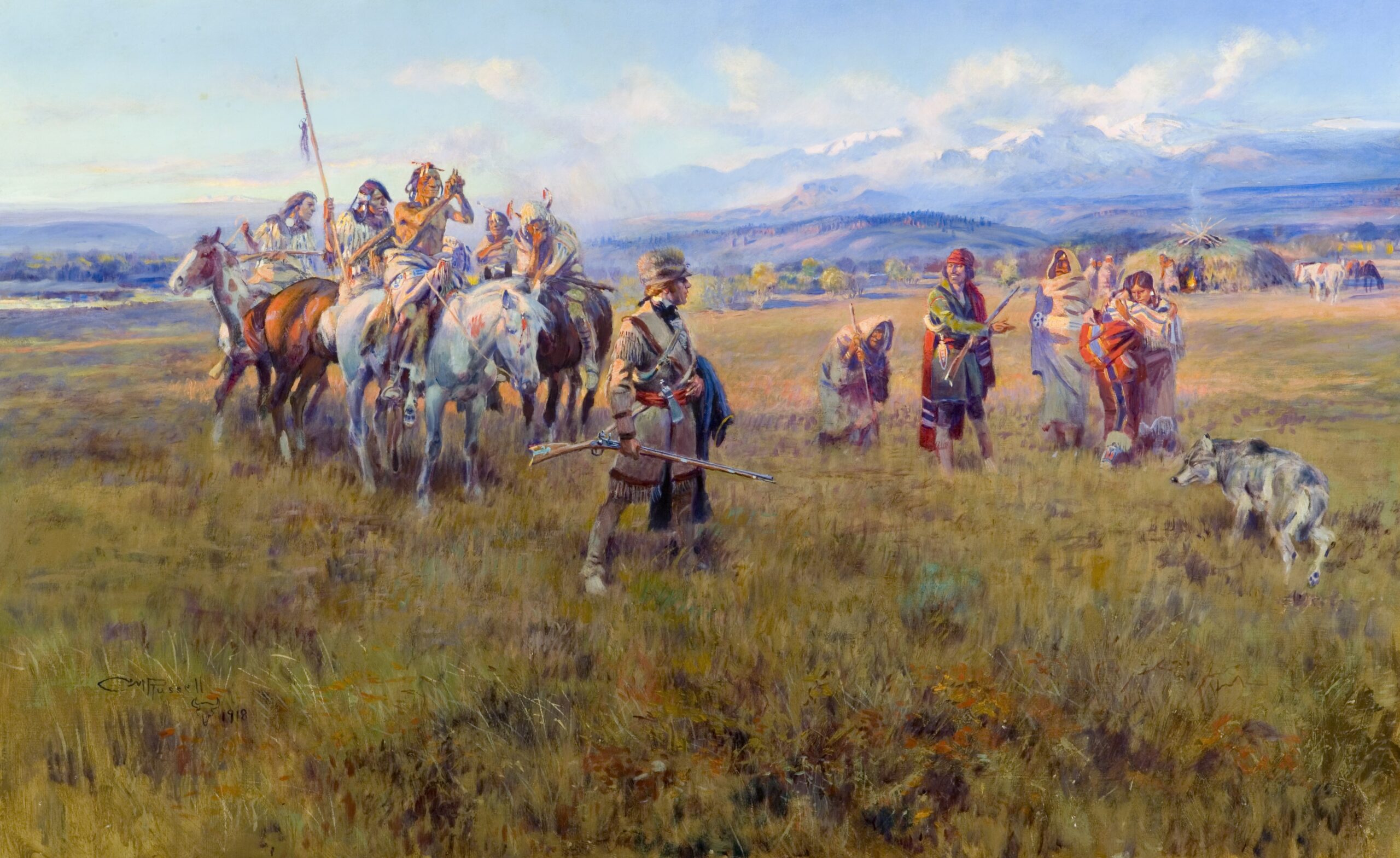
Russell’s painting depicts the meeting between the Corps of Discovery and a Shoshone band on August 17, 1805, in the Lemhi River valley of present-day Idaho. Sacagawea stands at center, her arm raised in a gesture of recognition and greeting, dressed in fringed hide with a red trade blanket draped behind her. Lewis and Clark appear at left in their weather-worn expedition coats, while Shoshone men on horseback gather at right against a backdrop of sagebrush flats and the Bitterroot foothills. Russell composes the scene in a wide horizontal format that emphasizes the open Western landscape, using the warm earth palette and loose, atmospheric brushwork typical of his mature oils. Sacagawea is the pivot of the composition—the moment shown is the instant before she recognized the band’s chief, Cameahwait, as her brother, a recognition that secured the horses the expedition needed to cross the Continental Divide.
Russell painted the work in 1918, late in a career devoted almost entirely to Western subjects. By this point he had moved beyond his cowboy genre scenes toward more ambitious historical compositions, and the Lewis and Clark Expedition occupied him repeatedly in his final two decades. The painting belongs to a cluster of Russell works—including the 1905 watercolor of Lewis and Clark on the Lower Columbia and the 1912 mural Lewis and Clark Meeting the Flathead Indians for the Montana State Capitol—that established his interpretation of the expedition as a story of Native facilitation rather than conquest. The emphasis on Sacagawea reflected a broader early-twentieth-century rediscovery of her role, which had been amplified by Eva Emery Dye’s 1902 novel The Conquest and the suffrage-era monuments that followed.
Russell, born in Missouri in 1864 and largely self-taught, spent his working life in Montana and drew on decades of firsthand observation of the northern plains, its peoples, and its light. The painting is held by the Gilcrease Museum in Tulsa, assembled by oilman Thomas Gilcrease, whose collection of Russell oils is among the most substantial in any public institution. The work remains one of the most reproduced images in the Lewis and Clark visual tradition, particularly in publications focused on Sacagawea’s role in the expedition.