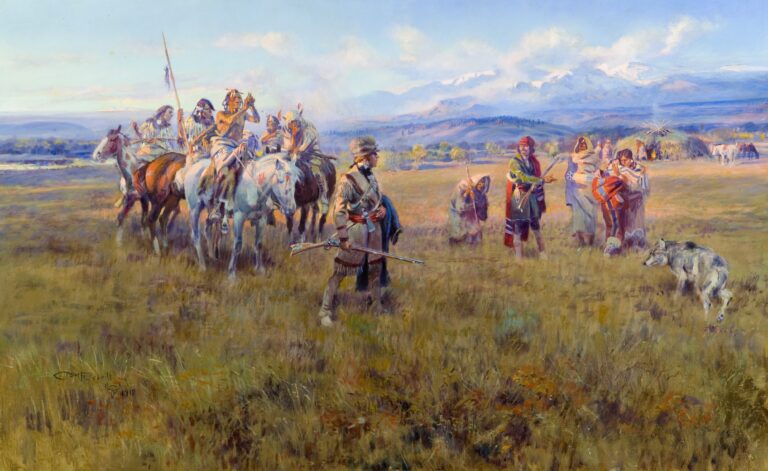
Running Fight Between Crees and Blackfeet, Old Style Warfare
Russell’s watercolor depicts a mounted skirmish between Cree and Blackfeet warriors on the open plains. Figures on horseback are arranged in a loose diagonal across the sheet, some firing rifles from the saddle, others wielding lances or bows as their horses gallop at full stretch. Russell uses graphite underdrawing to establish the anatomy of horses and riders, then washes in color to differentiate the two groups by their dress, weapons, and horse trappings. The palette is restrained—earth tones for the prairie, blue and grey for the distant sky—with brighter accents on shields, feathered headgear, and painted ponies. Dust kicked up by the running horses softens the middle distance, a device Russell used repeatedly to convey speed across flat country.
The subtitle “Old Style Warfare” signals Russell’s intent to record intertribal combat as it had been waged before the consolidation of the reservation system, when raiding and counter-raiding between Cree bands from the north and Blackfeet on the northwestern plains were ongoing features of life on the upper Missouri and Saskatchewan drainages. By 1895, when Russell made the painting, those running fights were a generation in the past. He was thirty-one and had been living in Montana since 1880, first as a wrangler and then increasingly as a working artist; he had spent the winter of 1888–89 with the Blood (Kainai) Blackfeet in Alberta, an experience that shaped his lifelong attention to Blackfeet material culture and to the horse cultures of the northwestern plains more broadly. Watercolors of this period helped him transition from illustrator to recognized painter of the West.
Russell (1864–1926) produced thousands of works ranging from quick sketches to large oils, and intertribal combat scenes form a recognizable subset within his output, distinct from his cowboy subjects and his Lewis and Clark paintings of the early twentieth century. The present sheet bears the credit line of the Amon G. Carter Collection and entered the holdings of the Amon Carter Museum of American Art in Fort Worth, the institution Carter’s collection seeded, which holds one of the most comprehensive groups of Russell’s works on paper. Its current location is not recorded in the available documentation.