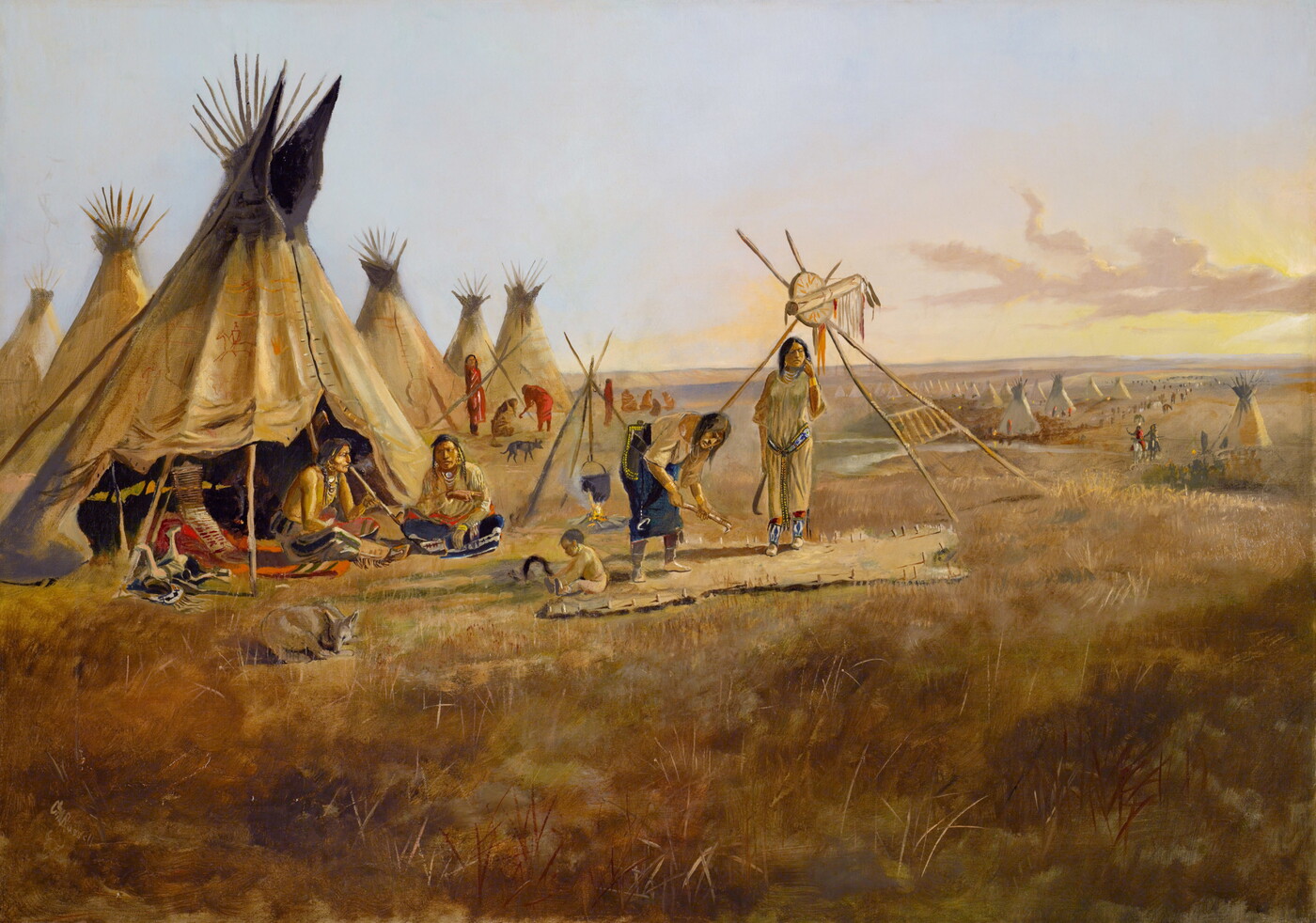
Indian Family with Travois
Russell’s watercolor depicts a Plains Indian family in transit, their belongings lashed to a travois — the A-frame drag sled made of lodgepoles harnessed to a horse or dog. The composition is horizontal, suited to the lateral movement of a traveling group across open country. A mounted figure leads or accompanies the procession, while the travois itself carries bundled goods and likely a child or elder. Russell renders the scene in transparent watercolor with graphite underdrawing, a combination he favored for working studies and finished sheets alike. The palette is restrained — earth tones for the figures and animals, washes of pale ground and sky — and the draftsmanship emphasizes the angular geometry of the travois poles against the rounded forms of horse and rider.
By 1897 Russell had been working in Montana for roughly seventeen years, having come west from St. Louis in 1880 as a teenager. He spent the 1880s as a wrangler and night herder in the Judith Basin, where he observed Blackfeet, Crow, and Cree camps firsthand and lived for a period among the Blood Blackfeet in Alberta in 1888. By the mid-1890s he had given up cowboying entirely for full-time painting, and subjects of Native domestic and travel life — as distinct from battle scenes or hunts — became a sustained interest. Travois imagery recurs throughout his work because the device condensed everything that interested him about pre-reservation Plains mobility: the horse culture, the movable lodge, the household on the march.
Russell (1864–1926) is the central figure in the Montana school of Western art and, with Frederic Remington, one of the two artists most responsible for shaping popular visual memory of the northern Plains. The sheet entered the collection of Amon G. Carter, the Fort Worth publisher and oilman whose Russell and Remington holdings became the founding core of the Amon Carter Museum of American Art when it opened in 1961. Although this watercolor does not illustrate a Lewis and Clark Expedition episode directly, Russell was the principal twentieth-century painter of Corps of Discovery subjects, and his ethnographic studies of travois transport inform the visual vocabulary later applied to expedition scenes such as his Montana statehouse mural and the Sacagawea paintings of the early 1900s.