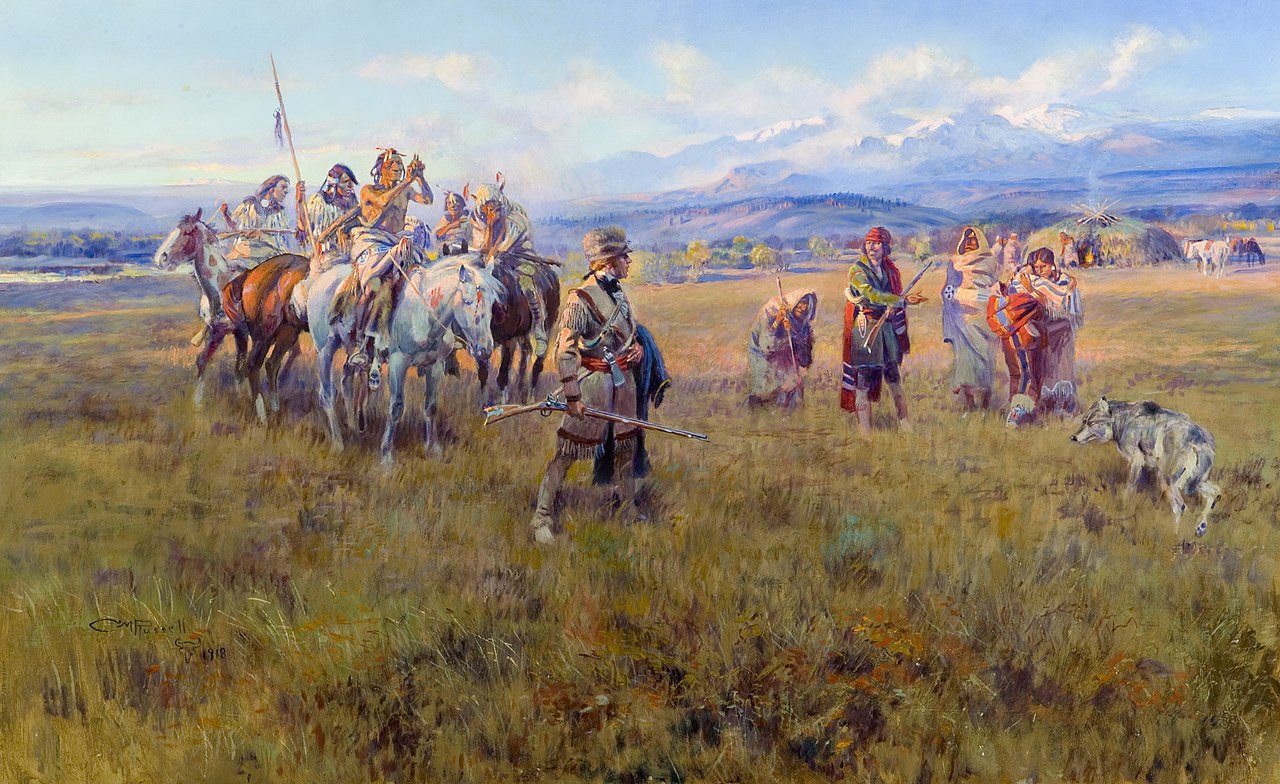
Lewis and Clark Reach Shoshone Camp
Russell’s oil depicts the moment in mid-August 1805 when the Corps of Discovery met the Lemhi Shoshone near the Continental Divide in present-day Idaho. The composition is built around the encounter on horseback: Shoshone riders, including the chief Cameahwait, gather in the foreground at left, while Lewis and his small advance party approach from the right. Sacagawea, recognizable for her central role in the negotiation, occupies the middle of the canvas as interpreter between the two groups. Russell sets the scene in an open sage valley with the Bitterroot or Beaverhead ranges rising in the background, painted in his characteristic palette of dusty greens, ochres, and cool blue-gray mountains. The handling is loose and atmospheric, with figures defined more by silhouette and gesture than by fine detail.
The meeting was strategically decisive for the expedition. Without horses to cross the mountains before winter, Lewis and Clark needed Shoshone cooperation, and the chance recognition between Sacagawea and Cameahwait — by most accounts her brother — secured the trade. Russell painted the subject in 1918, late in a career increasingly devoted to historical scenes of the northern plains and Rockies. By that date he had been working from his Great Falls, Montana studio for years, and the Lewis and Clark narrative was a recurring subject; he had already produced the larger mural Lewis and Clark Meeting the Flatheads (1912) for the Montana State Capitol, along with several watercolors and pen sketches of expedition episodes.
Russell (1864–1926) came to Montana as a teenager in 1880 and worked as a wrangler and night herder before turning fully to painting in the 1890s. His expedition pictures are notable within the Lewis and Clark visual tradition for foregrounding Native participants rather than treating them as scenery, a tendency rooted in his long contact with Blackfeet, Cree, and other Plains communities. Lewis and Clark Reach Shoshone Camp is held by the Gilcrease Museum in Tulsa, whose founder Thomas Gilcrease assembled one of the largest Russell collections in the country during the 1940s and 1950s. The painting is regularly reproduced in survey literature on the expedition’s bicentennial-era historiography.
Scene Location
Lemhi Pass area, Idaho/Montana border