Indians Discovering Lewis and Clark
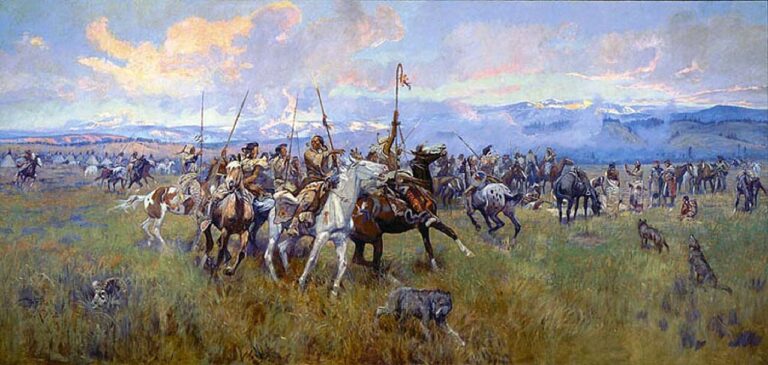
Russell’s painting presents the encounter from the Native perspective, a compositional choice that distinguishes it from most expedition imagery of its era. Mounted Plains Indian scouts occupy the foreground on a rise of open prairie, their horses gathered as the riders look down toward the small, distant figures of the Corps of Discovery moving across the plain below. The viewer stands behind the Indians, sharing their vantage and their moment of assessment. Russell handles the scene with the loose, atmospheric brushwork he favored in his oils of the 1890s, with the broad sweep of grassland and sky given as much weight as the human figures. The expedition party itself is rendered small and almost incidental, a column of strangers seen across a great distance.
The painting dates to 1896, when Russell was in his early thirties and working from his studio in Cascade, Montana, before his move to Great Falls and his rise to national prominence. By this point he had spent more than fifteen years in Montana, much of it among the Blackfeet and other northern Plains peoples, and he had developed a working knowledge of their material culture and horsemanship that informed his Indian subjects. The scene does not illustrate a specific documented moment from the journals, but rather the broader fact, repeated throughout 1804–1806, that the Corps was observed by Native scouts long before any formal meeting took place. Russell returned to Lewis and Clark subjects throughout his career, treating them as Montana history rather than national epic.
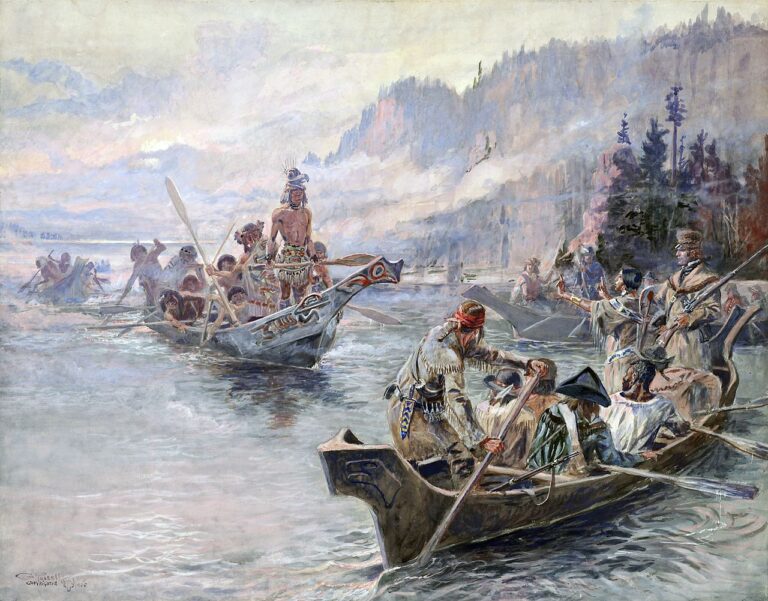
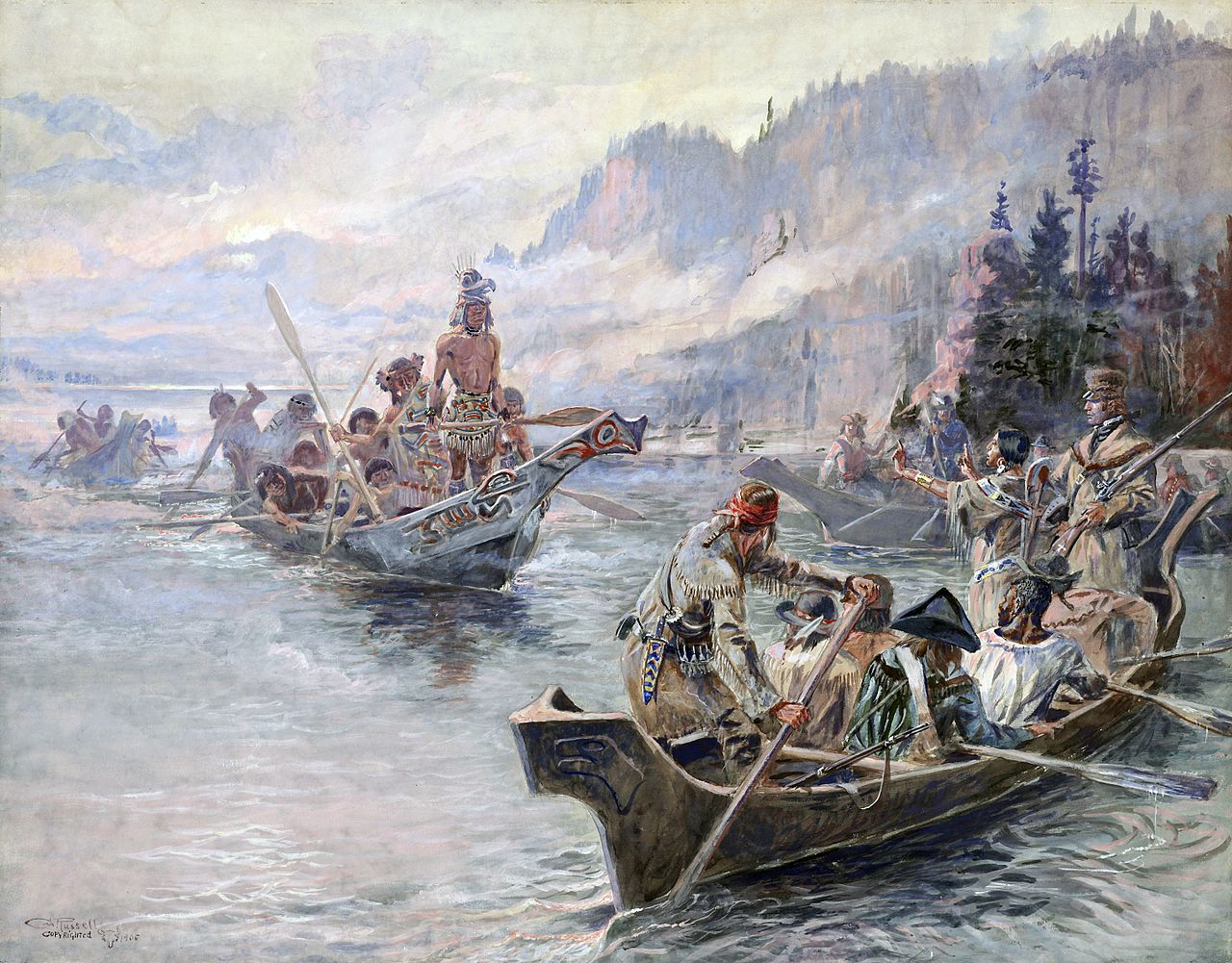
Russell (1864–1926) is the central figure in the Lewis and Clark visual tradition along with Edgar S. Paxson and, later, Olaf Seltzer. His insistence on placing Indians at the center of expedition imagery, and on showing the Corps as observed rather than observing, anticipates his better-known later treatments of the subject, including the 1905 watercolor of the same general theme and the 1912 mural Lewis and Clark Meeting the Flathead Indians in the Montana State Capitol. The 1896 oil remains in private hands. Its image circulates widely through public-domain reproductions and has been used frequently in Lewis and Clark scholarship to illustrate the Native viewpoint on first contact.
Scene Location
Upper Missouri River, Montana