Captain William Clark Meeting Indians of the Northwest
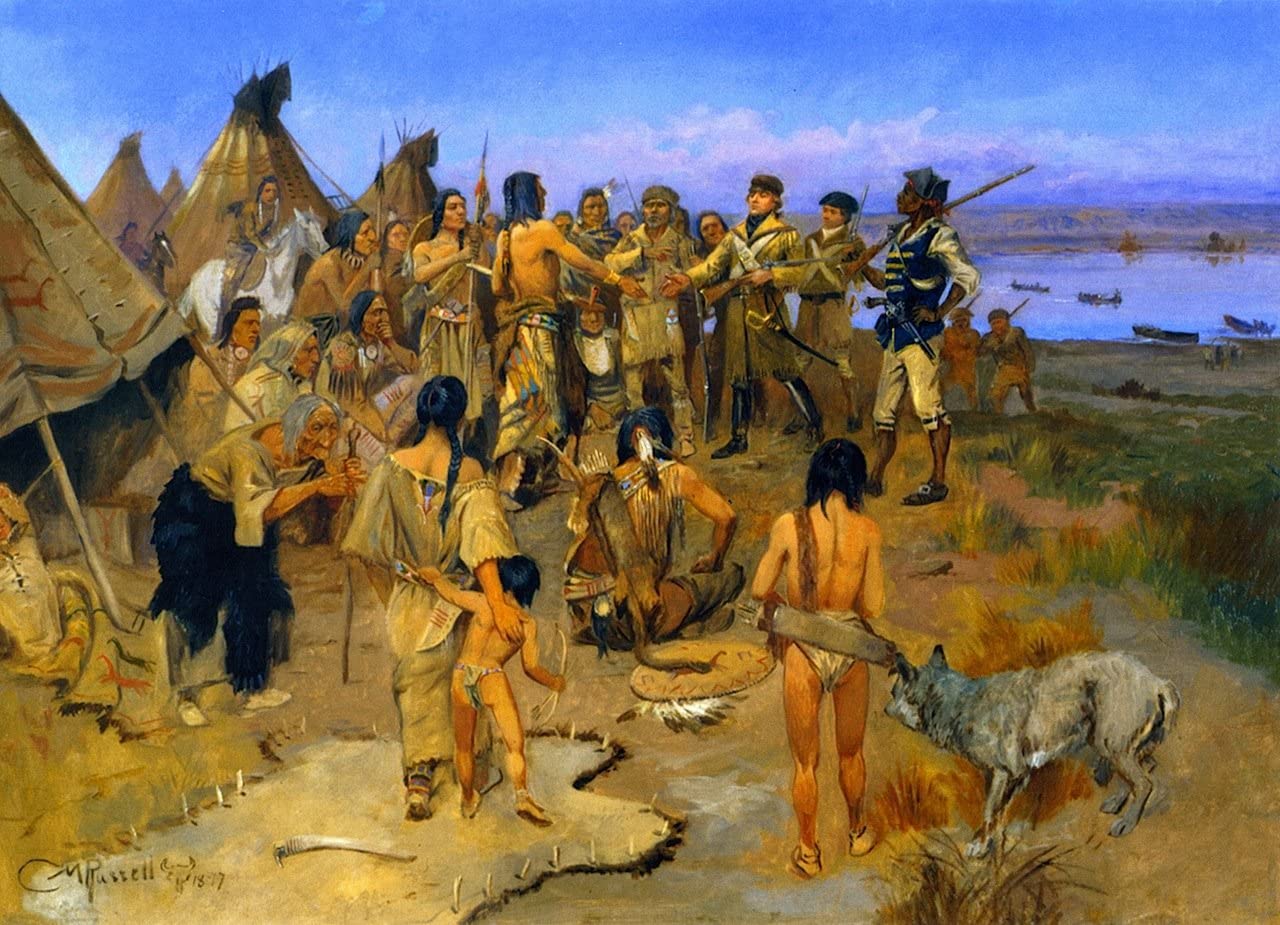
Russell’s painting shows Captain William Clark in a moment of formal encounter with a group of Northwest Indians, likely Chinookan or Salish peoples encountered during the expedition’s passage through the Columbia River drainage in late 1805 or early 1806. Clark stands at left in a dark coat and tricorne-style hat, his hand extended in a gesture of greeting toward seated and standing Indigenous figures arranged across the foreground. Several Native men hold trade goods or weapons, and one figure in a conical woven hat — a form characteristic of Lower Columbia peoples — occupies the center of the composition. The setting is an open riverside or coastal landscape with dim, overcast atmospherics typical of the Pacific Northwest. Russell paints the scene in his characteristic looser oil technique, with broad treatment of ground and sky and tighter modeling reserved for figures, clothing, and ethnographic detail.
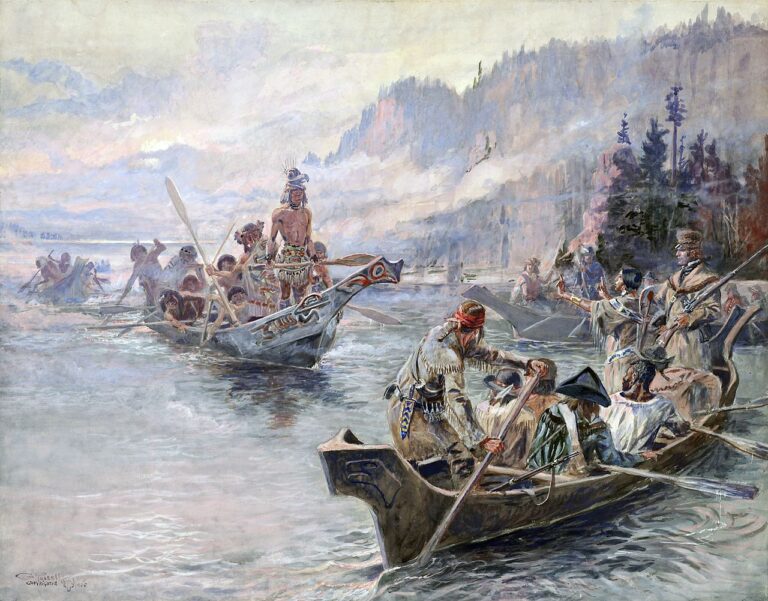
The work was completed in 1897, a productive period in which Russell was moving from informal cowboy painter to a more deliberate documentarian of frontier history. By the mid-1890s he had begun receiving steady commissions and exhibiting in Montana and beyond, and Lewis and Clark subjects suited both his interest in Indian cultures and a growing public appetite for narrative history paintings as the centennial of the expedition approached. Russell painted several Lewis and Clark scenes over his career, most famously the 1905 mural “Lewis and Clark Meeting the Flathead Indians” and the later “Lewis and Clark on the Lower Columbia.” This 1897 canvas is among the earliest of his treatments of the Corps of Discovery.
Charles Marion Russell (1864–1926) settled in Montana as a teenager and built his reputation on direct observation of cowboy and Plains Indian life, which he supplemented with research for historical subjects. The painting is held by the Sid Richardson Museum in Fort Worth, Texas, whose collection — assembled by oilman Sid W. Richardson in the mid-twentieth century — concentrates on Russell and Frederic Remington and constitutes one of the major public holdings of Russell’s work. The image has been reproduced in studies of Russell’s historical paintings and in Lewis and Clark visual histories, where it figures among the artist’s early efforts to picture the expedition’s Western encounters.