Lewis and Clark at Three Forks
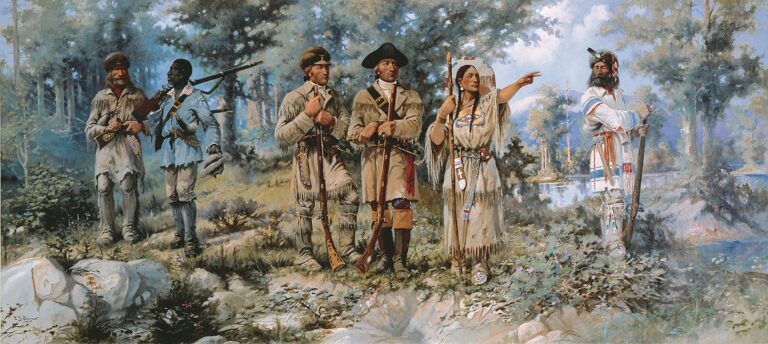
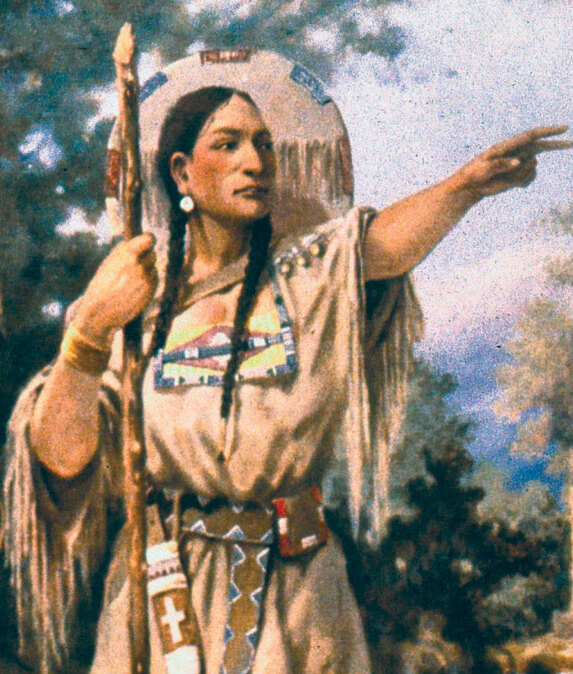
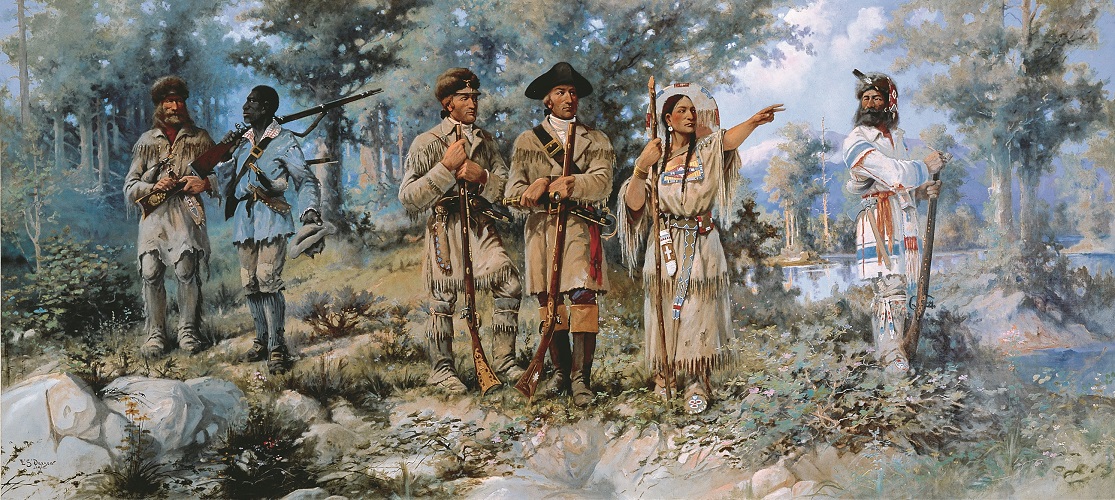
Paxson’s mural shows the Corps of Discovery at the headwaters of the Missouri River in present-day southwestern Montana, where the Jefferson, Madison, and Gallatin rivers converge. The composition centers on Meriwether Lewis and William Clark in conference with Sacagawea, who gestures toward the surrounding country she recognized from her childhood before her Hidatsa captivity. Expedition members occupy the middle ground with canoes, packs, and rifles, while the Tobacco Root and Madison ranges rise in the distance. Paxson worked in oil on a canvas more than twelve feet wide, using the bright, clear palette and finely drawn figures that characterized his historical work, with attention to the buckskin garments, trade goods, and Indigenous dress he had studied throughout his career.
The scene depicts events of late July 1805. The expedition reached the Three Forks on July 25, and Lewis named the three branches for President Thomas Jefferson and Secretaries James Madison and Albert Gallatin. Sacagawea identified the area as the place where, roughly five years earlier, a Hidatsa raiding party had captured her—information that helped the captains decide to follow the Jefferson River westward in search of her Shoshone relatives, whose horses they needed to cross the Continental Divide. Paxson painted the mural in 1912, during a period when western states were commissioning historical art for new public buildings and when the centennial of the expedition (1804–1806) had renewed national interest in its narrative.
Edgar Samuel Paxson (1852–1919) moved from New York to Montana Territory in 1877 and spent the rest of his life painting the northern Plains and Rocky Mountain West. He is best known for Custer’s Last Stand (1899), a meticulously researched battle scene, and for the six murals he produced for the Montana State Capitol between 1912 and 1914, of which Lewis and Clark at Three Forks is among the most reproduced. The mural remains installed in the Capitol in Helena, where it hangs with the other Paxson panels depicting Montana history. It has been a fixture of Lewis and Clark visual memory in the state for more than a century and is regularly cited in scholarship on Sacagawea’s role in the expedition.
Scene Location
Three Forks, Montana