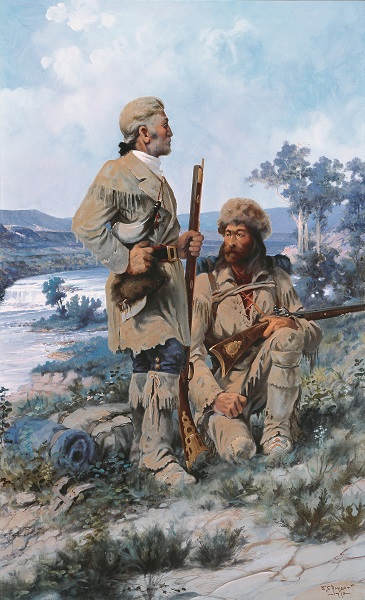
Lewis at Black Eagle Falls
Paxson’s vertical canvas places Meriwether Lewis in the foreground at the edge of Black Eagle Falls, the uppermost cataract of the Great Falls of the Missouri in present-day Montana. Lewis stands in buckskins with his rifle, looking outward across the falling water; cliffs and spray frame the figure, and a dark eagle—the bird that gave the falls its name—appears above the cascade in a cottonwood. The narrow, tall format compresses river, rock, and sky into a single vertical sweep, a compositional choice Paxson often used for the architectural settings of the Montana State Capitol. The handling is tight and illustrative, with crisp drawing of the figure against the more loosely brushed water and stone.
The scene corresponds to Lewis’s reconnaissance of the Great Falls in mid-June 1805. Having pushed ahead of the main party, Lewis reached the principal falls on June 13 and over the following days walked upriver to document the full series of five cascades. Black Eagle Falls, the last he encountered on June 14, took its name from an eagle nesting in a cottonwood on an island at the brink—a detail Lewis recorded in his journal and that Paxson reproduces directly. The discovery confirmed that the expedition had taken the correct fork of the Missouri but also forced the month-long portage that became one of the hardest episodes of the journey west.
Edgar Samuel Paxson (1852–1919) settled in Montana in 1877 and spent his career painting frontier and Native subjects from a base in Missoula. He is best known for “Custer’s Last Stand” (1899), completed after some twenty years of research. In 1912 he received the commission for six murals depicting Lewis and Clark and Montana history for the House and Senate chambers and corridors of the Montana State Capitol in Helena, where this canvas remains installed. The Capitol cycle is the largest and most public body of Paxson’s work, and his Lewis and Clark scenes—painted in the centennial decade following the expedition’s national rediscovery—helped fix the visual iconography of the Corps of Discovery in Montana through the twentieth century.