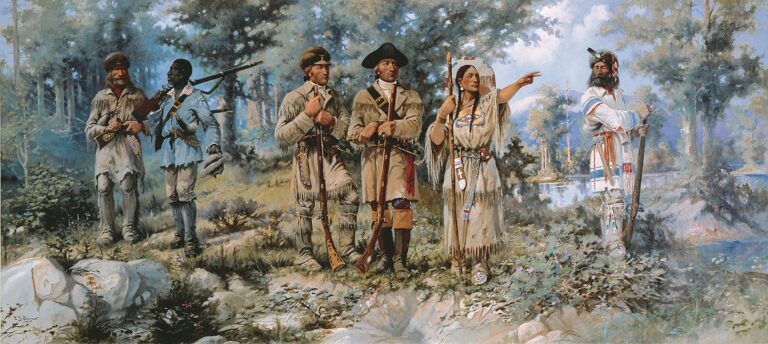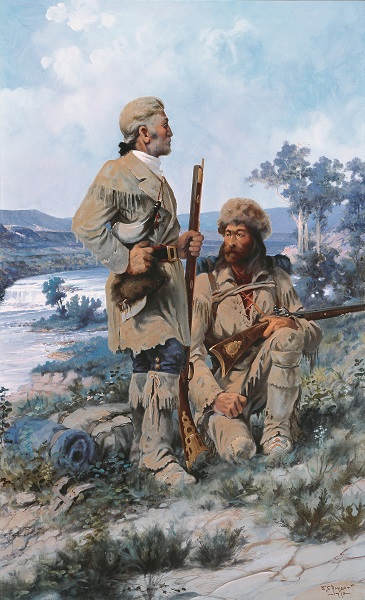
Lewis and Clark at Three Forks (mural detail)
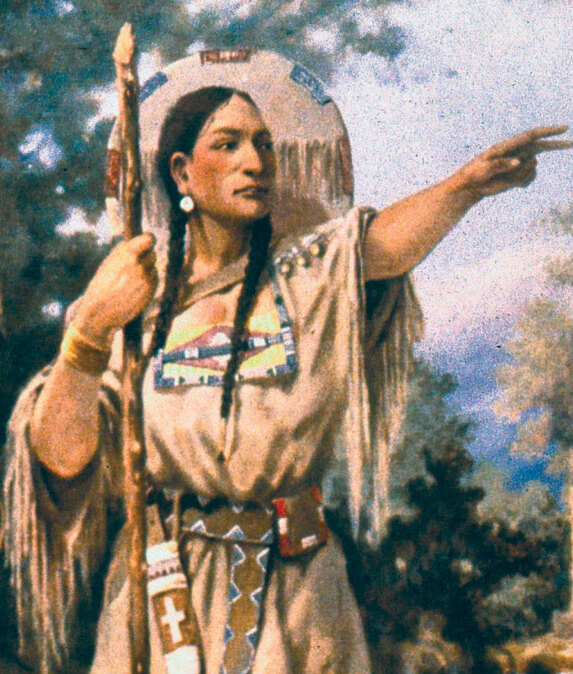
Paxson’s painting depicts Sacagawea at the Three Forks of the Missouri River in southwestern Montana, the headwaters formed by the confluence of the Jefferson, Madison, and Gallatin rivers. The Shoshone woman stands as a central figure in the composition, gesturing toward the surrounding landscape while members of the Corps of Discovery look on. Paxson rendered the scene in oil with the detailed naturalism that characterized his historical work, attending closely to the buckskin clothing of the expedition members, the bundled infant Jean Baptiste on Sacagawea’s back, and the broad valley terrain. The painting functions as a recognition scene: Three Forks was territory Sacagawea knew from childhood, the place where she had been captured by a Hidatsa raiding party around 1800.
The expedition reached Three Forks on July 25, 1805, during the upstream push toward the Continental Divide. Lewis and Clark depended on Sacagawea’s geographic memory to guide them toward her Shoshone relatives, whose horses they needed to cross the Bitterroots. The work was completed in 1912, the same year Paxson finished his cycle of murals for the Montana State Capitol. This commission came at the height of a national fascination with the centennial-era memory of the expedition and amid Montana’s effort to define a state historical identity rooted in frontier subjects.
Edgar Samuel Paxson (1852–1919) moved to Montana in 1877 and built his reputation painting Plains Indian subjects, frontier scenes, and military history, most famously the large 1899 canvas Custer’s Last Stand. His Capitol murals, including Lewis and Clark at Three Forks and Lewis and Clark Meeting the Flatheads at Ross’s Hole, remain among the most reproduced visualizations of the expedition’s Montana passage. Paxson knew the terrain firsthand and consulted survivors and Indigenous informants for details of dress and material culture, though his compositions follow the heroic conventions of his era. The murals remain installed in the House of Representatives chamber and adjoining corridors of the Montana State Capitol in Helena, where they have shaped public imagery of Sacagawea for more than a century, particularly in the regional historical-memory tradition that centers her as guide and interpreter rather than captive or passenger.
Scene Location
Three Forks, Montana