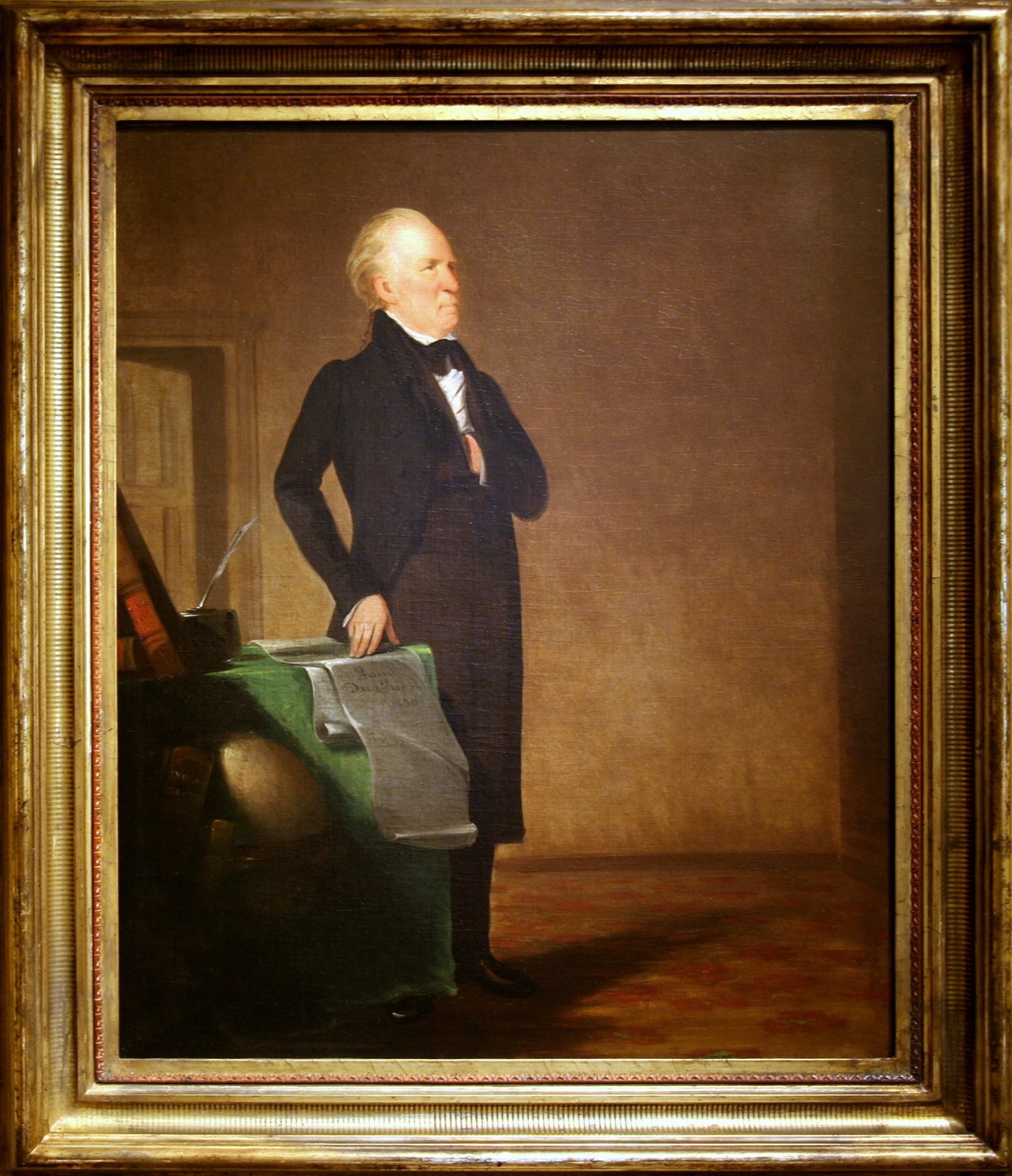
William Clark as Governor of Missouri Territory
Harding’s full-length portrait shows William Clark in middle age, depicted in formal civilian dress rather than military uniform, signaling his transition from frontier soldier to territorial administrator. Clark stands in a three-quarter pose against a darkened ground, with the conventional rhetorical apparatus of early American official portraiture: a column or drapery passage, a table holding documents, and a landscape opening that gestures toward the western country he had spent two decades governing and mapping. The handling is direct and somewhat blunt—Harding was a self-taught painter who worked rapidly, and the canvas shows his preference for solid form and plain modeling over finish or atmosphere. The large scale, nearly eight feet tall, places the picture in the tradition of state and civic portraits intended for public display.
The portrait dates from around 1820, when Clark was serving as Governor of Missouri Territory, an office he had held since 1813 and would continue in until Missouri’s admission as a state in 1821. By this point Clark was also Superintendent of Indian Affairs, headquartered in St. Louis, where he kept a museum of artifacts gathered on the 1804–1806 expedition with Meriwether Lewis and through his subsequent dealings with western tribes. The sitting coincides with Clark’s failed 1820 campaign for governor of the new state of Missouri, a loss generally attributed to his comparatively conciliatory record toward Indian nations.
Chester Harding (1792–1866) had begun painting only a few years earlier and was working his way west through Kentucky and Missouri in search of commissions when he encountered Clark; he would shortly travel to England and become one of the most successful American portraitists of the antebellum period, painting John Marshall, Daniel Webster, and Daniel Boone, among others. The Clark portrait is among the earliest substantial works of his career and one of the few life portraits of Clark as a mature statesman. It is held by the State Historical Society of Missouri in Columbia and has been reproduced widely in biographies and exhibitions concerned with Clark’s post-expedition career, serving as the standard visual reference for Clark in his Missouri years.