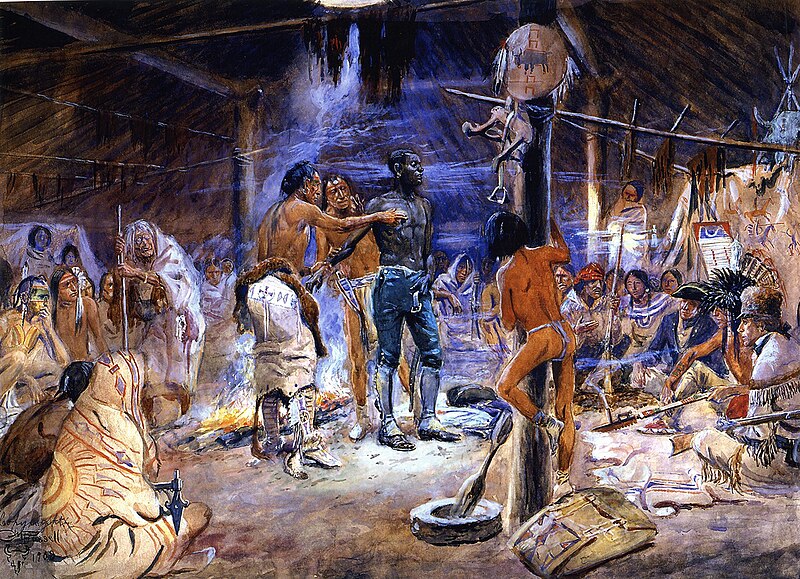
York
York (c. 1770–unknown) was an enslaved African American man owned by William Clark who served as a full working member of the Lewis and Clark Expedition from 1804 to 1806. York was the first African American to cross the continent north of Mexico and participate in an exploration of this magnitude. Throughout the journey, York performed the same duties as other Corps members — hunting, portaging, scouting, and voting on key decisions, including the choice of winter camp at Fort Clatsop. He was a source of great fascination to many Native American nations encountered along the route, particularly the Mandan and Arikara, who had never seen a Black man before. Despite his essential contributions to the expedition's success, York was not granted his freedom upon return. He repeatedly petitioned Clark for his liberty in the years that followed; historical accounts differ on when or whether he was eventually freed. York's story represents both the remarkable achievements and the deep contradictions of the early American republic.
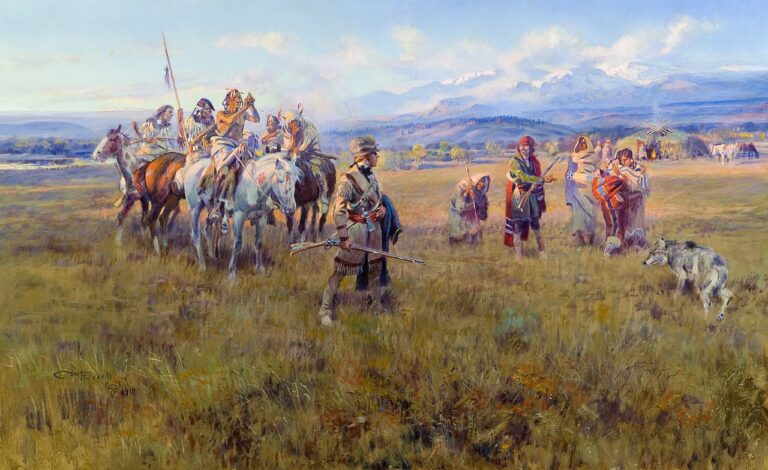
Portrait: Charles Marion Russell, "York" (1908), Montana Historical Society. Public domain.
Related Locations
Note: the longest gap between tagged appearances is about 6 months (Sep 25, 1804 → Apr 1, 1805). York may have been present in the corps during that span but is not named in the journals.
Tent of Many Voices (2)
Journal Entries (43)



Cross-Narrator Analyses
Analyses that cite or discuss York — showing 24 of the most recent matches.
York: The Enslaved Man Who Crossed a Continent
Introduction: A Singular Presence in the JournalsYork appears in the Lewis and Clark journals more often than any other African American of…
A Finished Canoe, an Empty Larder: Four Voices at Camp Chopunnish
The entries of May 26, 1806, capture the Corps of Discovery in suspended motion at Camp Chopunnish along the Clearwater, waiting for…
Arrival at Meriwether’s Bay: Three Voices Approach Winter Quarters
The seventh of December 1805 marks a pivotal logistical moment for the Corps of Discovery: the move from their temporary camp to…
Buffalo Shoals and a Bear on a Rock: Three Voices on a Rainy Descent
The expedition was divided on 30 July 1806, with Lewis and Ordway descending one watercourse and Clark navigating shoals on another as…
Burning Canoes and Empty Kettles at the Clearwater Camp
The entries of John Ordway, Patrick Gass, and William Clark for October 1, 1805 capture a single day at Canoe Camp on…
Buttons, Basilicon, and a Dying Man’s Tomahawk
June 2, 1806, found the Corps of Discovery at Camp Chopunnish on the Clearwater, waiting for the Bitterroot snows to recede. The…
Cows Roots, Sweat Lodges, and a Squawling Bird: Four Voices at Camp Chopunnish
The entries of May 28, 1806, offer a striking case study in how four members of the Corps of Discovery could share…
Drying Out at the End of the Voyage: Three Views of a Pacific Encampment
The expedition's encampment on the south shore of the Columbia, within sight of the breakers, produced three journal entries on November 16,…
Four Pens, One Trail: Departing the Lemhi for the Bitterroot Crossing
The expedition's departure from the Shoshone lodges on August 31, 1805 was recorded by four men whose journals, read side by side,…
News from the States: An Unexpected Encounter with Trader James Aird
The 3rd of September 1806 marks one of the expedition's first substantive reconnections with the wider world it had left more than…
Rain, Spoiling Meat, and a Misplaced Memory at Fort Clatsop
The entries dated December 22, 1805, present a revealing contrast among three expedition narrators. William Clark and John Ordway both record a…
Raising the Roof at Fort Clatsop: Three Views of a Rainy Saturday
December 14, 1805, was a working Saturday at the half-built fort the Corps would soon name for the Clatsop nation. Three narrators…
Reckoning the Continent: Mileage, Manners, and the Chinook Encounter
The entries of November 17, 1805, capture the Corps in a moment of pause along the south shore of the Columbia estuary,…
Salt, Storms, and a Beached Whale: Three Voices at Fort Clatsop
This analysis was generated with AI assistance and reviewed by a human editor.The journal entries dated 28 December 1805 present an unusual…
Saukee Prairie and the Sand in York’s Eye: Three Voices on the Missouri
The expedition's progress on June 20, 1804, along the Missouri near present-day Boonville, Missouri, produced three journal entries that share a common…
Skins, Sickness, and an Iron Boat: Four Voices at the Portage Camp
The journal entries of July 7, 1805 present an unusual split in the expedition's collective record. Three narrators — Lewis, Clark, and…
Smoke in the Valley: Three Witnesses to a Single Day’s Signal
The journals of 20 July 1805 capture the Corps of Discovery emerging from the rocky defile above the Great Falls into broader…
The First Elk West of the Rockies: Three Versions of a Welcome Kill
The journal entries from December 2, 1805, capture a single event — Joseph Fields walking into camp with elk marrow bones —…
Three Pens at The Dalles: Diplomacy, Fiddle Music, and a Fish Fried in Bear’s Oil
The Corps of Discovery spent October 26, 1805, encamped below the Celilo Falls portage at the mouth of Mill Creek, drying soaked…
Two Camps, Two Worlds: Canoes on the Yellowstone, Salt Plains on the Marias
The journals of July 20, 1806, capture the Corps of Discovery at its most geographically fractured. William Clark and his detachment labored…
Two Forks, Two Parties: Reconnoitering the Marias Decision
The expedition reached a crisis of geography at the mouth of the Marias River, where two roughly equal streams converged and the…
Wagons, Axletrees, and Drowning Buffalo: Two Views of the Great Falls Portage
June 22, 1805, in the Great Falls portage. Two published journals in this corpus record the day: Joseph Whitehouse's and Patrick Gass's…
Wagons, Hides, and the Iron Boat: Four Voices on the Portage
The journals of June 21, 1805, capture the Corps of Discovery mid-portage at the Great Falls of the Missouri, with labor divided…
François Labiche: Hunter, Waterman, and Interpreter of the Corps of Discovery
IntroductionFrançois Labiche — variously spelled Labieche, Labiech, Labeech, and Labice in the journals — was an enlisted private of the permanent party…
From the Heacock Memorial Archive
6 lewis-clark.org articles that mention York, preserved here for Robert Heacock’s photography. The articles were written by that site’s contributing authors.
Researcher or educator?
Get help using the archive in your work, suggest sources we should include, or talk with us about collaboration and classroom use.


