Clark: April 2, 1806
Wednesday April 2nd 1806 This morning we came to a resolution to remain at
our present encampment or Some where in this neighbourhood untill we had
obtained as much dried meat as would be necessary for our voyage as far as
the Chopunnish. to exchange our large Canoes for Small ones with the
nativs on our way to the great Falls of the Columbia or purchase Such
canoes from them for Elk skins and Merchindize as would answer our
purposes. these canoes we intend exchangeing with the nativs of the Plains
for horses as we proceed untill we obtain as maney as will enable us to
travel altogether by land. at Some convenient point, perhaps at the
enterance of Lewis’s River we intend Sending a party of 4 or 5 men ahead
to Collect our horses that they may be in readiness for us by our arrival
at the Chopunnish; Calculating by thus acquireing a large Stock of horses
we shall not only Secure the means of transporting our baggage over the
Mountains, but that we also have provided the means of Subsisting; for we
now view the horses as our only Certain resource for food, nor do we look
foward to it with any detestation or horrow, So Soon is the Mind which is
occupied with any interesting object, reconsiled to it’s Situation. The
men who went in quest of the Elk and Deer which were killed yesterday
returned at 8 A.M. this morning. we now informed the party of our
intention of laying in a Store of meat at this place, and imediately
dispatched two parties Consisting of nine men to the opposit Side of the
river. 5 of them below and 4 above quick Sand River. we also Sent out 3
others on this Side, and those who remained in Camp were employd in
Collecting wood makeing a Scaffold and Cutting up the meat in order to dry
it. about this time Several Canoes of the nativs arived at our Camp among
others two from below with Eight men of the Shah-ha-la Nation those men
informed us that they reside on the opposit Side of the Columbia near Some
pine trees which they pointed to in the bottom South of the Dimond Island,
they Singled out two young men whome they informed us lived at the Falls
of a large river which discharges itself into the Columbia on it’s South
Side Some Miles below us. we readily provailed on them to give us a Sketch
of this river which they drew on a Mat with a coal, it appeared that this
river which they Call Mult-no’-mah discharged itself behind the Island we
call the image Canoe island, and as we had left this Island to the South
both in decending & assending the river we had never Seen it. they
informed us that it was a large river and runs a Considerable distance to
the South between the Mountains. I deturmined to take a Small party and
return to this river and examine its Size and Collect as much information
of the nativs on it or near its enterance into the Columbia of its extent,
the Country which it waters and the nativs who inhabit its banks &c. I
took with me Six Men. Thompson J. Potts, Peter Crusat, P. Wiser, T. P.
Howard, Jos. Whitehouse & my man York in a large Canoe, with an Indian
whome I hired for a Sun glass to accompany me as a pilot. at half past 11
A.M. I Set out, and had not proceeded far eer I saw 4 large Canoes at Some
distance above decending and bending their Course towards our Camp which
at this time is very weak Capt. Lewis haveing only 10 men with him. I
hisitated for a moment whether it would not be advisable for me to return
and delay untill a part of our hunters Should return to add more Strength
to our Camp. but on a Second reflection and reverting to the precautions
always taken by my friend Capt Lewis on those occasions banished all
apprehensions and I proceeded on down. at 8 miles passed a village on the
South side at this place my Pilot informed me he resided and that the name
of his tribe is Ne-cha-co-lee, this village is back or to the South of
Dimond island, and as we passed on the North Side of the island both
decending & assending did not See or know of this Village. I proceeded
on without landing at this village. at 3 P.M. I landed at a large double
house of the Ne-er-choki-oo tribe of the Shah-ha-la Nation. at this place
we had Seen 24 aditional Straw Huts as we passed down last fall and whome
as I have before mentioned reside at the Great rapids of the Columbia. on
the bank at different places I observed Small Canoes which the women make
use of to gather Wappato & roots in the Slashes. those Canoes are from
10 to 14 feet long and from 18 to 23 inches wide in the widest part
tapering from the center to both ends in this form and about 9 inches deep
and So light that a woman may with one hand haul them with ease, and they
are Sufficient to Carry a woman an Some loading. I think 100 of those
canoes were piled up and Scattered in different directions about in the
Woods in the vecinity of this house, the pilot informed me that those
Canoes were the property of the inhabitents of the Grand rapids who used
them ocasionally to gather roots. I entered one of the rooms of this house
and offered Several articles to the nativs in exchange for Wappato. they
were Sulkey and they positively refused to Sell any. I had a Small pece of
port fire match in my pocket, off of which I cut a pece one inch in length
& put it into the fire and took out my pocket Compas and Set myself
doun on a mat on one Side of the fire, and a magnet which was in the top
of my ink Stand the port fire cought and burned vehemently, which changed
the Colour of the fire; with the Magnit I turned the Needle of the Compas
about very briskly; which astonished and alarmed these nativs and they
laid Several parsles of Wappato at my feet, & begged of me to take out
the bad fire; to this I consented; at this moment the match being
exhausted was of course extinguished and I put up the magnet &c. this
measure alarmed them So much that the womin and children took Shelter in
their beads and behind the men, all this time a very old blind man was
Speaking with great vehemunce, appearently imploreing his gode. I lit my
pipe and gave them Smoke & gave the womin the full amount of the roots
which they had put at my feet. they appeared Somewhat passified and I left
them and proceeded on on the South Side of Image Canoe Island which I
found to be two Islands hid from the opposit Side by one near the Center
of the river. the lower point of the upper and the upper point of the
lower cannot be Seen from the North Side of the Columbia on which we had
passed both decending and ascending and had not observed the apperture
between those islands. at the distance of 13 Miles below the last village
and at the place I had Supposed was the lower point of the image Canoe
island, I entered this river which the nativs had informed us of, Called
Mult no mah River so called by the nativs from a Nation who reside on
Wappato Island a little below the enterance of this river. Multnomah
discharges itself in the Columbia on the S. E. and may be justly Said to
be 1/4 the Size of that noble river. Multnomah had fallen 18 inches from
it’s greatest annual height. three Small Islands are situated in it’s
mouth which hides the river from view from the Columbia from the enterance
of this river, I can plainly See Mt. Jefferson which is high and Covered
with snow S. E. Mt. Hood East, Mt St. Helians a high humped Mountain to
the East of Mt St. Helians. I also Saw the Mt. Raneer Nearly North. Soon
after I arived at this river an old man passed down of the Clark a’mos
Nation who are noumerous and reside on a branch of this river which
receives it’s waters from Mt.,Jefferson which is emensely high and
discharges itself into this river one day and a half up, this distance I
State at 40 Miles. This nation inhabits 11 Villages their Dress and
language is very Similar to the Quath-lah-poh-tle and other tribes on
Wappato Island.
The Current of the Multnomar is as jentle as that of the Columbia glides
Smoothly with an eavin surface, and appears to be Sufficiently deep for
the largest Ship. I attempted fathom it with a Cord of 5 fathom which was
the only Cord I had, could not find bottom 1/3 of the distance across. I
proceeded up this river 10 miles from it’s enterance into the Columbia to
a large house on the N E. Side and Encamped near the house, the flees
being So noumerous in the house that we could not Sleep in it. this is the
house of the Cush-hooks Nation who reside at the falls of this river which
the pilot informs me they make use of when they Come down to the Vally to
gather Wappato. he also informs me that a number of other Smaller houses
are Situated on two Bayous which make out on the S. E. Side a little below
the house. this house appears to have been laterly abandoned by its
inhabitants in which they had left Sundery articles Such as Small Canoes
mats, bladdles of Oil and baskits bowls & trenchers. and as my pilot
informed me was gorn up this to the falls to fish which is 2 days or 60
miles up. this house is 30 feet wide & presisely 40 feet long. built
in the usial form of broad boads Covered with bark.
The course and distance assending the Molt no mar R from it’s enterance
into the Columbia at the lower point of the 3rd Image Canoe island. viz.
S. 30°W. 2 Miles to the upper point of a Small island in the Middle of
Moltnomar river. thence
S. 10° W. 3 miles to a Sluce 80 yards wide which devides Wappato Island
from the Main Stard. Side Shore passing a Willow point on the Lard. Side.
S. 60° E. 3 miles to a large Indian house on the Lard Side below Some high
pine land. high bold Shore on the Starboard Side. thence
S. 30° E 2 miles to a bend under the high lands on the Stard Side
miles 10 passing a Larborad point.
thence the river bends to the East of S East as far as I could See. at
this place I think the wedth of the river may be Stated at 500 yards and
Sufficiently deep for a Man of War or Ship of any burthen.
Entities mentioned in this entry
Auto-extracted from the entry text. Hover any entity for context.
Terrain360 · the place today
Departed Fort Clatsop, ascending Columbia River in 360°
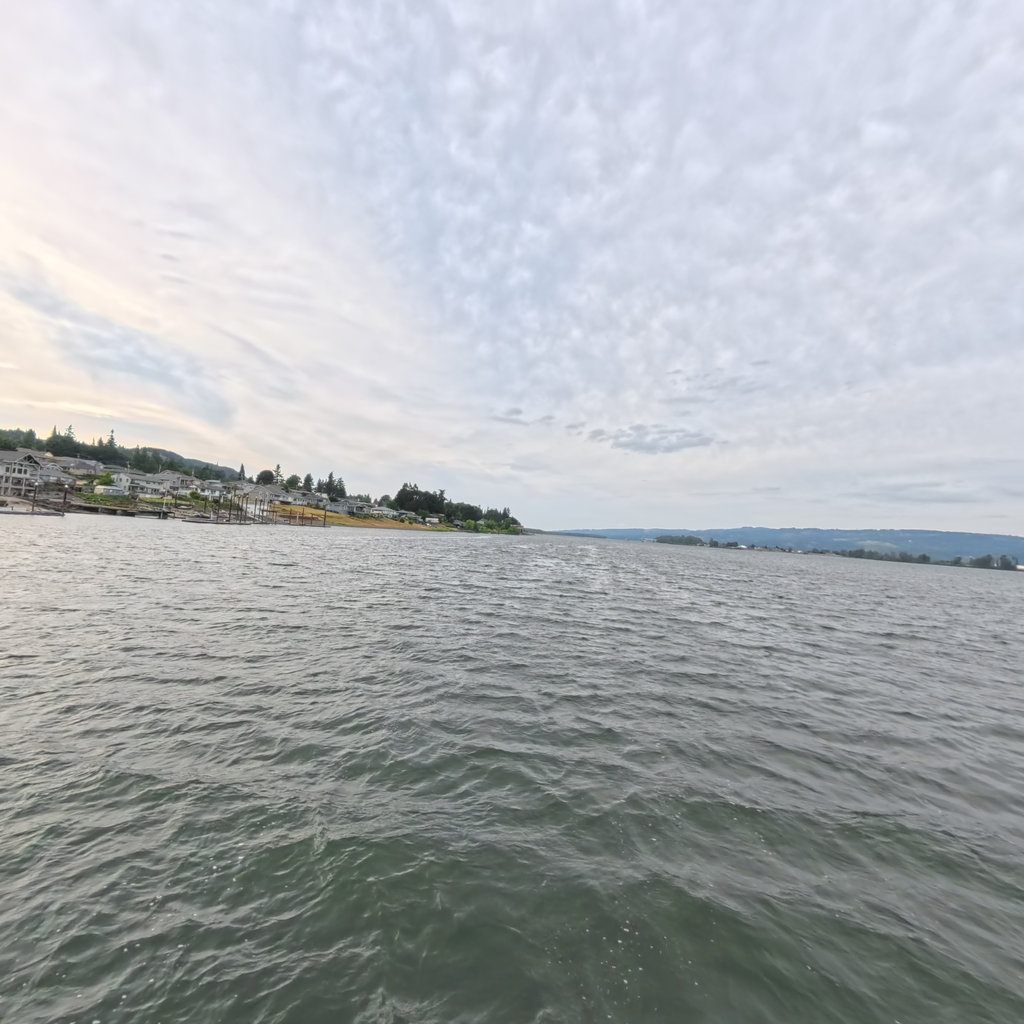
10 frames across 1.6 mi of the route around this location
Analyses
- The Multnomah Revealed: A River Missed Twice and a Plan Reconsidered
- Pierre Cruzatte: Fiddler, Waterman, and the Man Who Shot Meriwether Lewis
- York: The Enslaved Man Who Crossed a Continent
- Thomas Jefferson: The Distant Architect of the Voyage of Discovery
- The Nez Perce (Chopunnish): Allies of the Bitterroot and Kooskooske
Artwork
Help improve this record
See something that needs correcting, or know a source we are missing? The archive gets better through its readers.


