Clark: May 15, 1806
Thursday 15th of May 1806 This morning Reubin Fields went out to hunt his
horse very early and Saw a large bear and no great distance from Camp.
Several men went in pursute of the bear, and prosued his trail Some time
without gitting Sight of this Monster. Shannon went out with Labeach to
hunt and continue out 3 days, Gibson and Hall accompanied them for the
meat Labeech killed yesterday which they brought in by 11 A M. this
Morning the female was black with white hares intermixed and a white Spot
on the breast the Cubs were about the Size of a dog also pore. one of them
very black and the other a light redish brown or bey colour. These bear
give me a Stronger evidence of the various Coloured bear of this Country
being one Specie only, than any I have heretofore had. Several other
Colours have been seen. Drewyer and Peter Crusat went up the river. John
Shields, R. Fields and Willard hunted in the hills near Camp and returned
before 2 P. M without killing any thing except a fiew Grows. they saw but
few deer. Some bear Sign. Frazur Jo. Fields and Peter Wizer Complain of a
violent pain in their heads. Howard and York with violent Cholicks. the
Cause of those disorders we are unable to account for. their diet and the
Sudin Change of Climate must contribute. The Great Chief Tin
nach-e-moo-tolt (or broken Arm) and 12 of the young men of his nation left
us today about 11 oClock and Crossed the river to his Village
Hoh-hast-ill-pilt and 3 old men Continued with us untill about 5 P. M when
they left us and returnd. to their Village. a party of 14 Indians passed
our Camp about 1 P.M. on their way to the leavel uplands to run and kill
the deer with their horses and Bows and arrows. Some of them were also
provided with deers heads Cased for the purpose of decoying the deer.
those men continued withus but a fiew minits and proceeded on. Those
people hunt most Commonly on horse back Seround the Deer or Goat which
they find in the open plains & kill them with their arrows. tho they
Sometimes hunt the deer on foot & decoy them. we had all of our horses
drove together to day with a view to fermilurize them to each other. those
that were Cut yesterday are Stiff and Several of them much Swelled. we had
all our baggage Secured and Covered with a rouf of Straw. our little
fortification also completely Secured with brush around which our Camp is
formed. the Greater part of our Security from the rains &c. is the
grass which is formed in a kind of ruff So as to turn the rain Completely
and is much the best tents we have. as the days are worm &c. we have a
bowry made to write under which we find not only comfortable but
necessary, to keep off the intence heet of the Sun which has great effect
in this low bottom. on the high plains off the river the Climate is
entirely different cool. Some Snow on the north hill Sides near the top
and vegetation near 3 weeks later than in the river bottoms. and the rocky
Mountains imedeately in view covered Several say 4 & 5 feet deep with
Snow. here I behold three different Climats within a fiew miles a little
before dark Hoh-hast-ill-pilt and the 3 old men & one other returned
to our Camp and informed us the Canoe was a great way off and they could
not cross this evening.
Entities mentioned in this entry
Auto-extracted from the entry text. Hover any entity for context.
Terrain360 · the place today
Camp Chopunnish (Long Camp), waiting for snow to melt in 360°
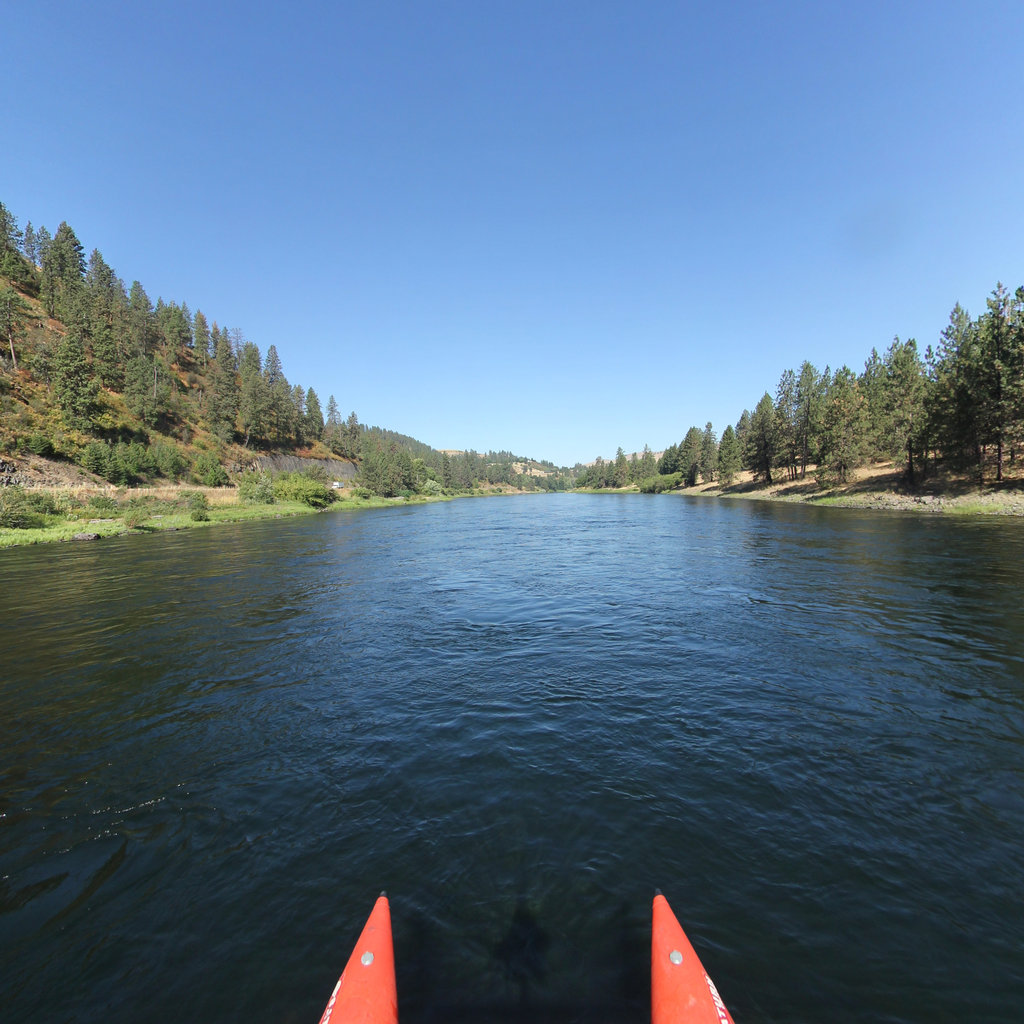
10 frames across 1.6 mi of the route around this location
Analyses
- Crossing the Koos-koos-ke: Bears, Horse Surgery, and a Six-Thumbed Trophy
- One Bear, Many Colors: Naturalist Inquiry and Camp Life at the Long Camp
- Pierre Cruzatte: Fiddler, Waterman, and the Man Who Shot Meriwether Lewis
- York: The Enslaved Man Who Crossed a Continent
- John Shields: The Expedition’s Blacksmith and Gunsmith
Artwork
Help improve this record
See something that needs correcting, or know a source we are missing? The archive gets better through its readers.


