Clark: August 25, 1804
Augt. 25th Satturday 1804 This morning Capt Lewis & my Self G D. Sjt.
Ouderway Shields J. Fields colter Bratten Cane Labeeche corp Wovington
Frasure & York Set out to Visit this mountain of evel Spirits, we Set
out from the mouth of the White Stone Creek, at 8 oClock, at 4 miles Cross
the Creek in an open plain, at 7 ms. the dog gave out & we Sent him
back to the Creek at 12 oClock we rose the hill Some time before we got to
the hill we obsevd. great numbers of Birds hovering about the top of this
Mound when I got on the top those Birds flw off. I discovered that they
wer Cetechig a kind of flying ant which were in great numbers abought the
top of this hill, those insects lit on our hats & necks, Several of
them bit me verry Shart on the neck, near the top of this nole I observed
three holes which I Supposed to be Prarie Wolves or Braroes, which are
numerous in those Plains. this hill is about 70 foot high in an emince
Prarie or leavel plain from the top I could not observe any woods except
in the Missourie Points and a few Scattering trees on the three Rivers in
view. i e the Soues River below, the River Jacque above & the one we
have crossed from the top of this Mound we observed Several large gangus
of Buffalow & Elk feeding upwards of 800 in number Capt Lewis being
much fatigued and verry thursty obliged us to go to the neares water which
we Could See, which was the W Stone Creek at right angles from the Course
we came out, and we got water in three miles in the Creek above whre the
beaver had darned it up after a Delay of about one hour & a half we
Set out for our boat, Cross the Creek three times wast deep, passing down
an ellgent bottom of about a mile in width bordered by a ridge of about 50
feet from the top of which it was leavel to the river, we proceeded on by
a Circular Derection to the place we Crossed this Creek going out where we
delayed for the men to rest themselves about 40 minits in a small grove
here we got Great quantities of the best largest grapes I ever tasted,
Some Blue Currents still on the bushes, and two kind of Plumbs, one the
Common wild Plumb the other a large Yellow Plumb growing on a Small bush,
this blumb is about double the Size of the Common and Deliscously
flavouredThose plains are leavel without much water and no timber
all the timber on the Stone River would not thickly timber 100 acres of
landwe returned to the boat at Sunset, my Servent nearly exosted
with heat thurst and fatigue, he being fat and un accustomed to walk as
fast as I went was the Causewe Set fire to the Praries in two
Places to let the Sons know we were on the river and as a Signal for them
to Come to the river above, our Party in the Boat & one Perogue undr.
the Comd of Sergt. Pryor answered us by firing a prarie near them. we
proceeded on to the place we Camped last night, and as it began to rain
and verry dark, we Concluded to Stay all night, our boys prepared us a
Supper of jurked meet and two Prarie Larks (which are about the Size of a
Pigeon and Peculier to this country) and on a Buffalow roabe we Slept
verry well in the morning we proceeded on and joined the boat at 6 miles,
they had camped & were Jurking an Elk & 5 Deer which R. Fields
& Shannon had brough in. from the Mound to the Hill S. S. mo. of R.
Soues S 70° E. to the opsd. Hills S. 45° E. and to the woods near River au
Jacque is West
—
Augt. 25th Satturday wind S E The Boat under Serjt Pryor after drying some
goods which got wet in the french Perogue & jurking the meet killed
yesterday Set out at 12 oClock and proceeded on Six miles and Camped on
the L. S. passed a Bluff of blue earth at 3 miles and a large Sand Island
in a bend to the S. S. at 5 miles, R Fields brought in 5 Deer, G Shannon
an Elk this eveng. rain at 3 oClock Murcky. 86 abo 0,
—
25th August Satturday 1804 a Cloudy morning Capt Lewis & my Self
Concluded to go and See the Mound which was viewed with Such turrow by all
the different Nation in this quarter, we Selected Shields J. Fields, W
Bratten, Sergt. Ordway, J Colter, Can, and Corp Worbington & Frasure,
also G. Drewyer and droped down to the mouth of White Stone River where we
left the Perogue with two men and at 200 yards we assended a riseing
ground of about Sixty feet, from the top of this High land the Countrey is
leavel & open as far as Can be Seen, except Some few rises at a Great
Distance, and the Mound which the Indians Call Mountain of little people
or Spirits this mound appears of a Conic form & is N. 20° W. from the
mouth of the Creek, we left the river at 8 oClock, at 4 miles we Crossed
the Creek 23 yards wide in an extensive Valley and continued on at two
miles further our Dog was So Heeted & fatigued we was obliged Send him
back to the Creek, at 12 oClock we arrived at the hill Capt Lewis much
fatigued from heat the day it being verry hot & he being in a
debilitated State from the Precautions he was obliged to take to provent
the affects of the Cobalt, & Mini. Substance which had like to have
poisoned him two days ago, his want of water, and Several of the men
complaining of Great thirst, deturmined us to make for the first water
which was the Creek in a bend N. E. from the mound about 3 milesaftr
a Delay of about 1 hour & a half to recrut our party we Set out on our
return down the Creek thro the bottom of about 1 mile in width, Crossed
the Creek 3 times to the place we first Struck it, where we geathered Some
delisious froot Such as Grapes Plumbs, & Blue Currents after a Delay
of an hour we Set out on our back trail & arrived at the Perogue at
Sun Set we proceedd on to the place we Campd. last night and Stayed all
night.
This Mound is Situated on an elivated plain in a leavel and extensive
prarie, bearing N. 20° W. from the mouth of White Stone Creek Nine Miles,
the base of the Mound is a regular parallelagram the long Side of which is
about 300 yards in length the Shorter 60 or 70 yardsfrom the longer
Side of the Base it rises from the North & South with a Steep assent
to the hight of 65 or 70 feet, leaveing a leavel Plain on the top of 12
feet in width & 90 in length. the North & South part of this mound
is joins by two regular rises, each in Oval forms of half its hight
forming three regular rises from the Plain the assent of each elivated
part is as Suden as the principal mound at the narrower Sides of its Bass
The reagular form of this hill would in Some measure justify a belief that
it owed its Orrigin to the hand of man; but as the earth and loos pebbles
and other Substances of which it was Composed, bare an exact resemblance
to the Steep Ground which border on the Creek in its neighbourhood we
Concluded it was most probably the production of nature-.
The only remarkable Charactoristic of this hill admiting it to be a
naturial production is that it is insulated or Seperated a considerable
distance from any other, which is verry unusial in the naturul order or
disposition of the hills.
The Surrounding Plains is open void of Timber and leavel to a great
extent; hence the wind from whatever quarter it may blow, drives with
unusial force over the naked Plains and against this hill; the insects of
various kinds are thus involuntaryly driven to the mound by the force of
the wind, or fly to its Leward Side for Shelter; the Small Birds whoes
food they are, Consequently resort in great numbers to this place in Surch
of them; Perticularly the Small brown Martin of which we saw a vast number
hovering on the Leward Side of the hill, when we approached it in the act
of Catching those insects; they were So gentle that they did not quit the
place untill we had arrivd. within a fiew feet of them-
One evidence which the Inds Give for believeing this place to be the
residence of Some unusial Spirits is that they frequently discover a large
assemblage of Birds about this moundis in my opinion a Suffient
proof to produce in the Savage mind a Confident belief of all the
properties which they ascribe it.
from the top of this Mound we beheld a most butifull landscape; Numerous
herds of buffalow were Seen feeding in various directions, the Plain to
North N. W & N E extends without interuption as far as Can be Seen
From the Mound to the mouth of Stone River is S. 20° E 9 miles.
to the woods near the mouth of River Jacque is West
to the High land near the mouth of Souis River is S. 70 E.
to the high land opposit Side or near the Maha Town is S. 45 E.
Some high lands to be Seen from the mound at a Great distance to the N. E
Some Nearer to the N W. no woods except on the Missouris Points
if all the timber which is on the Stone Creek was on 100 acres it would
not be thickly timbered, the Soil of those Plains are delightfull Great
numbers of Birds are Seen in those Plains, Such as black bird, Ren or
Prarie burd a kind of larke about the Sise of a Partridge with a Short
tail &c. &.
25th Augt the Boat under the Comd. of Sergt. Pryor proceeded on in our
absence (after jurking the Elk I Killed yesterday) Six Miles and Camped on
the Larboard Side R Fields brought in five Deer. George Shannon Killed an
Elk Buck Some rain this evening.
we Set the Praries on fire as a Signal for the Soues to Come to the river.
Entities mentioned in this entry
Auto-extracted from the entry text. Hover any entity for context.
Terrain360 · the place today
Spirit Mound, South Dakota in 360°
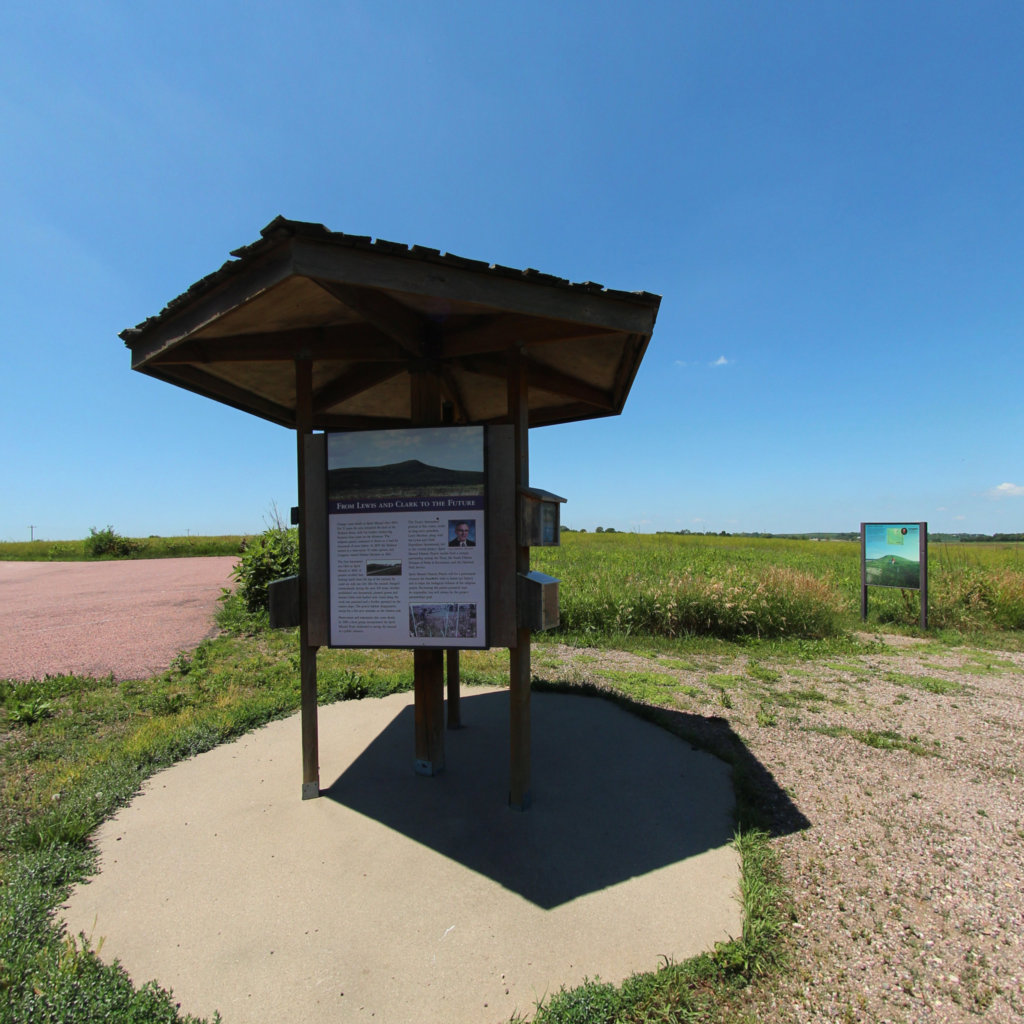
10 frames across 0.7 mi of the route around this location
Analyses
- The Omaha (Maha) Nation: A Diminished People in the Journals of Lewis & Clark
- York: The Enslaved Man Who Crossed a Continent
- William Bratton: Hunter, Saltmaker, and Patient of the Corps of Discovery
- Seaman: Lewis’s Newfoundland and the Fourth Member of the Corps
- John Colter: The Hunter Who Walked Away From Home
- Sergeant Nathaniel Pryor: A Steady Hand of the Corps of Discovery
Artwork
Help improve this record
See something that needs correcting, or know a source we are missing? The archive gets better through its readers.


