William Bratton
William Bratton served as a private and blacksmith in the Corps of Discovery. He suffered a severe back injury during the winter at Fort Clatsop that left him unable to walk for months, but was eventually cured through a sweat lodge treatment suggested by the Nez Perce. Bratton assisted John Shields at the forge and was a skilled hunter. After the expedition, he served in the War of 1812 under William Clark and later settled in Indiana.
Biography
William Bratton (1778-1841) was a skilled hunter and blacksmith who suffered one of the expedition’s most severe medical emergencies — a debilitating back injury that left him unable to walk for months during the winter at Fort Clatsop.
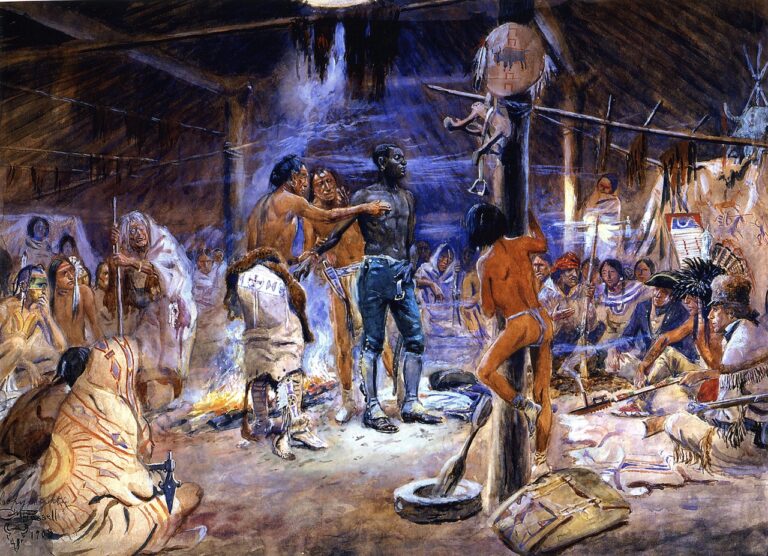
Bratton’s condition baffled the captains, who tried numerous remedies without success. Finally, John Shields suggested a frontier sweat lodge treatment: a pit was dug, heated with stones, and Bratton was placed inside and doused alternately with hot and cold water. Remarkably, after one treatment, Bratton could walk. After a second, he was nearly recovered — one of the expedition’s most striking medical episodes.
As a blacksmith, Bratton worked alongside Willard at Fort Mandan trading metalwork for food. His skills were essential to keeping the expedition’s equipment functional throughout the journey.
After the expedition, Bratton served in the War of 1812 under Andrew Jackson, then settled in Waynetown, Indiana, where he lived until 1841. His grave in Waynetown is one of the few marked Corps of Discovery burial sites.
Related Locations
Note: the longest gap between tagged appearances is about 4 months (Jul 1, 1805 → Nov 12, 1805). William Bratton may have been present in the corps during that span but is not named in the journals.
Journal Entries (85)


Cross-Narrator Analyses
Analyses that cite or discuss William Bratton — showing 11 of the most recent matches.
William Bratton: Hunter, Saltmaker, and Patient of the Corps of Discovery
Enlistment and Place in the CorpsWilliam Bratton enters the expedition record on May 26, 1804, when Meriwether Lewis issued his Detachment Orders…
A Deer, Two Swimmers, and the Limits of Frontier Medicine
The journals of John Ordway, Meriwether Lewis, and William Clark for May 23, 1806 offer an unusually clear window into how the…
A Horse, a Sweat Lodge, and a Squirrel: Four Voices at Camp Chopunnish
The entries for May 27, 1806, offer an unusually clean specimen of how the Lewis and Clark journalists divided narrative labor. Stalled…
Bratton’s Bear and the First Pines
The May 11, 1805 entries cluster around two events in the Missouri Breaks: a near-fatal grizzly encounter and Clark's ascent of the…
North West Company Visitors and the Blacksmiths’ Forge at Fort Mandan
The journal entries for 13 March 1805, recorded near the end of the expedition's winter at Fort Mandan, offer an instructive contrast…
The Sweat Hole at Camp Chopunnish: Four Voices on Frontier Medicine
The journals of May 24, 1806 offer an unusually rich opportunity to compare narrators, because all four diarists present at Camp Chopunnish…
François Labiche: Hunter, Waterman, and Interpreter of the Corps of Discovery
IntroductionFrançois Labiche — variously spelled Labieche, Labiech, Labeech, and Labice in the journals — was an enlisted private of the permanent party…
John Colter: The Hunter Who Walked Away From Home
Enlistment and First Mess AssignmentJohn Colter first appears in the official record on May 26, 1804, when Meriwether Lewis issued detachment orders…
John Shields: The Expedition’s Blacksmith and Gunsmith
An Older Hand Among Young SoldiersJohn Shields was, at thirty-four when the expedition departed, the oldest enlisted man in the permanent party…
Silas Goodrich: The Expedition’s Fisherman
Enlistment and Mess AssignmentSilas Goodrich first appears in the expedition record on May 26, 1804, when Captain Meriwether Lewis issued his Detachment…
York: The Enslaved Man Who Crossed a Continent
Introduction: A Singular Presence in the JournalsYork appears in the Lewis and Clark journals more often than any other African American of…
From the Heacock Memorial Archive
2 lewis-clark.org articles that mention William Bratton, preserved here for Robert Heacock’s photography. The articles were written by that site’s contributing authors.
Researcher or educator?
Get help using the archive in your work, suggest sources we should include, or talk with us about collaboration and classroom use.


