
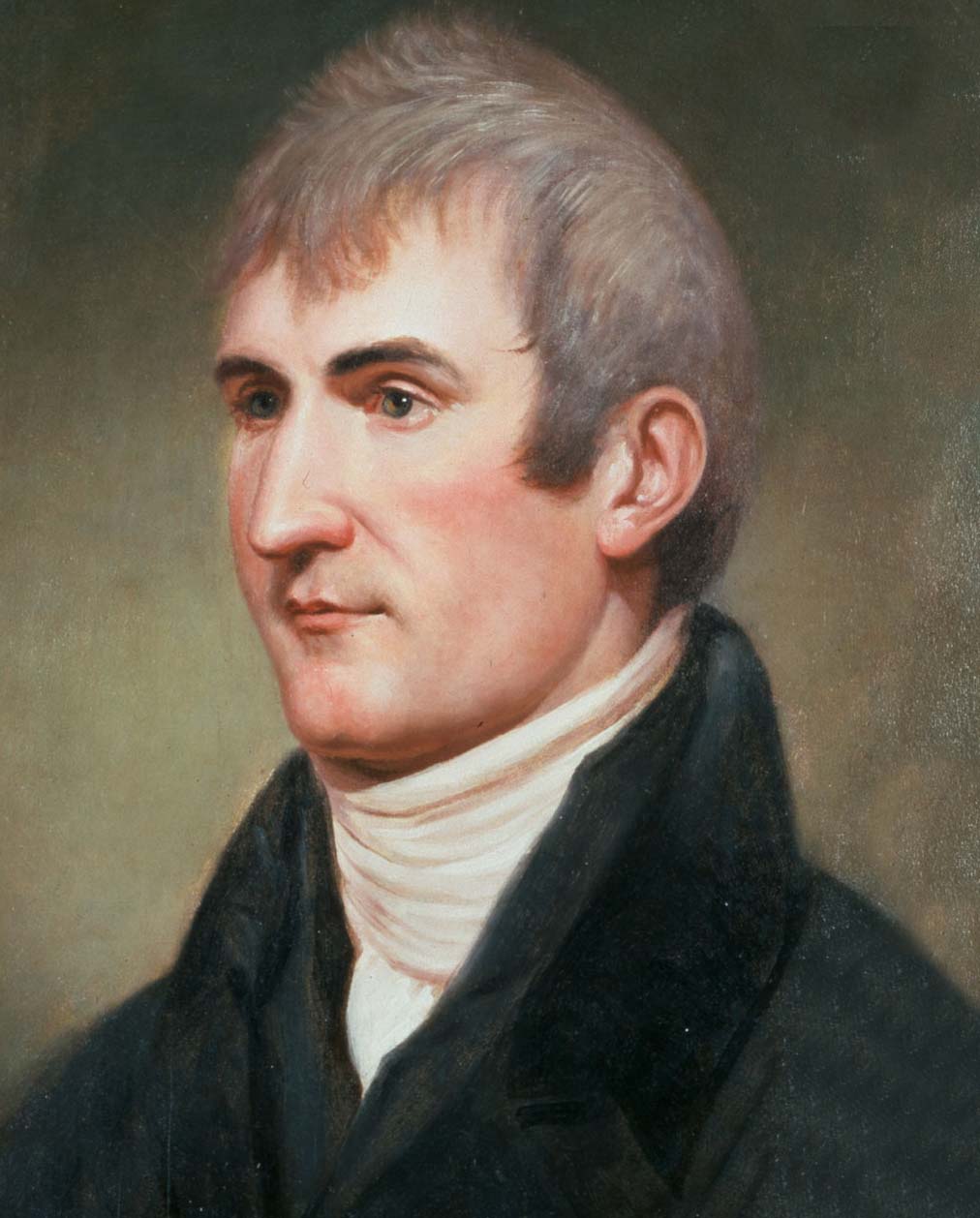
An Older Hand Among Young Soldiers
John Shields was, at thirty-four when the expedition departed, the oldest enlisted man in the permanent party — and one of the few married. His name appears in Lewis’s Detatchment Orders of May 26, 1804, where he is assigned to Sergeant Nathaniel Pryor’s mess as Private number 21, alongside Gibson, Shannon, Collins, Whitehouse, Wiser, Cruzatte, and Labiche (Lewis, May 26, 1804). From this organizational notice forward, Shields surfaces in the journals not as a colorful personality but as a constant, useful presence — the man who fixes things, finds meat, and is sent ahead.
Hunter and Scout on the Lower Missouri
Within hours of the formal organization of messes, Clark records sending Shields out with George Drouillard: George Drewyer & John Shields, Sent by Land with the two horses with directions to proceed on one day & hunt the next
(Clark, May 26, 1804). On June 2, the two reappeared at the mouth of the Osage after a hard week afield: Drewyer & Shields came to the opposit Side to day at SunSet… they had been absent 7 Days Swam many creeks, much worsted
(Clark, June 2, 1804). This pattern — Shields detached overland with the horses, rejoining the boats with game — recurs throughout the ascent of the Missouri (Clark, June 19, June 22, August 22, August 23, September 5, October 6, 1804).
Shields was also among the small party that accompanied Lewis and Clark on the August 25, 1804 excursion to the Spirit Mound: Capt Lewis & my Self G D. Sjt. Ouderway Shields J. Fields colter Bratten Cane Labeeche corp Wovington Frasure & York Set out to Visit this mountain of evel Spirits
(Clark, August 25, 1804). Two days later, when Shannon and the horses went missing, it was Shields and Joseph Fields who were sent back to recover them (Clark, August 27, 1804).
Fort Mandan: The Blacksmith’s Forge
It was during the winter of 1804–1805 that Shields’s most distinctive contribution emerged. With the smith’s forge set up at Fort Mandan, Shields and William Bratton produced ironwork — chiefly battle-axes and the prized squares of sheet iron cut from a worn-out camp stove — that the Mandan and Hidatsa eagerly traded for corn. Lewis records on February 6, 1805:
the blacksmiths take a considerable quantity of corn today in payment for their labour. the blacksmith’s have proved a happy resoce to us in our present situation as I believe it would have been difficult to have devised any other method to have procured corn from the natives… I permited the blacksmith to dispose of a part of a sheet-iron callaboos which had been nearly birnt out on our passage up the river, and for each piece about four inches square he obtained from seven to eight gallons of corn from the natives
The same entry notes Shields’s hunting prowess: Shields killed three antelopes this evening
(Lewis, February 6, 1805).
From the Great Falls to the Continental Divide
Setting out from Fort Mandan, Shields was briefly laid up — one man J. Shields Sick with rhumetism
(Clark, May 1, 1805) — but resumed his role as scout and hunter as the party climbed toward the mountains. He accompanied Lewis on the June 4, 1805 reconnaissance up the north fork (Marias River) at the great forking decision: those who accompanied Capt Lewis were G. Drewyer Serjt. Pryor, J Shields, P. Crusat J. B. de Page, R. Winser
(Clark, June 4, 1805).
At the portage of the Great Falls, Shields’s mechanical genius received Lewis’s most direct praise. On June 10, 1805, Lewis wrote one of the warmest character sketches in the journals:
Shields renewed the main Spring of my air gun we have been much indebted to the ingenuity of this man on many occasions; without having served any regular apprenticeship to any trade, he makes his own tools principally and works extreemly well in either wood or metal, and in this way has been extreenely servicable to us, as well as being a good hunter and an excellent waterman.
Through the late June construction of Lewis’s iron-frame experimental boat, Shields was a fixture of the work crews — gathering bark and timber on the islands above the falls (Lewis, June 25–28, 1805), shaving and fitting the horizontal bars of the boat’s sections (June 27), splitting wood for tar (July 1), and helping shape the way-strips (July 2). On June 26, Lewis noted that Shields and Gass had killed seven buffaloe in their absence the skins of which and a part of the best of the meat they brought with them
(Lewis, June 26, 1805).
With Lewis Among the Shoshones
When Lewis pressed ahead in August 1805 to find the Shoshones, Shields was among the small advance party. On August 11, with the captain anxious to locate the Indians, Lewis deployed his scouts in classic flanking order: I now sent Drewyer to keep near the creek to my right and Shields to my left, with orders to surch for the road which if they found they were to notify me by placing a hat in the muzzle of their gun
(Lewis, August 11, 1805). It was during this approach that Lewis’s first contact with a mounted Shoshone was famously botched — and Shields, far on the left flank, did not see Lewis’s signals to halt, contributing to the Indian’s flight.
Shields continued to hunt for the joint Shoshone-American camp (Lewis, August 14 and 16, 1805) and accompanied Clark on the harrowing canoe-building work at Canoe Camp on the Clearwater. Clark recorded on October 6, 1805 that one of the dugouts was the Canoe which Shields made… cut from the body of the tree
— a small but telling acknowledgment of his woodcraft. On the descent of the Clearwater, Shields supplied venison: met Shields with 3 Deer, I took a Small peice & Changed for his horse which was fresh
(Clark, September 22, 1805).
Fort Clatsop and the Return
The Pacific winter found Shields hunting the Netul (Lewis & Clark) River bottoms, often paired with Joseph Fields and Shannon. They went out repeatedly in late February and early March 1806 — sometimes returning empty-handed (March 8: Shields, R. Fields and Frazier returned this evening from the Kilhawanackkle unsuccessfull haveing Seen no Elk
), sometimes with five elk at a time (Clark and Lewis, February 28, 1806). At Fort Clatsop he was also set to leatherwork: we Set Shields at work to make Some Sacks of Elk Skin to contain my papers, and various articles which we wish kept Dry
(Clark, March 9, 1806).
On the homeward voyage, Shields’s gunsmithing again proved its worth. At a wind-bound camp on April 8, 1806, Clark wrote:
John Shields Cut out my Small rifle & brought hir to Shoot very well. the party ows much to the injenuity of this man, by whome their guns are repared when they get out of order which is very often.
Through April and May 1806, as the party recrossed the Columbia and Snake country and waited out the snows in Nez Perce country, Shields continued his familiar duties — sent across the river to find a lost canoe (Lewis, March 11, 1806), hunting near camp on May 8 and May 15, 1806, and rejoining the captains at the rapids of the Columbia.
Assessment from the Record
The journal record of John Shields is striking for what it does not contain: he is never disciplined, never quarrels, never figures in the courts-martial that punctuated the early months of the voyage. Instead, he appears wherever skill is needed — at the forge, at the gun-bench, on the hunt, in the woods cutting timber for canoes, in advance of the party with the horses. Lewis’s June 10, 1805 tribute — that without formal apprenticeship Shields makes his own tools principally and works extreemly well in either wood or metal
— stands as the captains’ clearest verdict. Beyond what the journals report, this synthesis offers no claims about his life before or after the expedition; the record here is restricted to the tagged entries.


