Lewis: May 26, 1804
Detatchment Orders. May 26th 1804. The Commanding Officers direct, that
the three Squads under the command of Sergts. Floyd Ordway and Pryor
heretofore forming two messes each, shall untill further orders constitute
three messes only, the same being altered and organized as follows (viz)
1 Sergt. Charles Floyd. (1)
Privates:
2 Hugh McNeal
3 Patric Gass
4 Reubin Fields (2)
5 John B Thompson
+ 6 John Newman
7 Richard Winsor
+ Francis Rivet &
8 Joseph Fields (3)
9 Sergt. John Ordway.
Privates.
10 William Bratton (4)
11 John Colter (5)
X 12 Moses B. Reed
13 Alexander Willard
14 William Warner
15 Silas Goodrich
16 John Potts &
17 Hugh Hall
18 Sergt. Nathaniel Pryor. (6)
Privates.
19 George Gibson (7)
20 George Shannon (8)
21 John Shields (9)
22 John Collins
23 Joseph Whitehouse
24 Peter Wiser
F 25 Peter Crusat &
F 26 Francis Labuche
The commanding officers further direct that the remainder of the
detatchmen shall form two messes; and that the same be constituded as
follows. (viz)
Patroon, Baptist Dechamps
Engages
Etienne Mabbauf
Paul Primaut
Charles Hébert
Baptist La Jeunesse
Peter Pinaut
Peter Roi &
Joseph Collin
1 Corpl. Richard Warvington.
Privates.
2 Robert Frasier
3 John Boleye
4 John Dame
5 Ebinezer Tuttle &
6 Isaac White
The Commanding officers further direct that the messes of Sergts. Floyd,
Ordway and Pryor shall untill further orders form the crew of the
Batteaux; the Mess of the Patroon La Jeunesse will form the permanent crew
of the red Perogue; Corpl. Warvington’s mess forming that of the white
perogue.
Whenever by any casualty it becomes necessary to furnish additional men to
assist in navigating the Perogues, the same shall be furnished by daily
detale from the Privates who form the crew of Batteaux, exempting only
from such detale, Thomas P. Howard and the men who are assigned to the two
bow and the two stern oars.For the present one man will be
furnished daily to assist the crew of the white perogue; this man must be
an expert boatman.
The posts and duties of the Sergts. shall be as follows (viz)when
the Batteaux is under way, one Sergt. shall be stationed at the helm, one
in the center on the rear of the Starboard locker, and one at the bow. The
Sergt. at the helm, shall steer the boat, and see that the baggage on the
quarterdeck is properly arranged and stowed away in the most advantageous
manner; to see that no cooking utensels or loos lumber of any kind is left
on the deck to obstruct the passage between the burthshe will also
attend to the compas when necessary.
The Sergt at the center will command the guard, manage the sails, see that
the men at the oars do their duty; that they come on board at a proper
season in the morning, and that the boat gets under way in due time; he
will keep a good lookout for the mouths of all rivers, creeks, Islands and
other remarkable places and shall immediately report the same to the
commanding officers; he will attend to the issues of sperituous liquors;
he shall regulate the halting of the batteaux through the day to give the
men refreshment, and will also regulate the time of her departure taking
care that not more time than is necessary shall be expended at each haltit
shall be his duty also to post a centinel on the bank, near the boat
whenever we come too and halt in the course of the day, at the same time
he will (acompanied by two his guard) reconnoiter the forrest arround the
place of landing to the distance of at least one hundred paces. when we
come too for the purpose of encamping at night, the Sergt. of the guard
shall post two centinels immediately on our landing; one of whom shal be
posted near the boat, and the other at a convenient distance in rear of
the encampment; at night the Sergt. must be always present with his guard,
and he is positively forbidden to suffer any man of his guard to absent
himself on any pretext whatever; he will at each relief through the night,
accompanyed by the two men last off their posts, reconnoiter in every
direction around the camp to the distance of at least one hundred and
fifty paces, and also examine the situation of the boat and perogues, and
see that they ly safe and free from the bank
It shall be the duty of the sergt. at the bow, to keep a good look out for
all danger which may approach, either of the enimy, or obstructions which
may present themselves to passage of the boat; of the first he will notify
the Sergt. at the center, who will communicate the information to the
commanding officers, and of the second or obstructions to the boat he will
notify the Sergt. at the helm; he will also report to the commanding
officers through the Sergt. at the center all perogues boats canoes or
other craft which he may discover in the river, and all hunting camps or
parties of Indians in view of which we may pass. he will at all times be
provided with a seting pole and assist the bowsman in poling and managing
the bow of the boat. it will be his duty also to give and answer all
signals, which may hereafter be established for the government of the
perogues and parties on shore.
The Sergts. will on each morning before our departure relieve each other
in the following mannerThe Sergt. at the helm will parade the new
guard, relieve the Sergt. and the old guard, and occupy the middle station
in the boat; the Sergt. of the old guard will occupy the station at the
bow, and the Sergt. who had been stationed the preceeding day at the bow
will place himself at the helm.The sergts. in addition to those
duties are directed each to keep a seperate journal from day today of all
passing occurences, and such other observations on the country &c. as
shall appear to them worthy of notice
The Sergts. are relieved and exempt from all labour of making fires,
pitching tents or cooking, and will direct and make the men of their
several messes perform an equal propotion of those duties.
The guard shall hereafter consist of one sergeant and six privates &
engages.
Patroon, Dechamp, Copl. Warvington, and George Drewyer, are exempt from
guad duty; the two former will attend particularly to their perogues at
all times, and see that their lading is in good order, and that the same
is kept perfectly free from rain or other moisture; the latter will
perform certain duties on shore which will be assigned him from time to
time. all other soldiers and engaged men of whatever discription must
perform their regular tour of guad duty.
All detales for guard or other duty will be made in the evening when we
encamp, and the duty to be performed will be entered on, by the
individuals so warned, the next morning.provision for one day will
be issued to the party on each evening after we have encamped; the same
will be cooked on that evening by the several messes, and a proportion of
it reserved for the next day as no cooking will be allowed in the day
while on the mach
Sergt. John Ordway will continue to issue the provisions and make the
detales for guard or other duty.The day after tomorrow lyed corn
and grece will be issued to the party, the next day Poark and flour, and
the day following indian meal and poark; and in conformity to that ratiene
provisions will continue to be issued to the party untill further orders.should
any of the messes prefer indian meal to flour they may recieve it
accordinglyno poark is to be issued when we have fresh meat on
hand.
Labuche and Crusat will man the larboard bow oar alternately, and the one
not engaged at the oar will attend as the Bows-man, and when the attention
of both these persons is necessary at the bow, their oar is to be maned by
any idle hand on board.
Meriwether Lewis Capt. Wm. Clark Cpt.
Entities mentioned in this entry
Auto-extracted from the entry text. Hover any entity for context.
Terrain360 · the place today
Missouri River near Gasconade River in 360°
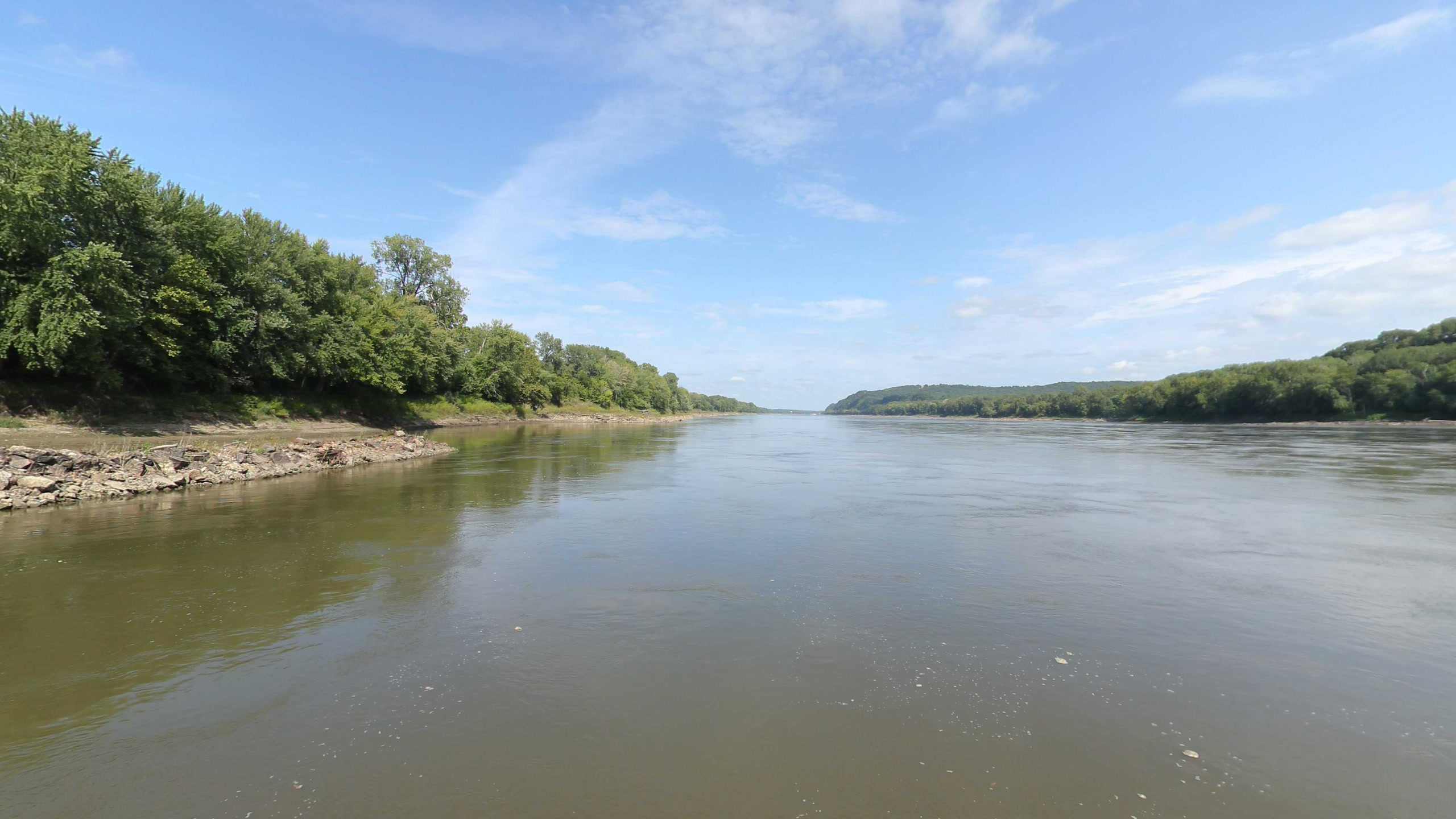
10 frames across 1.6 mi of the route around this location
Analyses
- Silas Goodrich: The Expedition’s Fisherman
- Pierre Cruzatte: Fiddler, Waterman, and the Man Who Shot Meriwether Lewis
- William Bratton: Hunter, Saltmaker, and Patient of the Corps of Discovery
- John Colter: The Hunter Who Walked Away From Home
- Hugh McNeal: A Private’s Long March
- Sergeant Nathaniel Pryor: A Steady Hand of the Corps of Discovery
Artwork
Help improve this record
See something that needs correcting, or know a source we are missing? The archive gets better through its readers.


