The Lewis and Clark Expedition
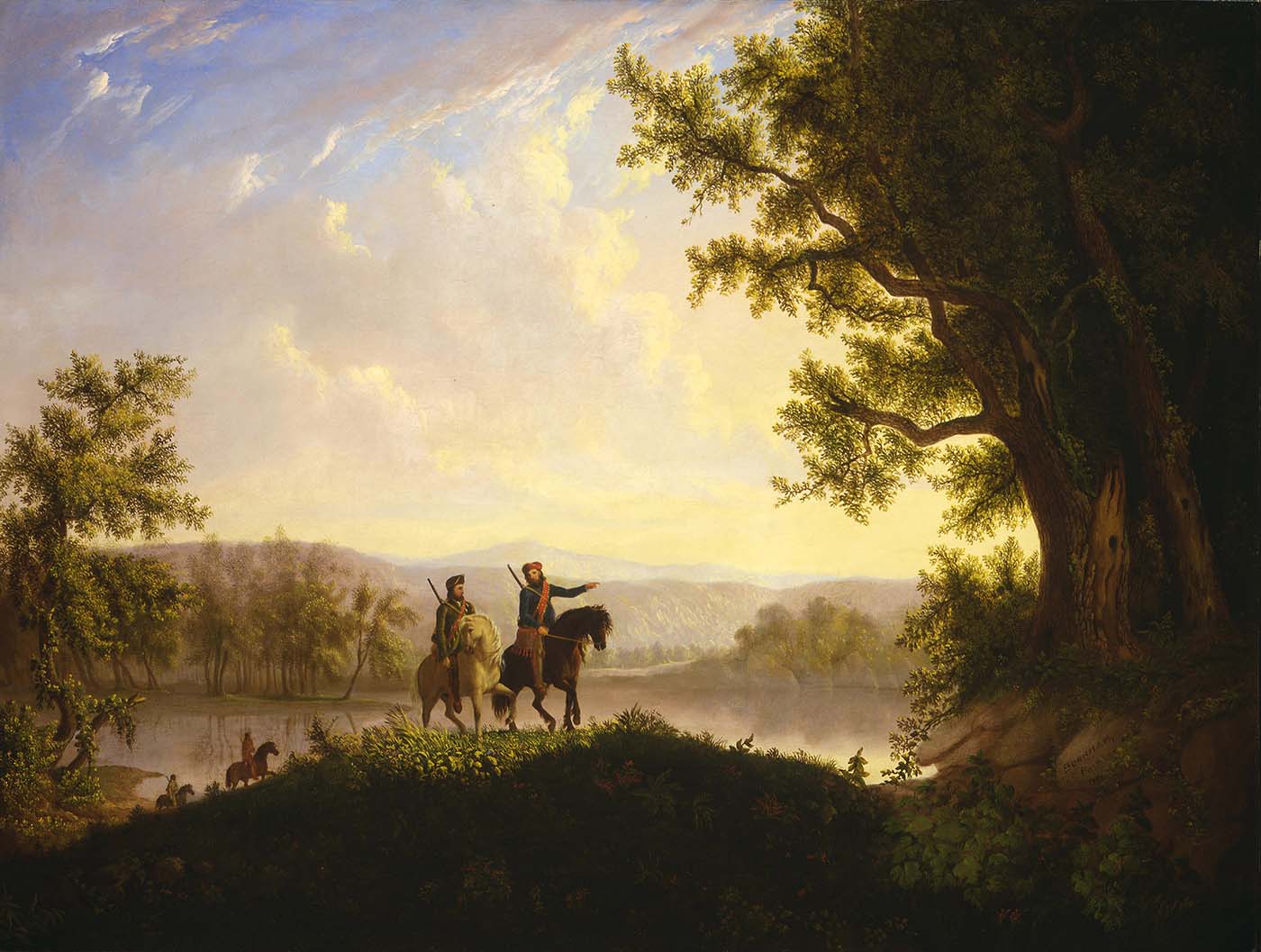
Burnham’s oil composition presents the Corps of Discovery as a small group of figures within an expansive western landscape. The painting groups Lewis, Clark, and several members of the party in the middle distance, with Sacagawea identifiable as the lone female figure. The captains are shown in conference with what appear to be Indigenous figures, while the rest of the company arranges itself across a clearing bounded by trees and open terrain. Burnham handles the scene in the academic narrative manner of the mid-century, with finished detail in the foreground figures and softer atmospheric treatment in the receding background. The composition is generalized rather than tied to a documentable event; no specific river crossing, council, or campsite is identified by setting.
The picture dates to around 1850, roughly four decades after the expedition’s return in 1806 and a generation after the deaths of Clark (1838) and the earlier loss of Lewis (1809). By midcentury the journey had passed out of living memory for most Americans and into the realm of national myth, fueled by Nicholas Biddle’s 1814 edition of the journals and by the broader public appetite for western imagery that accompanied the era of Manifest Destiny, the Mexican Cession, and the California Gold Rush. Painters working east of the Mississippi increasingly produced retrospective expedition scenes for audiences who associated the Corps of Discovery with the territorial expansion then underway.
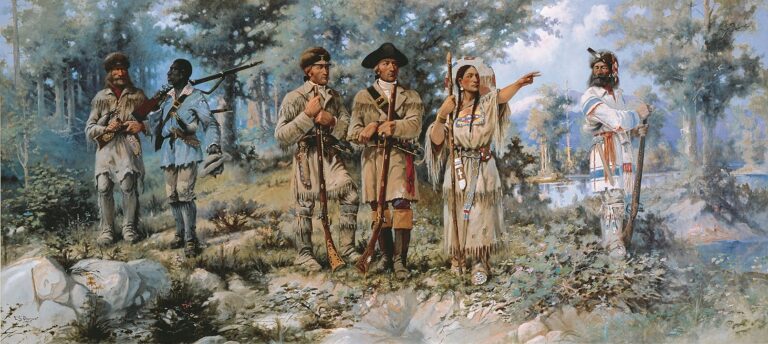
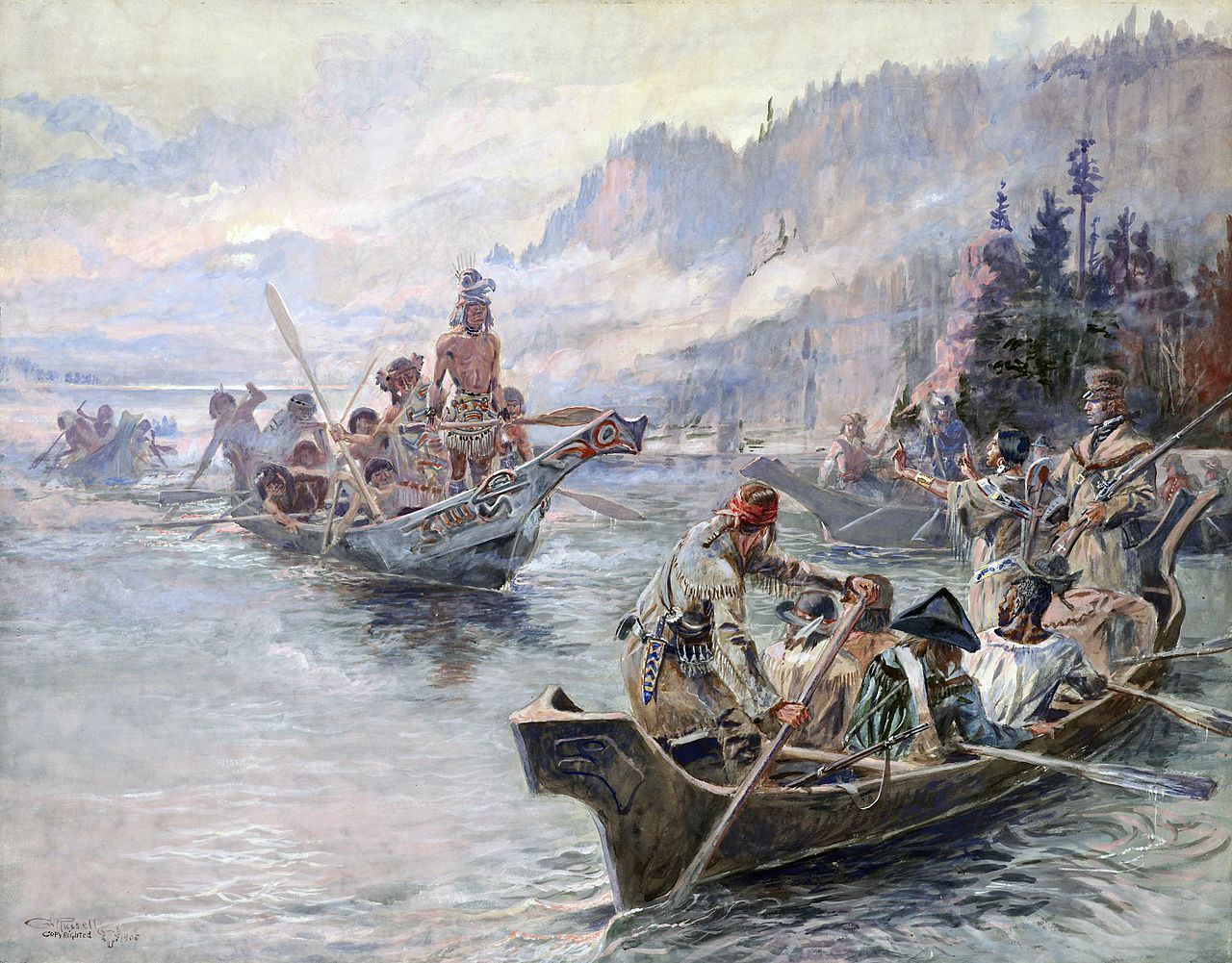
Thomas Mickell Burnham (1818–1866) was a Boston-based painter best known for genre scenes and political subjects, including his 1844 painting of an election day in front of the Massachusetts State House. He worked at some remove from the western frontier and almost certainly never saw the landscapes he depicted here, relying instead on published accounts and the visual conventions of contemporary landscape painting. The work now resides in the collection of the Tacoma Art Museum, which holds significant western American material, and has been reproduced in Lewis and Clark scholarship as one of the earliest oil paintings to attempt a group portrait of the expedition members, predating by half a century the more familiar treatments by Charles M. Russell and Edgar S. Paxson.