Mount Hood, Oregon
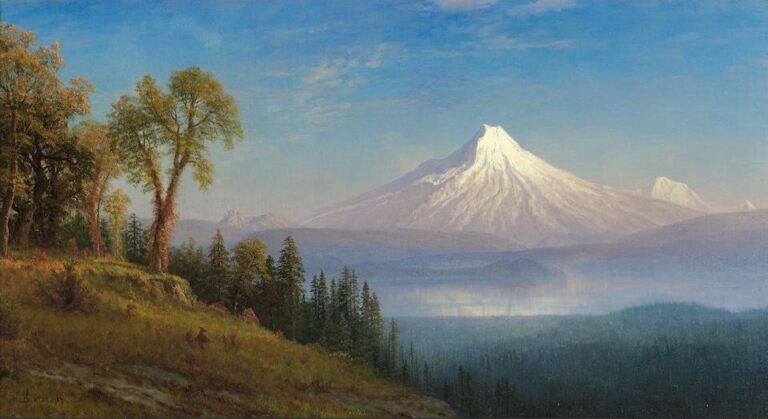
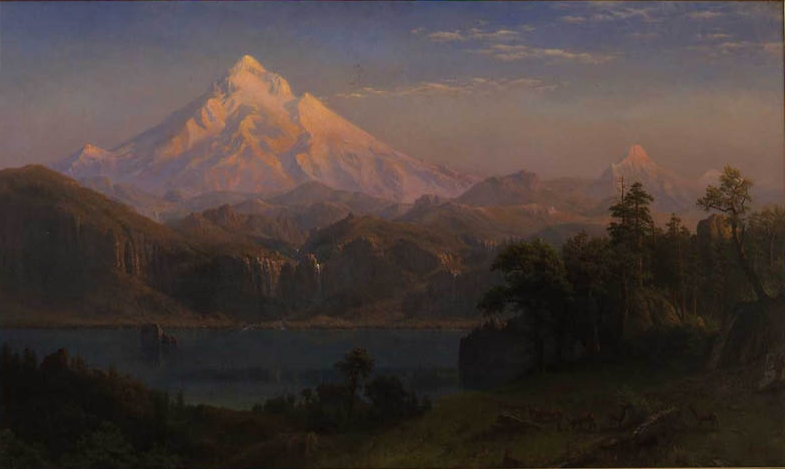
Bierstadt’s “Mount Hood, Oregon” presents the 11,250-foot stratovolcano rising above the forested Cascade foothills, its snow-covered peak catching light against a sky banked with cloud. The composition follows the artist’s standard formula for his major western landscapes: a darkened foreground of trees and water, a luminous middle distance, and the mountain itself pushed back into atmosphere so that scale reads as immense. Painted in oil, the canvas works the contrast between geological permanence and the transient effects of weather and light that Bierstadt had studied during his training in Düsseldorf in the 1850s.
The painting dates to 1869, the year after Bierstadt’s second major western trip and at the height of his commercial success. He had visited Oregon and the Columbia River region in 1863, sketching Mount Hood and the surrounding country during a journey that produced several large studio canvases over the following decade. The late 1860s marked the peak of public appetite for grand western landscapes in the wake of the Civil War, as railroad expansion and federal survey expeditions drew eastern viewers toward images of the trans-Mississippi country. Mount Hood itself had been a landmark for the Lewis and Clark Expedition in the fall of 1805, when the captains identified it from the Columbia using the earlier nomenclature of British navigator George Vancouver, whose Lieutenant William Broughton had named the peak in 1792.
Bierstadt (1830–1902) built his reputation on monumental views of Yosemite, the Rockies, and the Sierra Nevada, and Mount Hood occupied a comparatively small place in his Pacific Northwest output relative to his California and Wyoming subjects. His style fell out of fashion in the 1880s as American taste shifted toward Barbizon-influenced tonalism and Impressionism, and he died in relative obscurity before being reassessed in the mid-twentieth century. The painting is held by the Portland Art Museum, where it functions as one of the institution’s principal nineteenth-century landscapes and as a touchstone for the visual history of the Columbia River corridor traveled by Lewis and Clark sixty-four years before Bierstadt set up his easel in the region.
Scene Location
Mount Hood, Oregon