Pipestone Quarry on the Coteau des Prairies
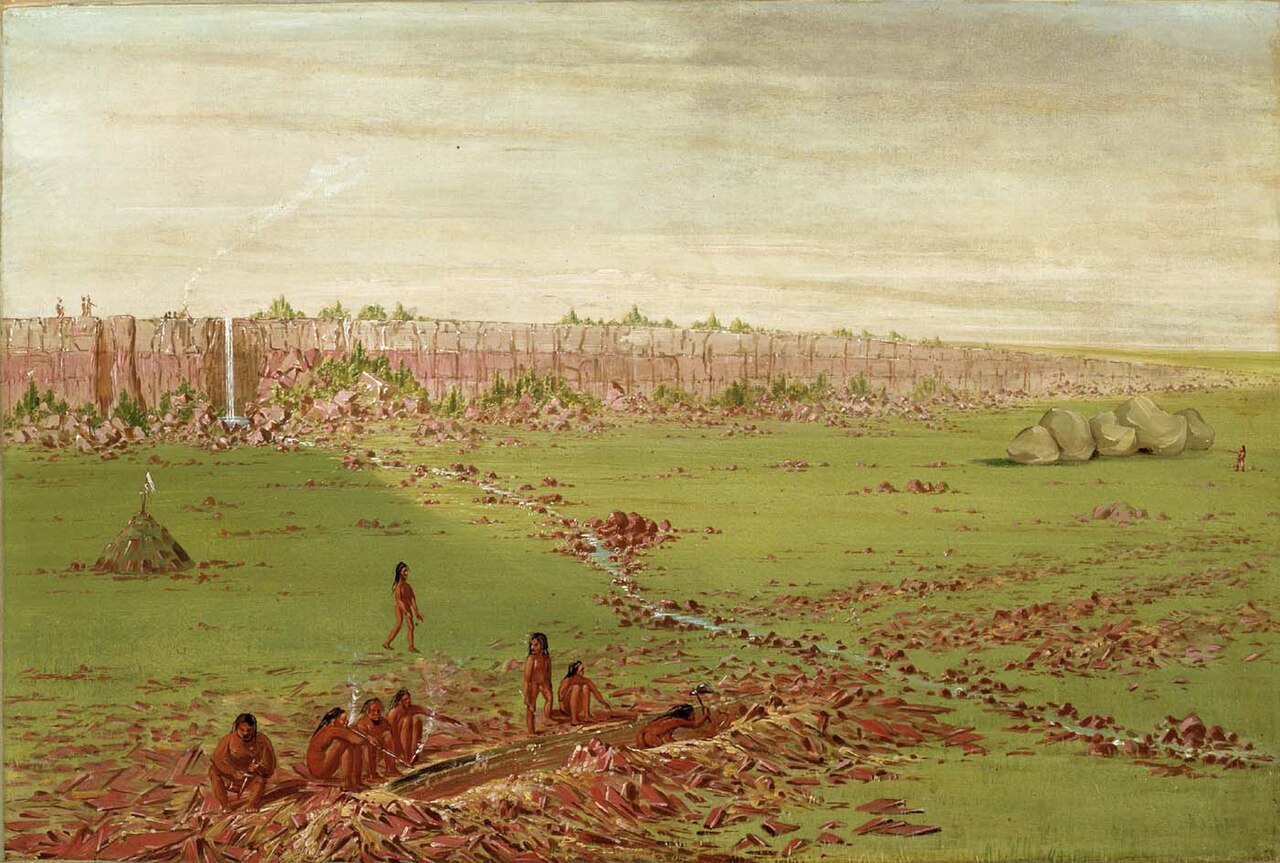
Catlin’s painting depicts the red pipestone quarry on the Coteau des Prairies in what is now southwestern Minnesota, a site sacred to numerous Plains tribes as the source of the soft red stone used for ceremonial pipes. The composition shows the quarry’s distinctive geological feature: a long, low escarpment of pink and gray quartzite running across the middle distance, with the exposed seam of catlinite at its base. Small figures of Native quarrymen labor at the rock face, dwarfed by the formation. The foreground opens onto rolling prairie, and Catlin includes large glacial boulders—the Three Maidens, granite erratics that mark the approach to the quarry. The handling is broad and loose, with thin paint and rapid brushwork typical of his fieldwork-derived studio pictures.
Catlin visited the quarry in 1836, traveling overland from Fort Snelling against the objections of Yankton Dakota who controlled access to the site and discouraged outside visitors. He was the first white artist to document the location, and he collected samples of the stone that were later analyzed by Boston mineralogist Charles T. Jackson, who named the mineral catlinite in his honor. The painting was made in the wake of this trip, part of the body of work Catlin assembled from his journeys across the upper Missouri and northern plains between 1830 and 1836. By this date he was actively building his Indian Gallery for public exhibition, having concluded that traditional Plains lifeways were rapidly disappearing.
Catlin (1796–1872) trained as a lawyer before turning to portraiture and then to his self-assigned project of documenting Native peoples west of the Mississippi. The pipestone canvas belongs to the core Indian Gallery collection that he toured in the United States and Europe, struggled to sell to Congress, and ultimately lost to creditors; it was acquired by the Smithsonian after his death through the bequest of Joseph Harrison’s widow in 1879. The quarry site Catlin recorded was designated Pipestone National Monument in 1937, and his painting remains the earliest pictorial record of a place that figured into the broader nineteenth-century documentation of the trans-Mississippi West initiated by Lewis and Clark a generation earlier.
Scene Location
Pipestone, Minnesota