Floyd’s Grave
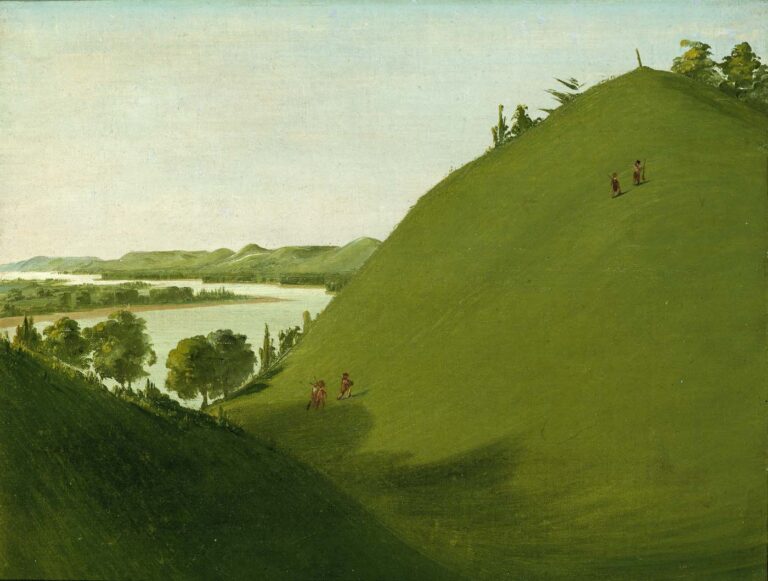
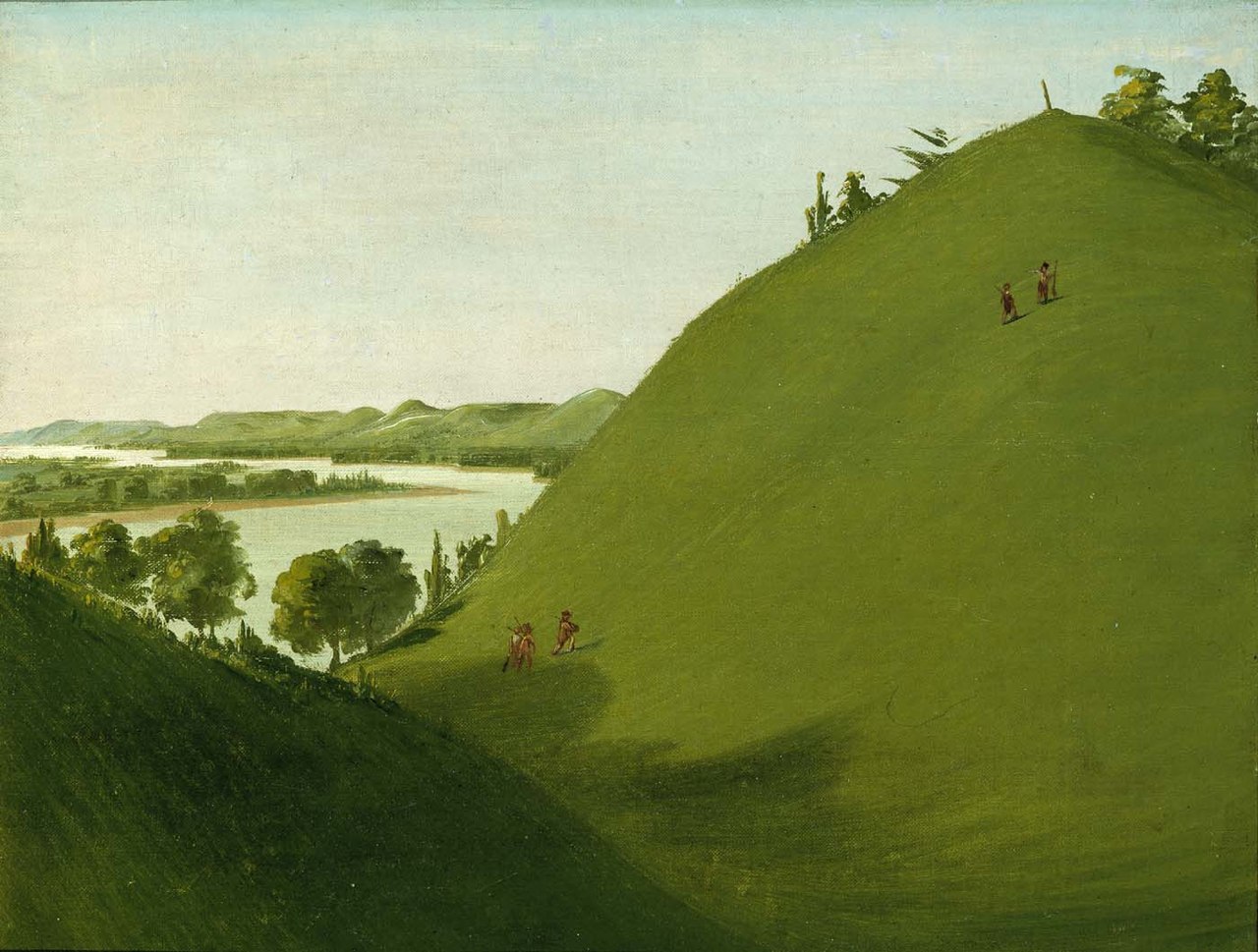
Catlin’s painting shows a conical earthen mound topped by a wooden marker on a high bluff above the Missouri River. The composition is dominated by the sweeping curve of the river below and the expanse of prairie sky; the grave itself is a small but central feature on the elevated ground at left, with two figures standing nearby for scale. The treatment is loose and atmospheric, characteristic of Catlin’s field practice—broad washes of color, minimal detail, and a horizon line that emphasizes the openness of the Upper Missouri landscape.
The site depicted is the burial place of Sergeant Charles Floyd, the only member of the Lewis and Clark Expedition to die during the journey. Floyd succumbed on August 20, 1804, near present-day Sioux City, Iowa, almost certainly from a ruptured appendix, and the captains buried him on a prominent bluff overlooking the river, marking the grave with a cedar post inscribed with his name and rank. Catlin passed the spot in 1832 during his ascent of the Missouri aboard the steamboat Yellow Stone, the same voyage that produced the bulk of his Plains Indian portraits and landscapes. By the time of his visit, the marker had been disturbed and the mound partially eroded, and Catlin recorded the location both in paint and in the narrative he later published in 1841 as Letters and Notes on the Manners, Customs, and Condition of the North American Indians.
Catlin (1796–1872) had abandoned a legal career in the 1820s to document Native peoples of the American interior, and his 1832 trip up the Missouri yielded the core of what he called his Indian Gallery. Floyd’s Grave belongs to the landscape subset of that body of work, scenes recording specific places along the river rather than ethnographic subjects. The painting is held by the Smithsonian American Art Museum as part of the Catlin collection acquired from the artist’s widow’s estate in the late nineteenth century. The image has been frequently reproduced in Lewis and Clark scholarship as one of the earliest visual records of the Floyd burial site, which was subsequently lost to erosion and reinterred several times before the present obelisk was erected in 1901.
Scene Location
Near Sioux City, Iowa