Bull Dance, Mandan O-kee-pa Ceremony
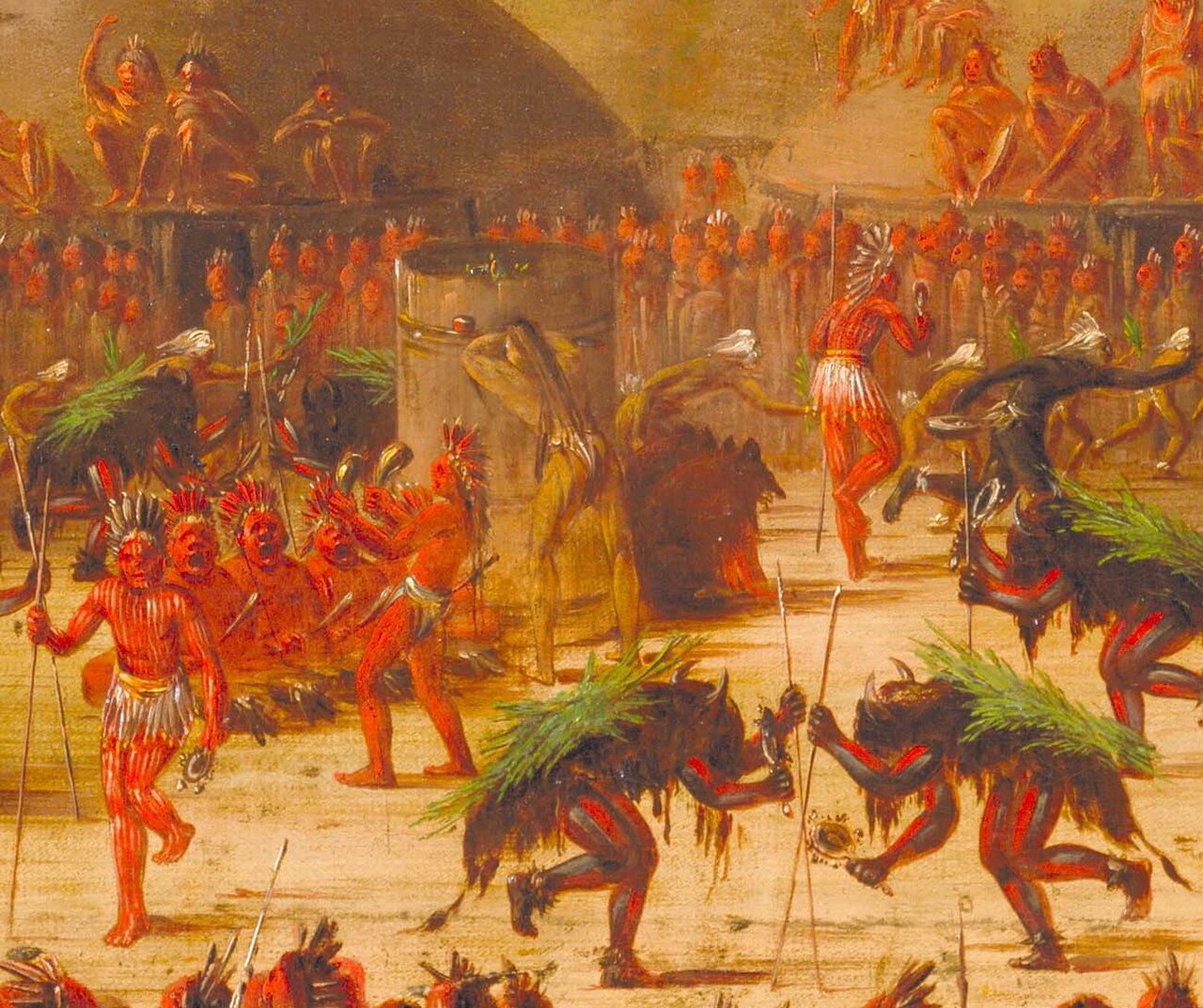
Catlin’s painting depicts the central public day of the Mandan O-kee-pa, the four-day ceremony held annually in the earth-lodge villages on the upper Missouri. In the foreground, eight male dancers move in a circle around the sacred cedar post and plank enclosure that stood at the center of the Mandan plaza. Four of the dancers wear buffalo-head masks with horns and trailing hides, representing the bulls; the others carry rattles and staffs. Their bodies are painted in red, black, and white according to ritual prescription. Behind them, Catlin renders the packed earth lodges of the village, with spectators clustered on the rounded roofs and along the perimeter of the plaza. The medicine lodge stands at left. The composition is built around the dark central post and the encircling dance, painted loosely and at speed in the manner of Catlin’s field studies.
Catlin witnessed the O-kee-pa in the Mandan village of Mih-tutta-hang-kusch, near present-day Stanton, North Dakota, during the summer of 1832, while traveling up the Missouri aboard the American Fur Company steamboat Yellow Stone. He was among the few outsiders ever to observe the ceremony in full; the Mandan population was nearly destroyed by the smallpox epidemic of 1837, and the ritual was effectively ended within a generation of his visit. The Bull Dance was the public portion of a rite concerned with the renewal of the buffalo herds and the reenactment of Mandan origin narratives. Lewis and Clark had wintered with the Mandan in 1804–1805 at Fort Mandan, roughly fifty miles downstream, but did not record the ceremony itself.
The painting is part of Catlin’s Indian Gallery, the body of more than 500 portraits and scenes he produced during his travels among Plains and Woodlands peoples in the 1830s. After decades of touring the Gallery in the United States and Europe in an unsuccessful effort to sell it to Congress, the works were acquired by the railroad investor Joseph Harrison and donated by his widow to the Smithsonian in 1879. Catlin later expanded his Mandan material into the 1867 monograph O-kee-pa: A Religious Ceremony, which remains the principal ethnographic source on the rite and for which this canvas serves as the key visual document.
Scene Location
Mandan Village, near Washburn, North Dakota