Buffalo Chase, Mouth of the Yellowstone
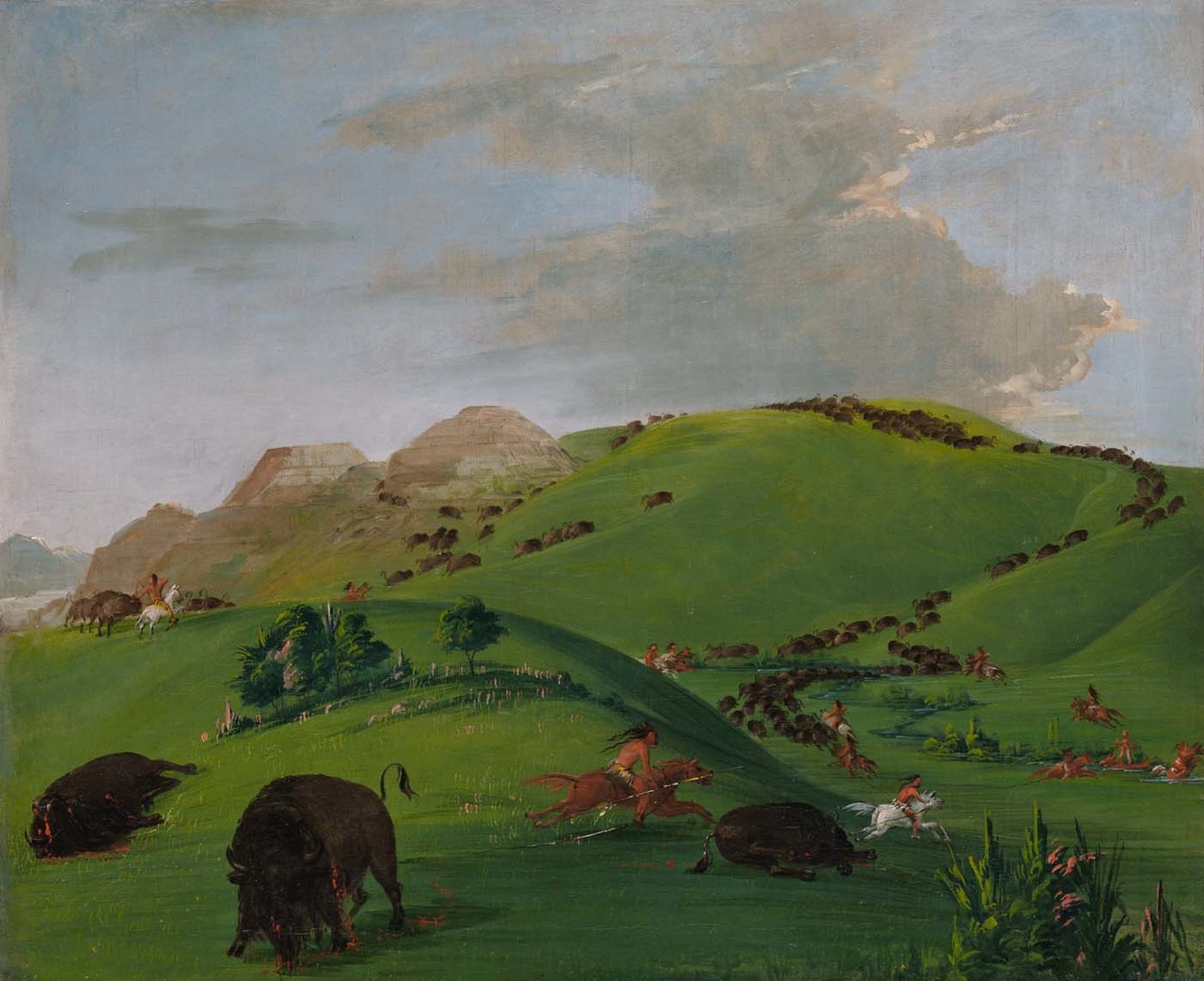
George Catlin’s Buffalo Chase, Mouth of the Yellowstone depicts a group of mounted Plains hunters pursuing bison across open prairie near the confluence of the Yellowstone and Missouri Rivers. The composition centers on a hunter drawing his bow against a wounded bull, with additional riders and fleeing buffalo scattered across a middle ground that opens onto a broad, low horizon. Catlin painted the scene in oil on canvas at modest easel scale, using rapid brushwork and a muted palette of browns, ochres, and dust-toned greens. The handling is characteristic of his fieldwork: figures are summarily modeled, the ground is loosely scumbled, and the sky carries the bulk of the atmospheric weight.
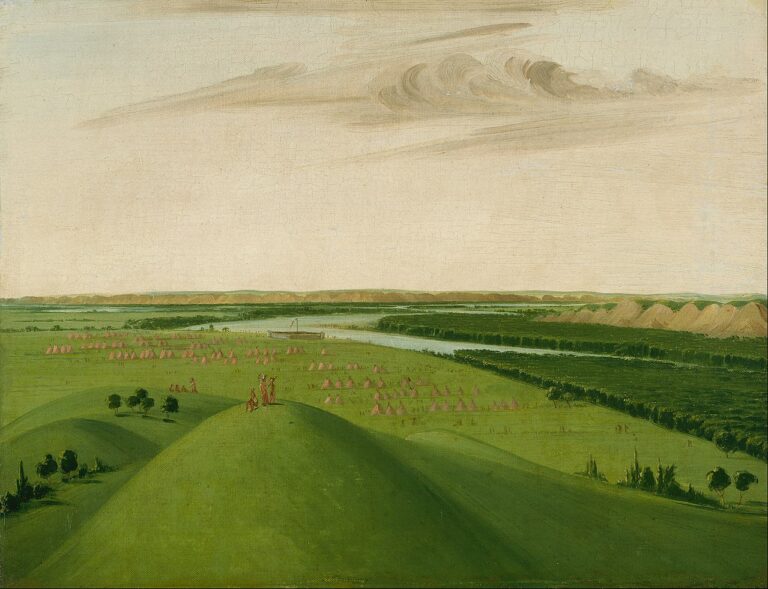
The painting dates from Catlin’s 1832 ascent of the Missouri aboard the American Fur Company steamboat Yellow Stone, which carried him as far as Fort Union, established two years earlier at the mouth of the Yellowstone River in present-day North Dakota. He spent several weeks there in the summer of 1832 sketching Assiniboine, Crow, Blackfeet, and Plains Cree visitors to the post and observing communal buffalo hunts on the surrounding plains. Lewis and Clark had passed the same river junction in April 1805 on the outbound leg of their expedition and again in August 1806 on the return, and the site remained a key geographic marker for the fur trade Catlin documented a generation later. He worked up many of the Fort Union subjects into finished oils during the winter of 1832–1833 in St. Louis.
Catlin (1796–1872) trained as a lawyer before turning to portraiture and, in 1830, committing himself to recording Native peoples of the trans-Mississippi West. Buffalo Chase, Mouth of the Yellowstone belongs to his Indian Gallery, the roughly 500-painting body of work he exhibited in American and European cities through the 1830s and 1840s. After decades of financial trouble, the core of the Gallery entered the Smithsonian in 1879 through the bequest of Joseph Harrison’s widow and is now held by the Smithsonian American Art Museum. The buffalo-hunt subjects in particular have been frequently reproduced in publications on the Upper Missouri and the Lewis and Clark route.
Scene Location
Mouth of the Yellowstone River, North Dakota