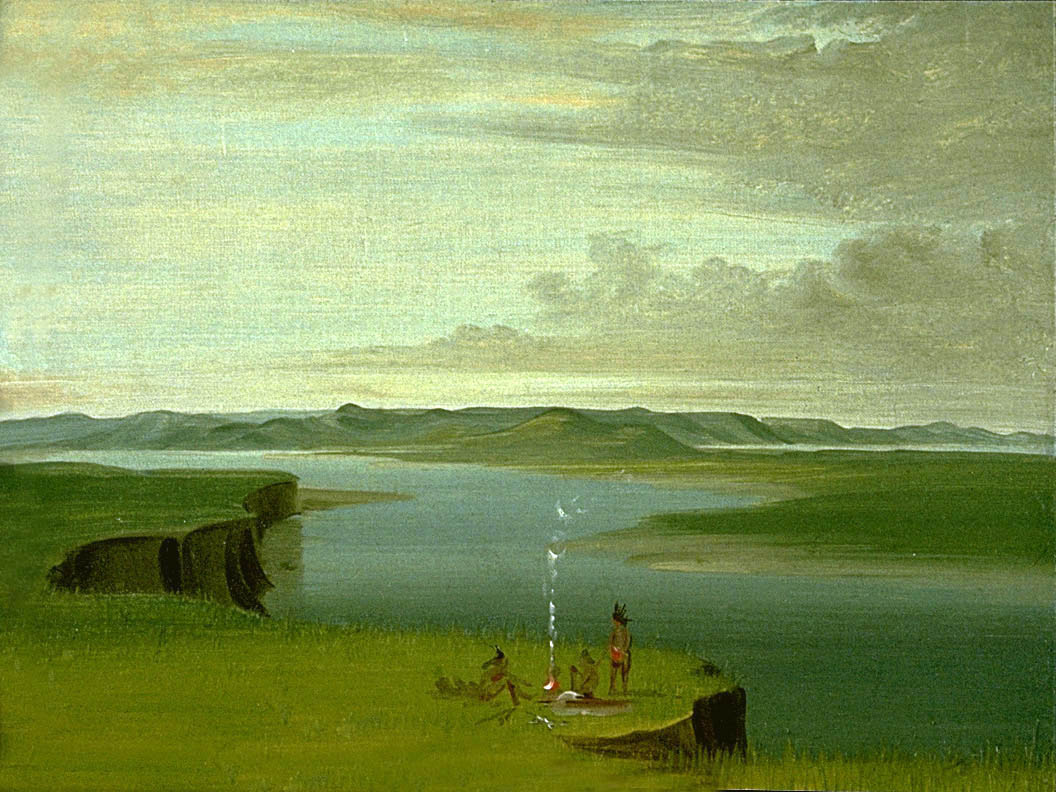
Prairie Bluffs at Sunrise, near the Mouth of the Yellowstone River
Catlin’s small oil shows the eroded bluffs along the upper Missouri near its confluence with the Yellowstone River, rendered in the soft, raking light of early morning. The composition is horizontal and spare: layered tablelands recede into the distance, their stratified faces catching pink and amber tones against a pale sky, while the foreground holds the flat valley floor and a suggestion of river. There are no figures. Catlin worked thinly and quickly in oil on a modestly sized canvas, treating the bluffs almost as portraiture—each rise distinguished by its silhouette and the weathered grooves cut into its sides. The handling is loose, with broad washes for sky and ground and more directed brushwork on the bluff faces themselves.
The painting dates to Catlin’s 1832 voyage up the Missouri aboard the American Fur Company steamboat Yellow Stone, which reached Fort Union—near the mouth of the Yellowstone River in present-day North Dakota—in late June of that year. Catlin spent several weeks at the post painting Assiniboine, Crow, Blackfeet, Cree, and Ojibwe visitors and sketching the surrounding country before descending the river by canoe. The journey followed the route Lewis and Clark had traveled in April 1805, and Catlin was conscious of working in their wake. The bluffs near the confluence had been described in the expedition journals; Catlin was among the first artists to render them.
This canvas belongs to the core group of field studies Catlin produced during his 1832 Missouri trip, the campaign that established his reputation and supplied material for his Indian Gallery, which he toured through American and European cities beginning in 1837. Like most of those works, it remained with the artist through decades of financial difficulty until the collection was acquired by the Philadelphia industrialist Joseph Harrison, Jr., who rescued it from a Pennsylvania boiler works. Harrison’s widow gave the group to the Smithsonian in 1879, and it now resides at the Smithsonian American Art Museum. Catlin’s upper Missouri landscapes have been frequently reproduced in Lewis and Clark scholarship as the earliest painted record of the country the expedition crossed.