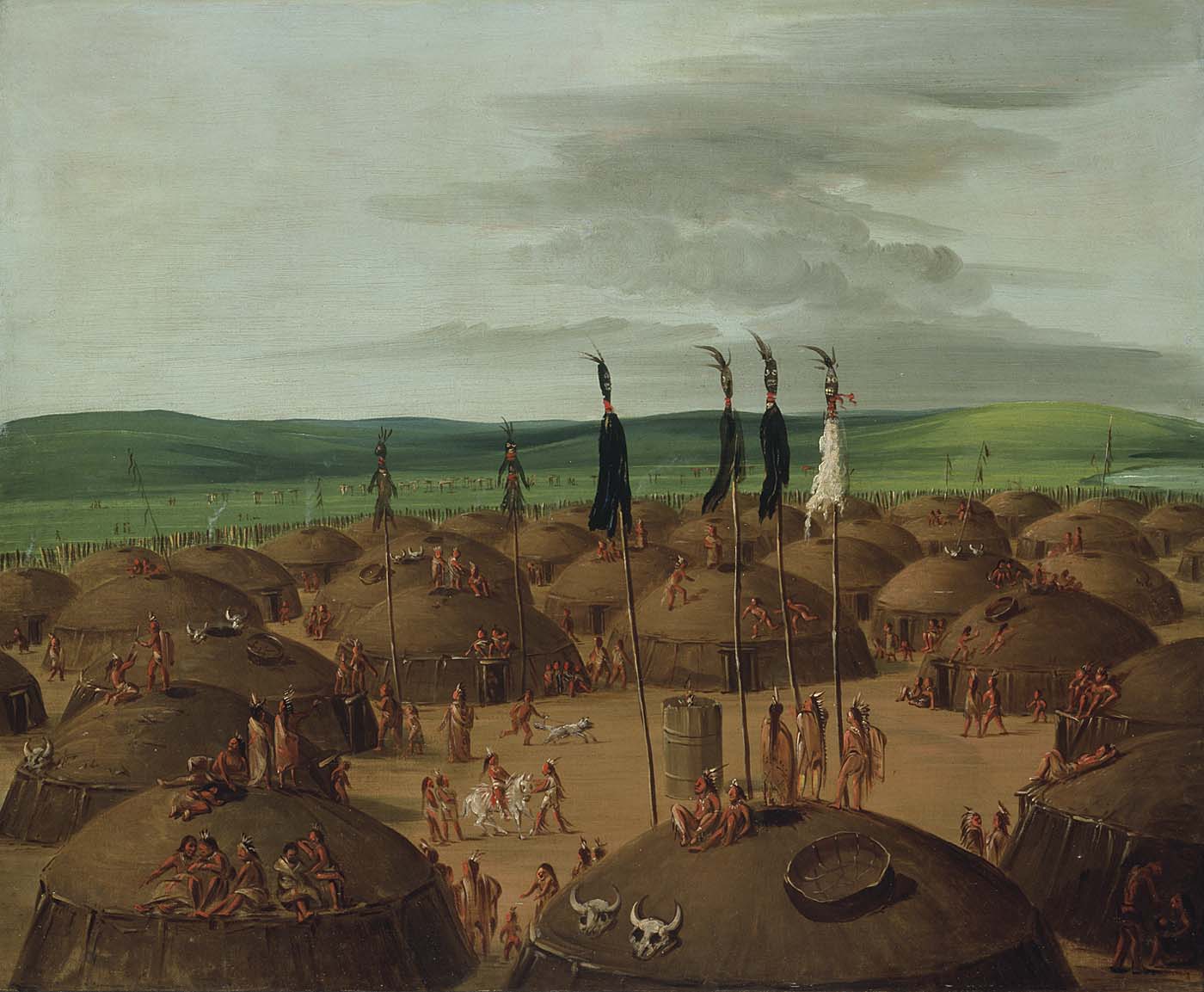
Bird’s-eye View of the Mandan Village, 1800 Miles above St. Louis
Catlin’s painting presents an elevated, oblique view of an earthlodge village on a bluff above the Missouri River. Dozens of domed earthen lodges are packed within a circular palisade of vertical timbers, with a central open plaza where a cedar post stands enclosed by a plank shrine—the focal point of the Okipa ceremony. Scaffolds for drying meat and hides rise between the lodges, and the rooftops themselves serve as gathering places, dotted with seated figures, bullboats stored upside down, and racks of weapons and shields. Outside the palisade, the bluff drops to the river, where canoes are pulled up on the bank and a procession of villagers moves along a path. Catlin worked in oil with the rapid, slightly flattened handling typical of his field-based ethnographic pictures, prioritizing the legibility of cultural detail over atmospheric finish.
Catlin visited the Mandan villages in the summer of 1832, traveling upriver on the American Fur Company steamboat Yellow Stone. The view records the larger of the two principal Mandan towns near the mouth of the Knife River, the same complex of villages where Lewis and Clark had wintered in 1804–1805 at nearby Fort Mandan. Catlin returned east with hundreds of sketches and studies, and worked them up into finished canvases between 1837 and 1839 for exhibition in his traveling Indian Gallery. The timing was consequential: a smallpox epidemic in 1837 destroyed the Mandan population Catlin had documented only five years earlier, giving his Mandan paintings a sudden documentary weight he had not anticipated.
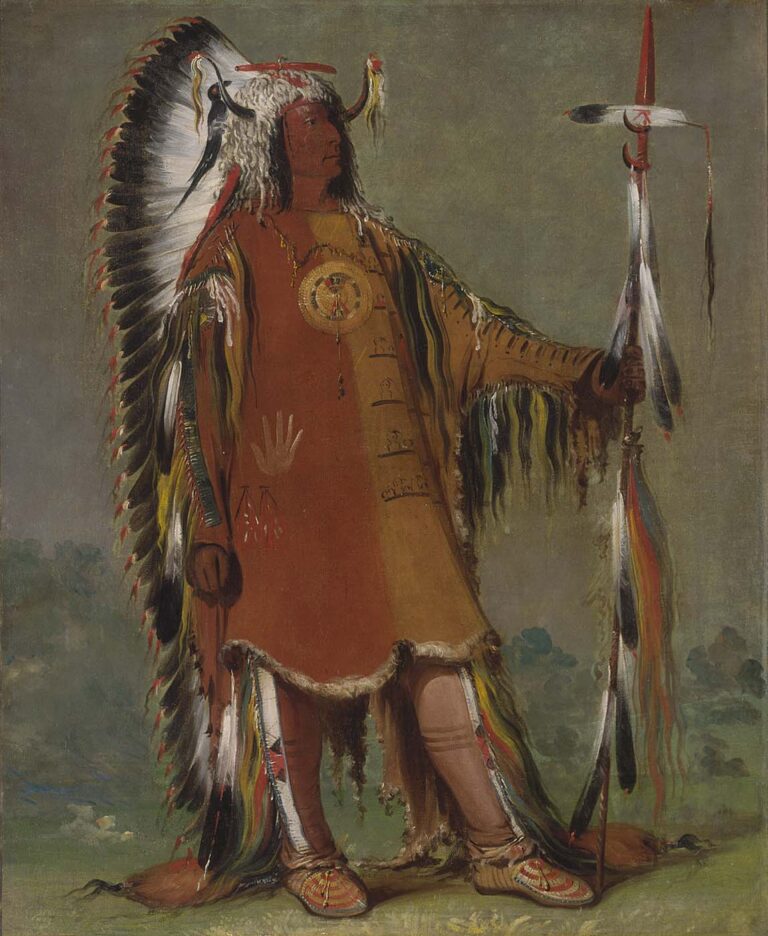
Catlin (1796–1872) built his career on the premise that Plains Indian life was vanishing and required pictorial recording, and the Mandan series—portraits of Mato-Tope, scenes of the Okipa, and overviews like this one—remains the most cited portion of his output. The Indian Gallery toured American and European cities through the 1840s before financial collapse forced its sale. Joseph Harrison, Jr., a Philadelphia industrialist, purchased the collection in 1852; his widow’s gift transferred it to what is now the Smithsonian American Art Museum. The bird’s-eye view has been reproduced repeatedly in studies of Mandan architecture, in Lewis and Clark scholarship concerned with the expedition’s winter quarters, and in the ethnohistorical literature on the pre-epidemic upper Missouri.