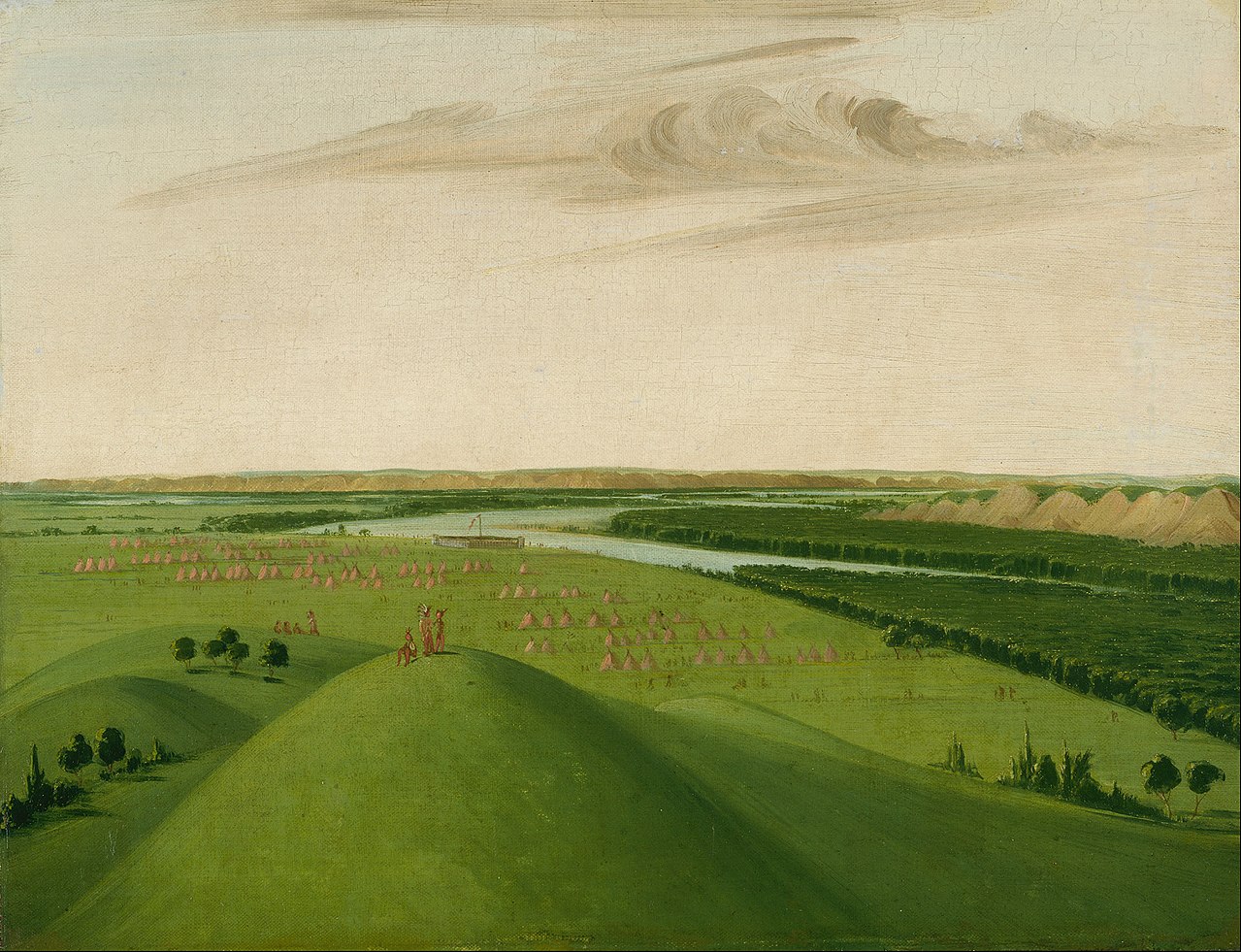
Fort Union, Mouth of the Yellowstone River
Catlin’s view shows the American Fur Company’s Fort Union, completed in 1828 at the confluence of the Missouri and Yellowstone Rivers in what is now western North Dakota. The painting presents the post from a distance across open prairie, with the palisaded walls, bastions, and central flagpole rendered in pale tones against a wide sky. In the foreground, mounted and standing figures—both Native and Euro-American—gather near the riverbank, with tipis pitched outside the walls and small groups dispersed across the middle ground. The handling is rapid and thin, characteristic of Catlin’s field practice: forms are blocked in with economical brushwork, and topographical accuracy takes precedence over finish.
Catlin reached Fort Union in June 1832 aboard the steamboat Yellow Stone on its second annual voyage upriver, an event that opened the upper Missouri to regular steam navigation. He stayed several weeks as the guest of Kenneth McKenzie, the trader who ran the post, and used it as a base to paint portraits of Assiniboine, Crow, Cree, Blackfeet, and Plains Ojibwe visitors who came to trade. The site lay roughly twenty-five miles below the spot where Lewis and Clark had camped in late April 1805, on their outbound journey, and again in August 1806 returning east. By the time Catlin arrived, the fur trade had transformed the confluence from the unsettled landscape the captains described into the principal commercial hub of the northern plains.
Catlin (1796–1872), trained as a lawyer in Pennsylvania before turning to portraiture, undertook five trips into Indian country between 1830 and 1836, producing the roughly five hundred paintings that became his Indian Gallery. The 1832 Missouri trip yielded his most ambitious body of work, including the Fort Union views and the portraits made there. The painting is held by the Smithsonian American Art Museum as part of the Indian Gallery, the bulk of which entered the Smithsonian in 1879 through the gift of Joseph Harrison’s widow, after Catlin had failed for decades to sell the collection to the U.S. government. The Fort Union images remain among the earliest visual records of the upper Missouri trading frontier that succeeded the expedition’s reconnaissance.
Scene Location
Fort Union, Mouth of the Yellowstone, North Dakota