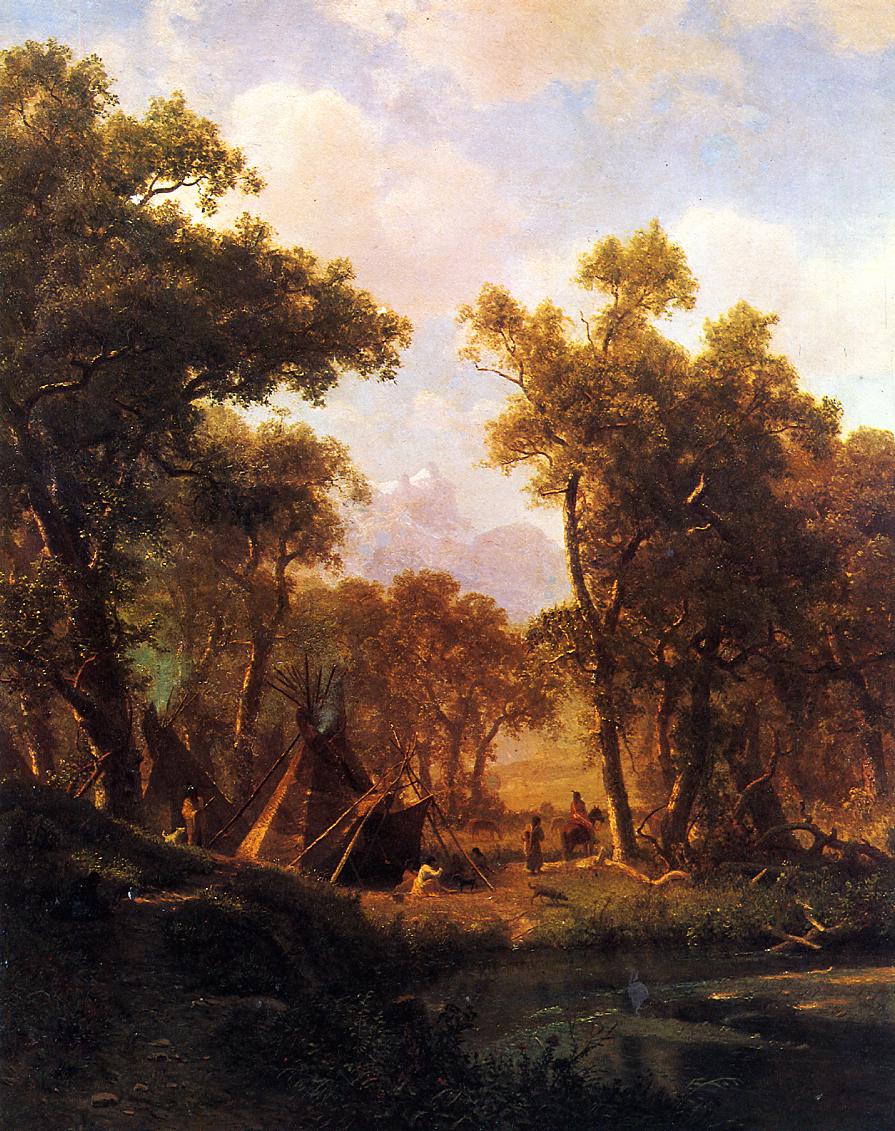
Indian Encampment, Shoshone Village
Bierstadt’s Indian Encampment, Shoshone Village shows a cluster of conical hide lodges set on open ground beneath the Wind River Mountains of present-day Wyoming. Small figures move among the tipis and along the bank of the Sweetwater River, with horses scattered through the middle distance. The painter has compressed the encampment into the lower third of the composition, reserving the upper two-thirds for the granite peaks and a luminous, atmospheric sky. Executed in oil on millboard at roughly two feet in height, the panel has the worked-up surface of a finished studio piece rather than a quick field sketch, though Bierstadt drew on plein-air studies for the topography and the quality of mountain light.
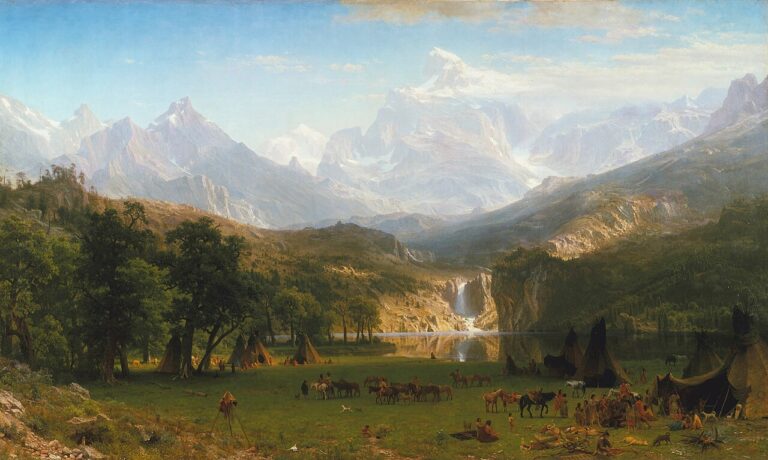
The picture dates to 1860, the year after Bierstadt’s first trip west. In 1859 he had accompanied Colonel Frederick W. Lander’s wagon-road survey across the South Pass region, sketching the Wind River Range, the Sweetwater drainage, and the Shoshone bands camped along Lander’s route. He returned to his New York studio with portfolios of drawings, photographs, and Indian artifacts, and through 1860 and 1861 produced a sequence of paintings drawn from this material. Indian Encampment, Shoshone Village belongs to that first western group, predating the large-scale exhibition canvases—The Rocky Mountains, Lander’s Peak (1863) chief among them—that would make his reputation. The Shoshone country it depicts is the same ground Lewis and Clark traversed in August 1805, when Sacagawea’s reunion with her brother Cameahwait at the Lemhi-Shoshone camps secured the horses the expedition needed to cross the Bitterroots.
Bierstadt (1830–1902), Düsseldorf-trained and based in New Bedford and later New York, built his career on western subjects of exactly this kind, balancing ethnographic specificity with Romantic landscape convention. The painting entered the collection of the New York merchant and philanthropist Robert L. Stuart and was given to The New-York Historical Society by his widow, Mary Stuart, as part of the Stuart bequest. It remains in that collection. Within the Lewis and Clark visual tradition, Bierstadt’s Shoshone subjects have long served as the standard imagery of the Wind River country the captains crossed, even though they postdate the expedition by more than half a century.