Puget Sound on the Pacific Coast
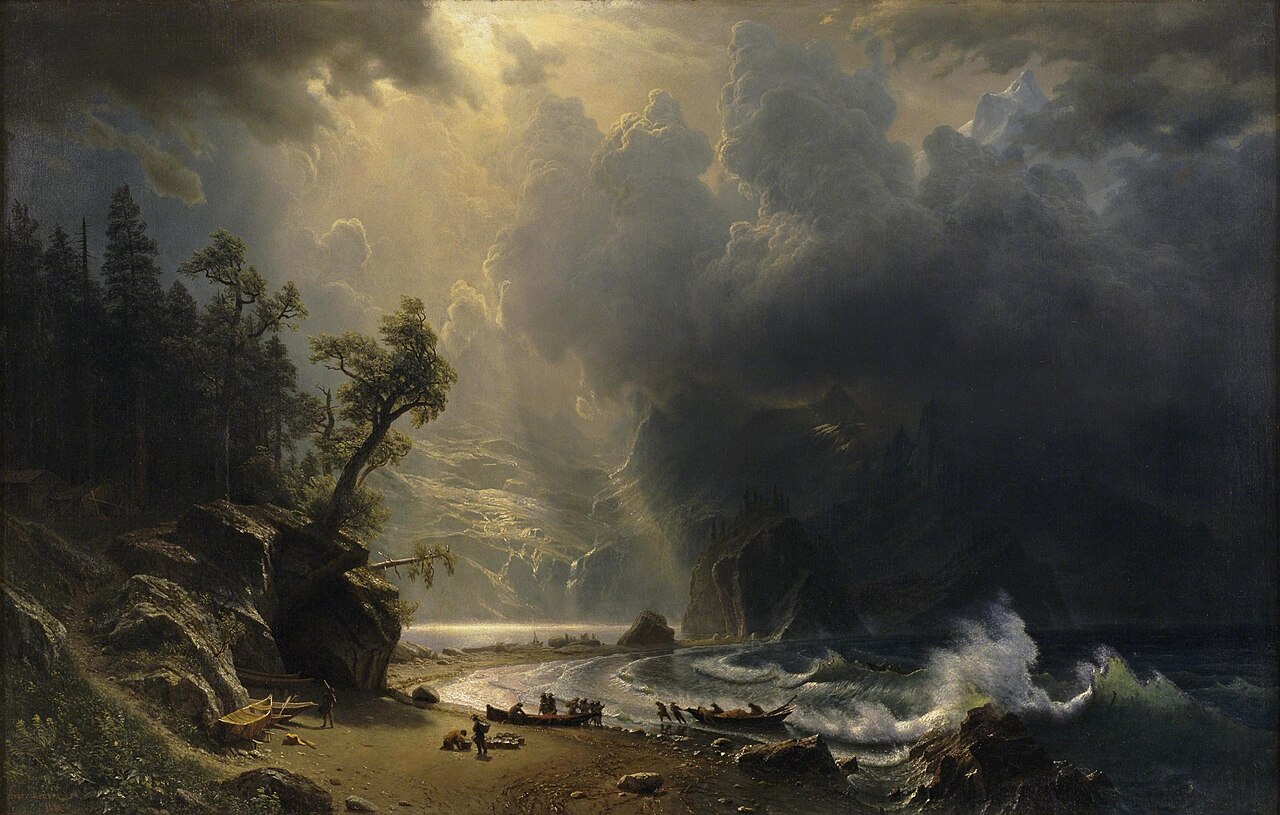
Bierstadt’s canvas shows a storm-battered stretch of the Pacific Northwest coast, with breaking surf in the foreground, a beached or foundering vessel listing on the rocks, and shadowy figures of Native fishermen working among the shallows. Cliffs and timbered headlands rise on the left, while a wedge of luminous sky breaks through the storm clouds above the open water on the right. The composition follows Bierstadt’s standard formula of theatrical contrasts: dark, rocky foreground masses, a middle ground of churning sea, and a softened, atmospheric distance bathed in filtered light. Despite the title’s specificity, the scene is a composite invention rather than a topographically accurate view of Puget Sound proper, which is a protected inland waterway, not an exposed surf coast.
The painting was produced in 1870, near the height of Bierstadt’s commercial success and shortly after his second extended western trip of 1863, which included travel to the Pacific Coast and Oregon. By the late 1860s Bierstadt had moved beyond the Rocky Mountain subjects that made his reputation and was producing large coastal and marine pictures aimed at the same audience of American collectors and European patrons. The work belongs to a broader cultural moment in which the recently acquired or recently consolidated Pacific territories—Washington Territory had been organized in 1853—were being visualized for eastern viewers who had never seen them.
Bierstadt (1830–1902), German-born and Düsseldorf-trained, was the dominant painter of the western American landscape in the 1860s and early 1870s before his reputation declined under critics who found his canvases bombastic and his geography unreliable. Puget Sound on the Pacific Coast is among the larger surviving examples of his coastal subjects and has been part of the Seattle Art Museum collection, where it is one of the institution’s signature nineteenth-century holdings. While the painting does not depict a Lewis and Clark Expedition event, it occupies the same imaginative territory the Corps of Discovery reached in November 1805, when Clark recorded his famous “Ocian in view!” entry near the mouth of the Columbia, roughly 150 miles south of the body of water Bierstadt named in his title.
Scene Location
Puget Sound, Washington