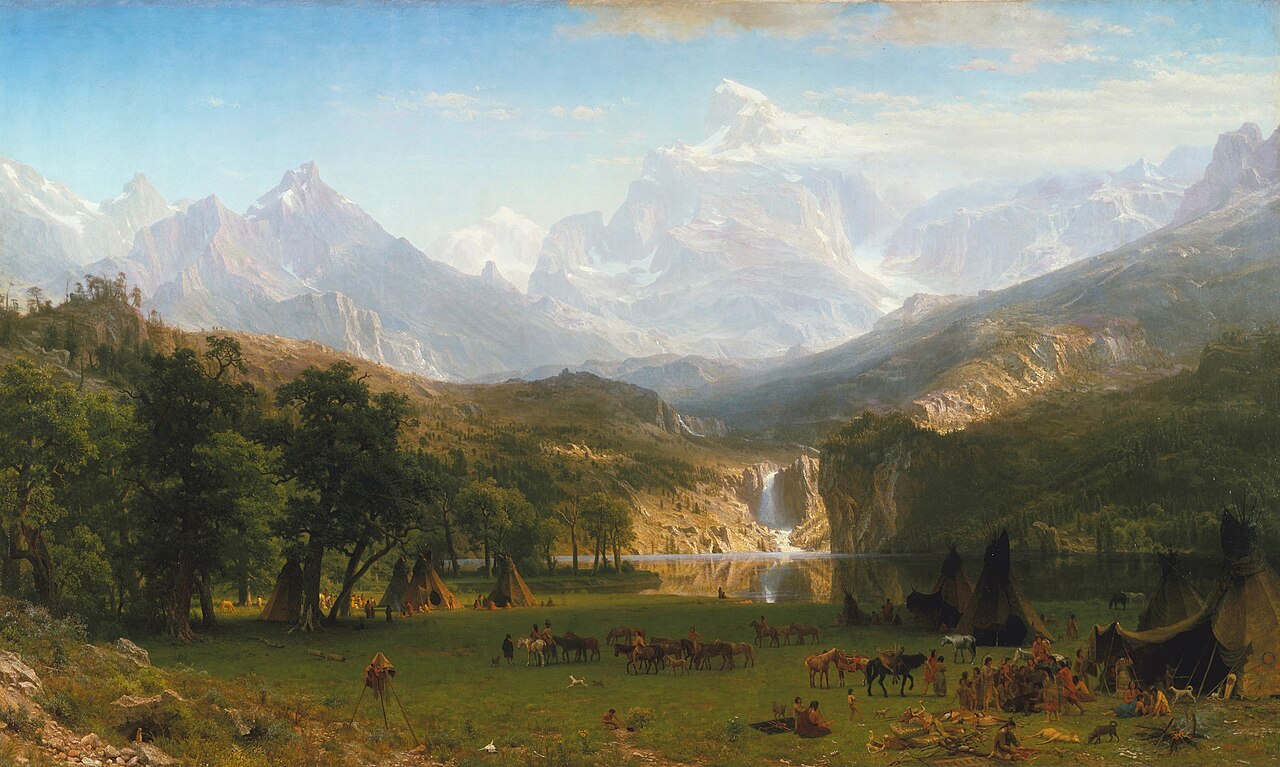
The Rocky Mountains, Lander’s Peak
Bierstadt’s monumental canvas presents an idealized panorama of the Wind River Range in present-day Wyoming, with the snow-capped summit of Lander’s Peak rising at center-right above a chain of secondary ridges and a glacial valley. The middle ground opens onto a sunlit meadow where a Shoshone encampment occupies the foreground: tipis, figures preparing game, horses, and a small stream that cascades from the cliffs above. Bierstadt builds the composition in three carefully graded zones—the warmly lit native camp, a darker forested middle distance with a reflective lake, and the cool, atmospheric peaks behind—using the academic landscape conventions he had absorbed in Düsseldorf. The handling is meticulous: individual pine boughs, lichen on rock faces, and the costumes of the Shoshone figures are rendered with near-ethnographic specificity, while the upper reaches dissolve into the luminous mist that became his signature.
The painting derives from sketches and photographs Bierstadt made during his 1859 expedition west with Colonel Frederick W. Lander’s overland survey, which mapped a wagon route through South Pass. Lander was killed in the Civil War in 1862, and Bierstadt named the peak in his honor when he completed the studio painting the following year. Exhibited in New York in 1863, the canvas appeared at a moment when the Union public, weary of war news, embraced grand western scenery as a vision of national continuity and territorial promise. It was shown alongside Frederic Church’s Heart of the Andes and helped establish Bierstadt as Church’s principal rival among American landscape painters.
Bierstadt (1830–1902) had emigrated from Prussia as a child and trained in Düsseldorf in the mid-1850s before turning to western subjects, which would occupy him for three decades. Lander’s Peak was purchased by the railroad entrepreneur James McHenry for a reported $25,000, an enormous sum for an American painting at the time, and was acquired by the Metropolitan Museum of Art in 1907 through the bequest of Rogers Fund purchases. Although the scene lies south of the Lewis and Clark route, the painting has long served as a visual shorthand for the northern Rockies in popular publications about the expedition and the broader iconography of western exploration.
Scene Location
Wind River Range, Rocky Mountains, Wyoming