Mount St. Helens, Columbia River, Oregon
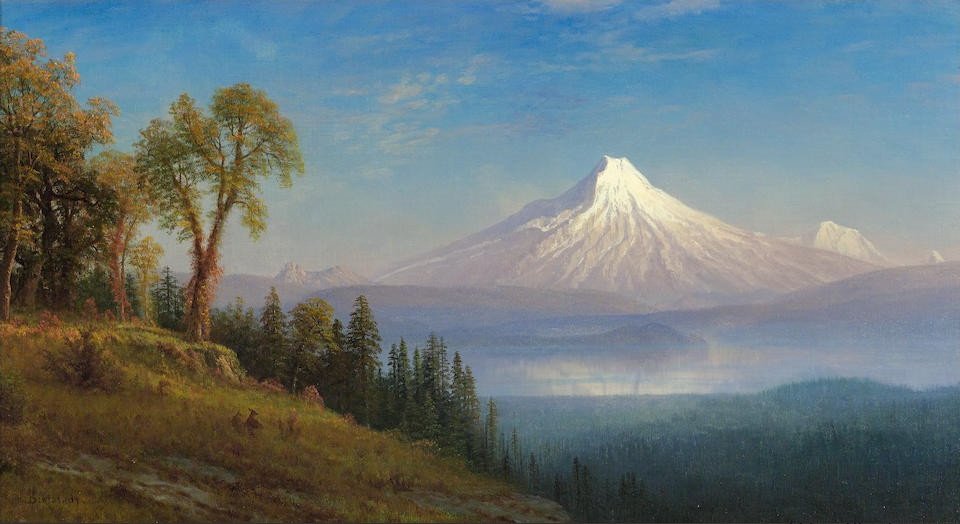
Bierstadt’s painting depicts Mount St. Helens rising in the distance above the Columbia River, its snow-covered cone catching light against a sky of broken clouds. The foreground occupies the lower third of the canvas with timbered slopes and the river’s surface reflecting the mountain and sky. The middle distance is given over to forested ridgelines that step back toward the volcano. As in much of Bierstadt’s late landscape work, the composition employs aerial perspective to exaggerate the apparent distance between the viewer and the peak, and the lighting suggests either early morning or late afternoon, with the mountain illuminated against cooler shadowed terrain.
Painted in 1889, the canvas belongs to the final productive decade of Bierstadt’s career, when his reputation had declined from its 1860s peak but he continued to produce Western subjects for private patrons and exhibition. Mount St. Helens, then still a symmetrical glaciated cone—nearly a century before its 1980 eruption reshaped the summit—had been a familiar landmark to travelers on the lower Columbia since the Lewis and Clark Expedition passed beneath it in November 1805 and again in spring 1806. While the painting does not depict an expedition event, it documents the river corridor the Corps of Discovery descended toward the Pacific, and the mountain itself was among the features Clark recorded in his journals.
Bierstadt (1830–1902), born in Prussia and raised in New Bedford, Massachusetts, built his career on monumental Western landscapes drawn from sketches made during his 1859 trip with Frederick W. Lander’s survey and subsequent travels through the Rockies, Yosemite, and the Pacific Northwest. He visited the Columbia River region in the 1880s, and works from that period—including views of Mount Hood, Mount Adams, and Mount St. Helens—reflect a renewed engagement with Pacific Northwest subjects late in life. This canvas is held in a private collection, and like many of Bierstadt’s later works it has circulated outside major museum holdings. Within the broader Lewis and Clark visual tradition, Bierstadt’s Columbia River paintings function less as narrative illustration than as records of the topographic landmarks the expedition encountered on its descent to the sea.
Scene Location
Mount St. Helens, Washington