The Grand Canyon of the Yellowstone
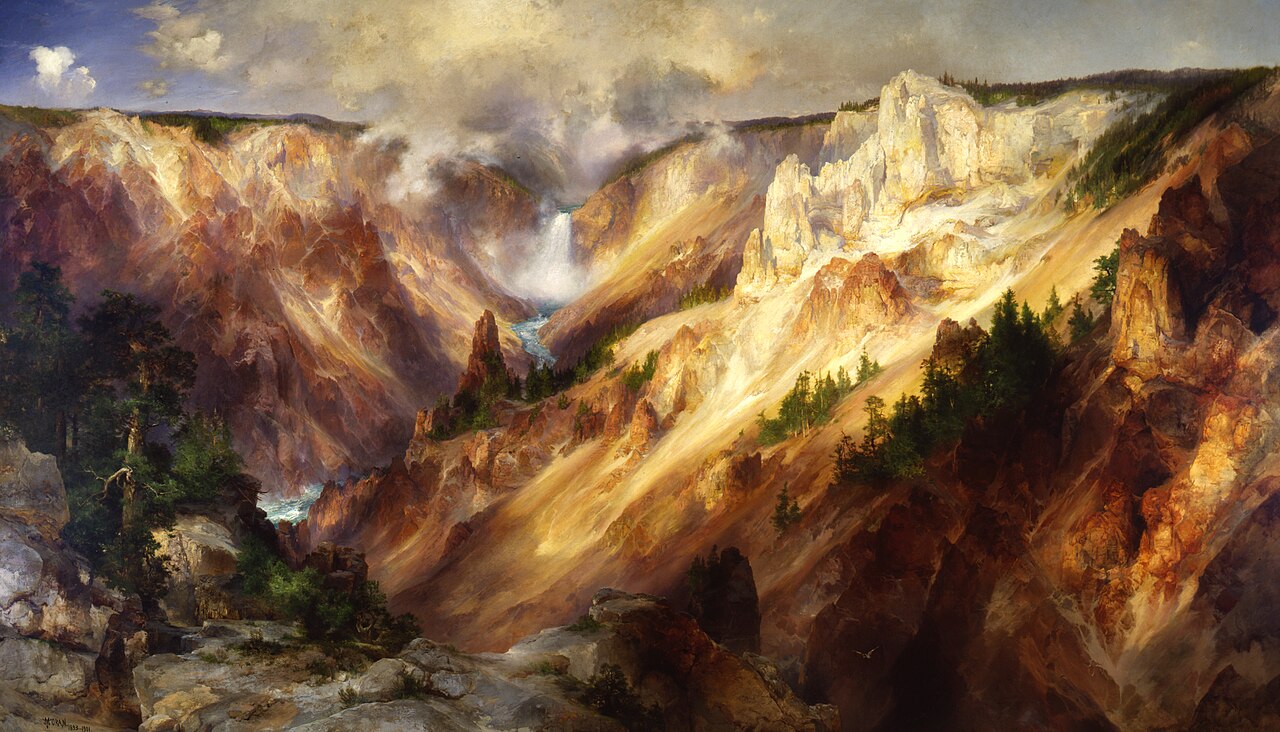
Moran’s canvas depicts the Yellowstone River plunging through its canyon from a high vantage on the south rim, looking downstream toward the Lower Falls. The composition organizes the scene around the vertical drop of water at center-left, framed by the sulfur-yellow, ochre, and rose-tinted volcanic walls that gave the canyon its name. In the foreground, a small group of figures—members of the survey party—stand on an outcrop of rock, dwarfed by the chasm. Moran painted the gorge with attention to its mineral coloration, using stratified washes of yellow and pink against the deep blue-green of pine forest at the rim. The middle distance dissolves into atmospheric haze, with the Absaroka Range suggested on the horizon. At seven by twelve feet, the work was conceived as a public spectacle.
Moran produced the painting in 1872 following his participation the previous summer in Ferdinand V. Hayden’s geological survey of the Yellowstone region, the first scientific expedition to systematically document the area. Moran traveled with the survey from July through August 1871, sketching alongside photographer William Henry Jackson. The watercolors and field studies he brought back, together with Jackson’s photographs, were circulated to members of Congress and helped persuade legislators to establish Yellowstone as the first national park in March 1872. Moran completed the large oil shortly after, working in his Newark studio. Congress purchased it that same year for $10,000.
Thomas Moran (1837–1926), English-born and trained partly through engraving and illustration work for Scribner’s Monthly, built his career on western subjects after this Yellowstone trip, producing companion canvases of the Chasm of the Colorado (1873–74) and the Mountain of the Holy Cross (1875). The Grand Canyon of the Yellowstone hung for decades in the U.S. Capitol before being transferred to the Department of the Interior and ultimately to the Smithsonian American Art Museum, where it remains. Though it post-dates the Lewis and Clark Expedition by nearly seven decades, the painting belongs to the broader visual tradition that translated the upper Missouri and Yellowstone country—territory Clark’s party traversed in 1806—into a national iconography, and it is frequently cited in scholarship on the artistic afterlife of the Corps of Discovery’s route.
Scene Location
Grand Canyon of the Yellowstone, Wyoming